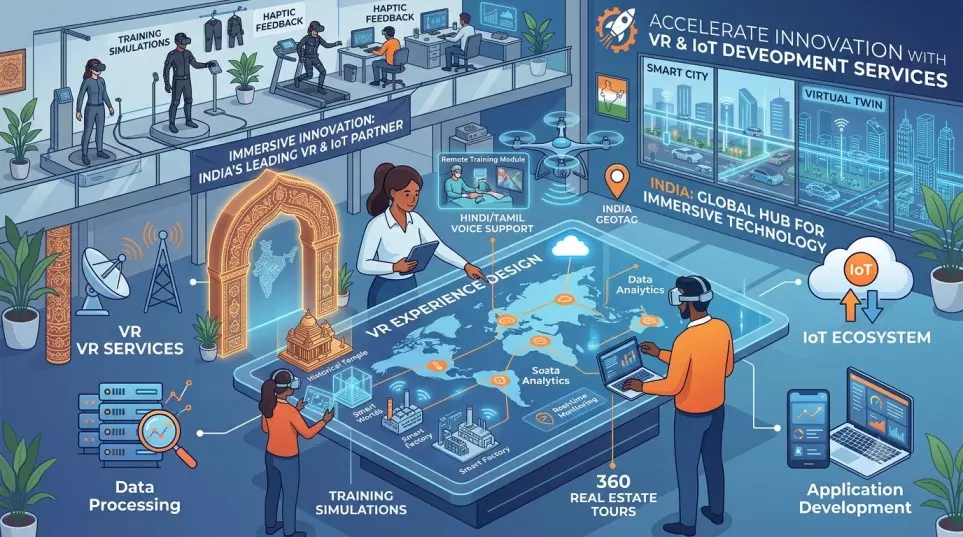
VR Development Services in India: Complete Guide for Businesses in 2026
Virtual reality (VR) is no longer limited to gaming and entertainment. In 2026, businesses are using VR to improve employee training, product demonstrations, customer experiences, education, healthcare simulations, real estate tours, and manufacturing processes.
As businesses look for cost-effective and technically skilled development partners, VR development services in India are becoming an attractive option. Indian development teams offer expertise in immersive technologies, 3D environments, Unity, Unreal Engine, and custom application development.
This guide explains VR development services, their business benefits, technologies, development process, costs, and what to consider when choosing a VR development partner in India.
What Are VR Development Services?
VR development services involve designing and building immersive digital environments that allow users to interact with virtual objects and experiences using VR headsets, controllers, sensors, or compatible devices.
Virtual reality app development services can include:
- Custom VR application development
- Immersive 3D environment development
- VR training and simulation solutions
- Virtual product demonstrations
- VR games and entertainment applications
- Virtual showrooms and tours
- Enterprise VR applications
- VR testing, optimization, and maintenance
Businesses can develop VR applications for standalone headsets, PC-based VR systems, and other immersive platforms depending on their target audience and requirements.
Why Are Businesses Investing in VR Development in 2026?
VR can help businesses create experiences that traditional websites, mobile apps, and videos cannot easily replicate.
For example, manufacturers can train employees on virtual machinery without exposing them to real-world risks. Real estate companies can offer immersive property tours, while retailers can create virtual stores where customers explore products digitally.
Major business benefits include:
- More engaging customer experiences
- Interactive employee training
- Realistic business simulations
- Virtual product visualization
- Reduced dependence on physical prototypes
- Remote demonstrations and collaboration
- Improved learning and knowledge retention
The right VR solution should therefore focus on solving a specific business problem rather than implementing immersive technology simply because it is available.
Why Choose VR Development Services in India?
India has a large technology ecosystem with developers experienced in mobile applications, gaming, cloud computing, AI, IoT, and immersive technologies.
Choosing VR development services in India can provide businesses with access to specialized development teams while offering flexibility in project scope and engagement models.
Indian VR developers can also work with international businesses that need custom applications for multiple devices and markets.
Other advantages can include access to Unity and Unreal Engine developers, 3D designers, UI/UX specialists, QA engineers, and backend developers within a single development team.
Types of VR Development Services Available in India
A professional virtual reality development company in India may provide different solutions depending on the client's business objectives.
Custom VR Application Development
Custom VR development services focus on creating applications designed around specific business workflows, users, and technical requirements.
VR Training and Simulation
Organizations can create virtual environments where employees practice complex tasks, safety procedures, equipment operation, or emergency scenarios.
Enterprise VR Development
Enterprise applications can support virtual meetings, workforce training, product design, collaboration, and operational simulations.
Virtual Showrooms and Product Visualization
Businesses can create interactive spaces where customers explore products, properties, equipment, or environments without visiting a physical location.
VR Game Development
VR developers can create immersive games featuring interactive environments, realistic physics, multiplayer capabilities, and motion-based interactions.
How Can VR Development Benefit Your Business?
One of the biggest advantages of VR is its ability to create controlled and interactive environments.
For training-focused businesses, employees can repeat procedures without consuming physical resources or damaging equipment. For customer-facing businesses, VR can provide interactive demonstrations before customers make purchasing decisions.
VR can also help businesses:
- Improve customer engagement
- Deliver immersive brand experiences
- Visualize complex products
- Conduct realistic simulations
- Support remote learning
- Reduce some training-related risks
- Demonstrate products before manufacturing
The actual return depends on the use case, implementation quality, and adoption among users.
Industries Using VR Development Services
Demand for virtual reality app development services extends across multiple industries.
Healthcare: VR can support medical education, procedure simulations, rehabilitation experiences, and professional training.
Education: Schools and training organizations can create interactive learning environments that help students visualize difficult concepts.
Real Estate: Virtual property tours allow potential buyers to explore homes, offices, and commercial properties remotely.
Retail & E-commerce: Brands can create virtual stores, interactive product experiences, and immersive demonstrations.
Manufacturing: VR simulations can support equipment training, safety procedures, product visualization, and maintenance training.
Travel & Hospitality: Hotels and travel businesses can provide virtual previews of rooms, destinations, and experiences.
Technologies Used for VR App Development
Choosing the appropriate technology stack is essential for performance, scalability, and device compatibility.
Common technologies include:
- Unity
- Unreal Engine
- C#
- C++
- OpenXR
- WebXR
- 3D modeling tools
- Spatial audio technologies
- Cloud platforms
- APIs and backend technologies
Developers may also integrate VR applications with artificial intelligence, IoT devices, analytics systems, and cloud infrastructure depending on the project requirements.
VR Development Process: From Idea to Launch
A structured development process helps turn a VR concept into a reliable application.
1. Requirement Analysis: Define business objectives, users, features, devices, and technical requirements.
2. Concept & Planning: Determine the VR experience, interactions, application architecture, and development roadmap.
3. UI/UX & 3D Design: Create interfaces, virtual environments, objects, characters, and user interactions.
4. Development: Developers build application functionality and integrate required APIs, databases, or external systems.
5. Testing: Test usability, performance, interactions, hardware compatibility, and overall stability.
6. Deployment: Launch the application on the required VR platforms or devices.
7. Maintenance: Monitor performance, fix issues, optimize features, and provide updates after launch.
How Much Does VR Development Cost in India in 2026?
There is no universal price for VR development because every project has different requirements.
Development cost can depend on:
- Project complexity
- Number of features
- Quality and quantity of 3D assets
- Supported VR devices
- Multiplayer functionality
- Backend infrastructure
- AI or IoT integrations
- Testing requirements
- Development timeline
A simple VR experience may take a few months, while a complex enterprise or multiplayer platform can require six months or longer. Businesses should request a project-specific estimate after defining their functional and technical requirements.
Challenges to Consider Before Developing a VR App
Despite its advantages, VR development presents several challenges.
Hardware fragmentation can make it difficult to provide identical experiences across devices. High-quality 3D environments also require careful optimization to maintain smooth performance.
Other important considerations include motion comfort, application security, user privacy, accessibility, data protection, device compatibility, and scalability.
These issues should be discussed during the planning phase rather than after development begins.
How to Choose a Virtual Reality Development Company in India
Choosing the right virtual reality development company in India requires more than comparing development costs.
Before hiring a company, evaluate:
- Previous VR projects and portfolio
- Unity and Unreal Engine expertise
- 3D design capabilities
- Industry experience
- Supported VR platforms
- Development methodology
- Quality assurance process
- Communication practices
- Source-code ownership
- Maintenance and support
A reliable VR app development company in India should also explain why particular technologies and platforms are appropriate for your project.
Read: Best Mobile App Development Companies in India to Watch
Future of VR Development in India
VR is expected to continue evolving alongside artificial intelligence, spatial computing, mixed reality, digital twins, IoT, and cloud technologies.
AI could make virtual environments more responsive, while digital twins can help organizations simulate real-world facilities, machines, and operations.
Web-based immersive experiences may also make some VR applications easier to access without complex installation processes.
For businesses, the key will be identifying where immersive technology provides measurable value instead of adopting VR solely because it is trending.
Why Choose Space To Tech for Custom VR Development Services?
Space To Tech helps businesses plan and build digital solutions based on their specific operational and customer requirements.
Our custom VR development services can focus on creating scalable, interactive, and business-oriented virtual experiences.
From initial planning and UI/UX to development, testing, deployment, and ongoing support, businesses can work with a development team throughout the complete project lifecycle.
If you are exploring VR development services in India, start by defining your users, business problem, required devices, core functionality, and expected outcomes.
Conclusion
Virtual reality offers businesses new ways to train employees, demonstrate products, visualize environments, educate users, and create immersive customer experiences.
However, successful VR development requires the right combination of strategy, 3D design, software engineering, testing, and hardware optimization.
Choosing an experienced VR app development company in India can help businesses transform VR ideas into practical applications while building around their technical and commercial objectives.
FAQs About VR Development Services in India
What are VR development services?
VR development services include designing, developing, testing, and maintaining immersive applications for VR devices and platforms.
How long does VR app development take?
A basic application may require a few months, while complex enterprise or multiplayer VR solutions may take six months or longer.
Which industries can benefit from VR?
Healthcare, education, manufacturing, real estate, retail, gaming, travel, and corporate training are common areas for VR adoption.
What technologies are used for VR development?
Unity, Unreal Engine, C#, C++, OpenXR, WebXR, 3D modeling technologies, cloud platforms, and APIs are commonly used.
Can VR applications integrate with AI and IoT?
Yes. Depending on the use case, VR applications can connect with AI models, IoT devices, analytics platforms, cloud systems, and other enterprise technologies.