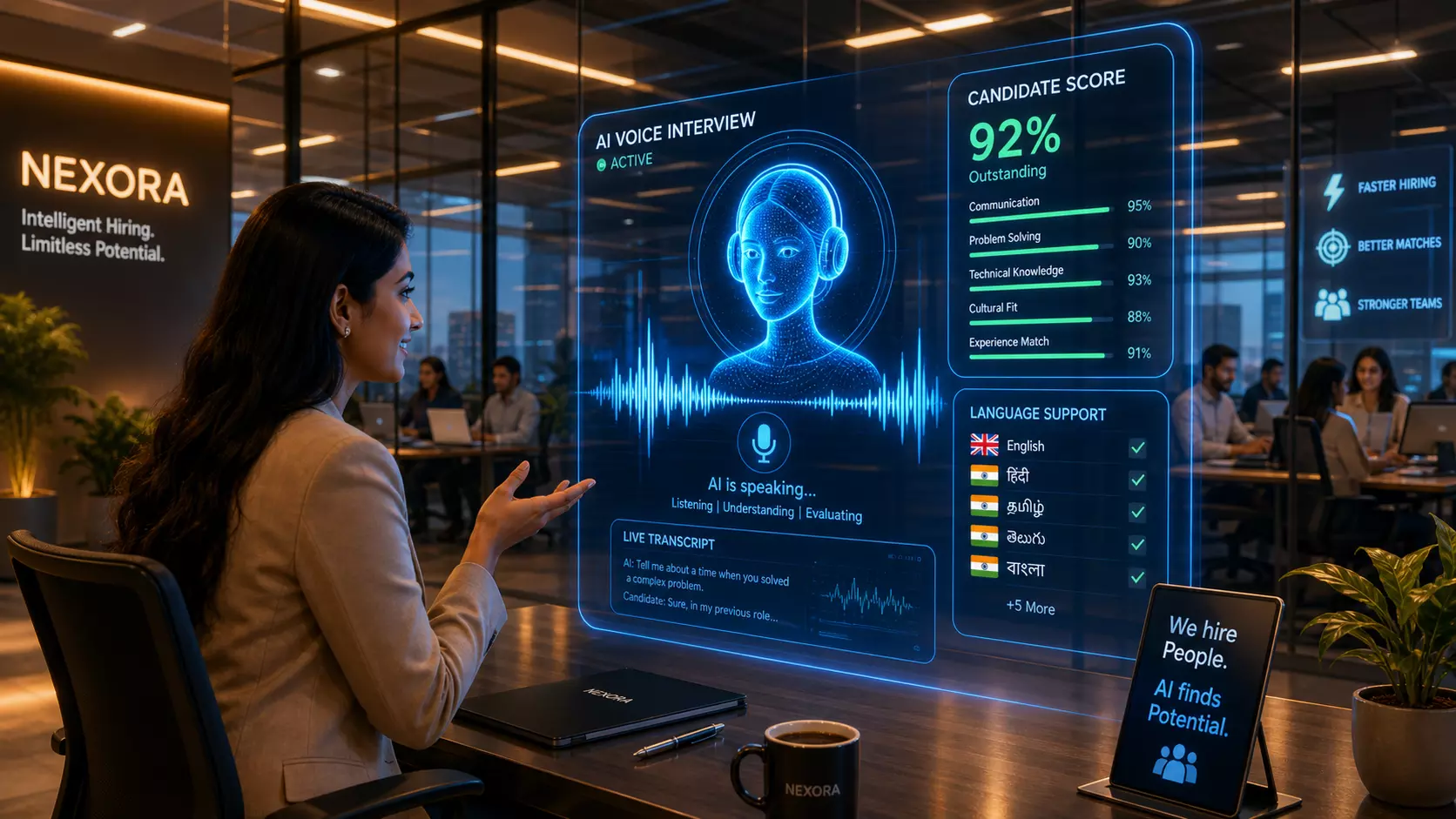
Top Voice AI Platforms Powering Automated Hiring and Recruitment
Ask any recruiter in India who's handled mass hiring, say, 400 applications for 12 open roles, and they'll tell you the same thing: the first-round screening is where time goes to die.
Hours on the phone. Candidates who don't pick up. Inconsistent notes. And somehow, it still takes two weeks before anyone gets shortlisted.
That's the gap voice AI platforms are filling right now, not just in theory, but in actual practice across Indian companies.
These tools handle the repetitive, structured part of early-stage recruitment: the call, the questions, the evaluation, and the report. And they do it at a scale no human team can match without burning out.
What's interesting is how differently these platforms approach the same problem. Some are built purely for developers. Some are enterprise software giants.
And at least one was built specifically because India's hiring challenges are different from anywhere else in the world.
Here are five voice AI platforms worth knowing, ranked with India's hiring context front and center.
1. Rootle AI: Built in India, Built for How India Actually Hires
Most voice AI tools weren't built with India in mind. They were built for English-speaking candidates in Western markets, then adapted awkwardly for everywhere else. Rootle AI took the opposite approach.
It started with India: the languages, the hiring volumes, the candidate profiles, the recruiter bandwidth constraints. Everything else followed from there.
The result is a voice AI platform that feels less like imported software and more like something that actually understands what it means to screen 800 candidates for a BPO role in Pune, or run first-round interviews for a logistics company hiring across Gujarat, Maharashtra, and Rajasthan simultaneously.
What Rootle AI Actually Does
- Conducts fully automated, voice-based candidate screening calls, no human needed on the other end
- Supports Hindi, Tamil, Telugu, Kannada, Marathi, Bengali, Gujarati, and English, not just toggling a translation layer, but genuinely conversing in each language
- Scores candidates on communication clarity, response coherence, confidence level, and role-specific criteria
- Generates structured interview summaries and recruiter-ready reports immediately after each call
- Handles thousands of simultaneous calls. A Monday morning shortlisting rush doesn't slow it down
- Let recruiters define custom question flows by role, level, department, or location
- Connects with ATS systems so candidate data moves without manual re-entry
- Triggers interview scheduling automatically after screening, with no back-and-forth coordination
Why It Hits Differently for Indian Hiring Teams
Here's the honest reality: most Indian companies deal with a hiring funnel that's top-heavy. Hundreds of applications, maybe thousands for volume roles.
And somewhere between receiving those applications and making offers, there's a brutal manual bottleneck in the phone screen.
Rootle AI removes that bottleneck entirely. A candidate applies, gets a call from the AI within minutes, goes through a structured voice interview, and by the time a recruiter logs in the next morning, there's already a ranked shortlist waiting.
That kind of turnaround doesn't just save hours; it changes how teams think about hiring timelines altogether.
- Tier-2 and tier-3 city candidates aren't left out because of language barriers
- Evaluation criteria stay consistent; the fifth candidate gets the same quality of assessment as the first
- Recruiters spend their actual time on shortlisted candidates, not filtering through everyone
- Pricing is structured for Indian market realities, not at SaaS rates built for US enterprise budgets
Industries Using It
- BFSI: banking, insurance, and financial services companies running high-volume agent hiring
- BPO and contact centers: where consistent communication assessment is non-negotiable
- IT and SaaS companies: technical screening rounds before the panel stage
- Retail and logistics: especially for frontline and ops roles across multiple cities
- Staffing and RPO firms: managing client hiring mandates at scale
The Bigger Picture
Rootle AI isn't trying to be everything to everyone. It's a focused, India-first voice AI platform built specifically for the automated hiring and recruitment space. That focus shows.
When a tool is designed for one job and does that job exceptionally well, it tends to outperform the broader platforms that treat recruitment as just another use case.
2. Retell AI: Developer-First Voice Infrastructure That Recruitment Teams Are Adapting
Retell AI isn't a recruitment tool in the traditional sense; it's a voice infrastructure. Think of it less like hiring software and more like the engine underneath hiring software.
Companies and developers use Retell to build their own custom voice agents, and a growing number of Indian HR-tech firms have started using it to power their own branded screening products.
What Makes It Stand Out
- Remarkably low latency voice conversations feel human, not robotic or laggy
- Supports multiple LLMs underneath: OpenAI, Anthropic, Gemini, you pick the brain, Retell handles the voice
- Function calling built directly into voice flows, agents can look things up, update systems, trigger actions mid-call
- Phone number provisioning included no separate telephony setup needed
- Call monitoring dashboard with analytics, transcripts, and agent performance data
- Webhooks for ATS and CRM integrations, candidate data flows where you need them
How Recruitment Teams Use It
- Building custom first-round screening agents with company-specific question logic
- Deploying FAQ bots that handle candidate queries post-application status, process, and expectations
- Automating interview scheduling coordination as a voice interaction
- Creating role-specific voice agents for different hiring pipelines within one organization
Who Should Consider It
Retell is genuinely excellent, but it rewards teams with technical capacity. If you have developers who can build and maintain a voice agent pipeline, Retell gives you serious flexibility.
If you're an HR team that wants plug-and-play, the learning curve is real. Best suited for product-minded HR-tech companies building their own voice AI hiring tools.
3. Vellum AI: LLM Workflow Control for Recruitment Builders Who Want Precision
Vellum AI sits in an interesting space. It's not a voice platform in the traditional sense, but it's showing up in recruitment tech stacks because of what it does exceptionally well:
managing, testing, and deploying LLM-powered workflows with granular control. For teams building AI-powered hiring pipelines, Vellum is the control panel for the AI itself.
Core Capabilities
- Prompt versioning track, compare, and roll back AI prompts across different recruitment stages
- Side-by-side A/B testing of different prompt approaches to see which screens better
- Document parsing at scale pulls structured data from resumes and applications automatically
- Multi-LLM support: switch between OpenAI, Anthropic, Cohere without rebuilding pipelines
- The evaluation framework measures how well your AI is actually scoring candidates against real outcomes
- Workflow orchestration for chaining multiple AI steps in a single hiring flow
Where It Fits in Recruitment
- Generating job descriptions that actually attract the right candidates and testing variations
- Structured resume parsing that feeds clean candidate data into ATS fields
- Interview question banks generated and customized by role, seniority, and domain
- Candidate scoring rubrics built and refined over time using evaluation data
The Honest Assessment
Vellum is powerful in the right hands. But those hands need to be technical. It's a builder's tool, not a ready-made hiring platform.
If your team can leverage it, you end up with far more control over how AI makes decisions in your hiring process than any off-the-shelf tool would allow. If your team can't, you're better off with something purpose-built.
4. Yellow.ai: India's Homegrown Conversational AI Giant, Now Deep in HR
Yellow.ai started as a customer experience platform and became one of India's most recognizable conversational AI names in the process.
Over time, it expanded into HR automation with enough depth that it now competes directly with dedicated hiring tools.
The advantage Yellow.ai brings is brand familiarity, enterprise trust, and a platform that doesn't silo recruitment from the broader employee journey.
Platform Highlights
- Omnichannel coverage: voice, chat, WhatsApp, email, all handled from one unified system
- 135+ languages with genuine conversational quality, not just keyword matching
- Dynamic AI that trains on your own company data for domain-specific accuracy over time
- Pre-built integrations with SAP SuccessFactors, Workday, Oracle HCM, Greenhouse, and others
- SOC 2, ISO 27001, and GDPR compliance for enterprise security requirements
- Yellow.ai recruits a dedicated module handling the full candidate journey end-to-end
What Recruitment Looks Like on Yellow.ai
- AI handles inbound candidate queries from the moment a job is posted
- Screening conversations happen via voice or WhatsApp, wherever candidates are most comfortable
- Post-offer onboarding is automated through the same platform, so the candidate experience stays consistent
- Internal mobility conversations, existing employees can discover open roles through the same AI
Best Suited For
Large Indian enterprises and multinationals that want their recruitment automation to sit inside a broader HR automation ecosystem, not as a separate tool, but as part of the same platform managing onboarding, engagement, and employee queries.
If you're already in Yellow.ai's ecosystem, the recruitment module is a natural extension.

5. Cognigy: Enterprise Voice AI With Serious Depth for Complex Hiring Operations
Cognigy is what you'd reach for when the hiring operation is genuinely complex, multiple business units, multiple countries, multiple compliance requirements, and zero room for error.
It's a global enterprise conversational AI platform that's found strong adoption in India's BFSI, IT services, and healthcare sectors, all of which run large, structured hiring cycles.
What It Brings to the Table
- Cognigy.AI is a no-code/low-code platform for building voice and chat agents without deep developer dependency
- Cognigy Voice Gateway connects AI agents directly to existing telephony setups, no rip-and-replace required
- Real-time Agent Assist AI listens to live recruiter calls and suggests follow-up questions or flags important information in real time
- Deep NLU engine built for nuanced, industry-specific language rather than generic conversational patterns
- Handles millions of simultaneous interactions. Enterprise scale isn't a marketing claim here; it's proven infrastructure
- Data residency and GDPR controls for global companies managing cross-border hiring
How Recruitment Teams Deploy It
- Automated voice agents handle first-round screening for high-volume roles at BPO and shared services centres
- AI-powered HR helpdesk manages candidate FAQs, application status updates, and process explanations without recruiter involvement
- Live call support for human interviewers, with real-time question suggestions based on what the candidate just said
- Structured post-call summaries with candidate scoring delivered immediately to hiring managers
The Right Fit
Cognigy isn't for everyone, and it doesn't try to be. It's built for organizations where recruitment is a serious operational function with compliance stakes, cross-departmental scale, and IT governance requirements.
If that describes your organization, Cognigy delivers enterprise-grade voice AI without the instability that comes from repurposing consumer-grade tools for complex workflows.
Read: How a White Label Laravel Development Company Helps Digital
How to Actually Choose the Right One for Your Team
Every platform on this list does something genuinely well. But 'genuinely well' means different things depending on what you're trying to solve.
A staffing company screening 2,000 candidates a month has different priorities than an IT services firm building its own in-house hiring tool.
Before committing to any voice AI platform for your recruitment workflow, these are the things that actually matter:
- Language coverage isn't just a checkbox: it determines who you can realistically reach. If 40% of your applicants are more comfortable in a regional language, a platform that only does English isn't a real solution.
- Purpose-built beats adapted: tools designed for recruitment from day one will always outperform general conversational AI tools that were retrofitted with an HR module.
- ATS integration determines adoption: if your voice AI data doesn't flow cleanly into your existing HR stack, your recruiters will work around it rather than with it.
- Candidate experience matters more than people admit: a clunky, robotic-sounding voice agent increases candidate drop-off and reflects poorly on your employer brand.
- Ask for real post-interview reports: a platform that just tells you ‘The call happened' is useless. You need a scored, structured output that a recruiter can act on immediately.
- Check the data privacy posture: India's data protection requirements are evolving. Platforms that can't clearly explain how candidate voice data is stored and processed are a liability.
The market for AI-powered automated voice interviewing for hiring has matured enough that you no longer need to compromise between quality and cost, especially in India, where the right platform can dramatically change how fast and how well you fill roles.
Final Thoughts
Voice AI in recruitment isn't a trend you need to catch up to. It's already running at companies competing with yours for the same talent pool. The question at this point isn't whether it works; it's which platform works for your specific context.
For Indian hiring teams, the calculus is clear: platforms built with India in mind, that handle the linguistic diversity and volume realities of this market, will always outperform tools adapted from other geographies.
That's not bias, that's just practical experience. The companies winning at hiring right now are the ones that stopped treating first-round screening as a human task and started treating it as an infrastructure problem. Voice AI is the infrastructure.
Pick the right tool, set the right evaluation criteria, and what used to take your team two weeks can be done before your next morning standup.