Voice AI Platform: Why Companies Are Replacing Traditional Call Handling
My cousin works at a bank's call center in Pune. Not the glamorous side of fintech, the side where you answer the same seven questions 200 times a day, eat lunch at your desk because the queue won't stop, and go home with your voice slightly gone.
She's good at her job. Genuinely good. But she'll tell you, without much prodding, that at least 60% of what lands in her queue on any given Tuesday shouldn't require a human being at all.
"Someone called yesterday to check if their EMI got deducted," she told me once. "That's it. That's the whole call."
This is the quiet absurdity sitting at the center of traditional call handling. Companies spend real money on salaries, training, real estate, and attrition costs to have skilled people answer questions that a decently built system could resolve in eleven seconds.
And everyone involved kind of knows it. The agents know it. The managers know it. The customers, who've waited nine minutes to ask a thirty-second question, definitely know it.
What's actually changing now is that businesses are finally doing something about it.
But What Actually Is a Voice AI Platform?
Not the brochure version, the real one.
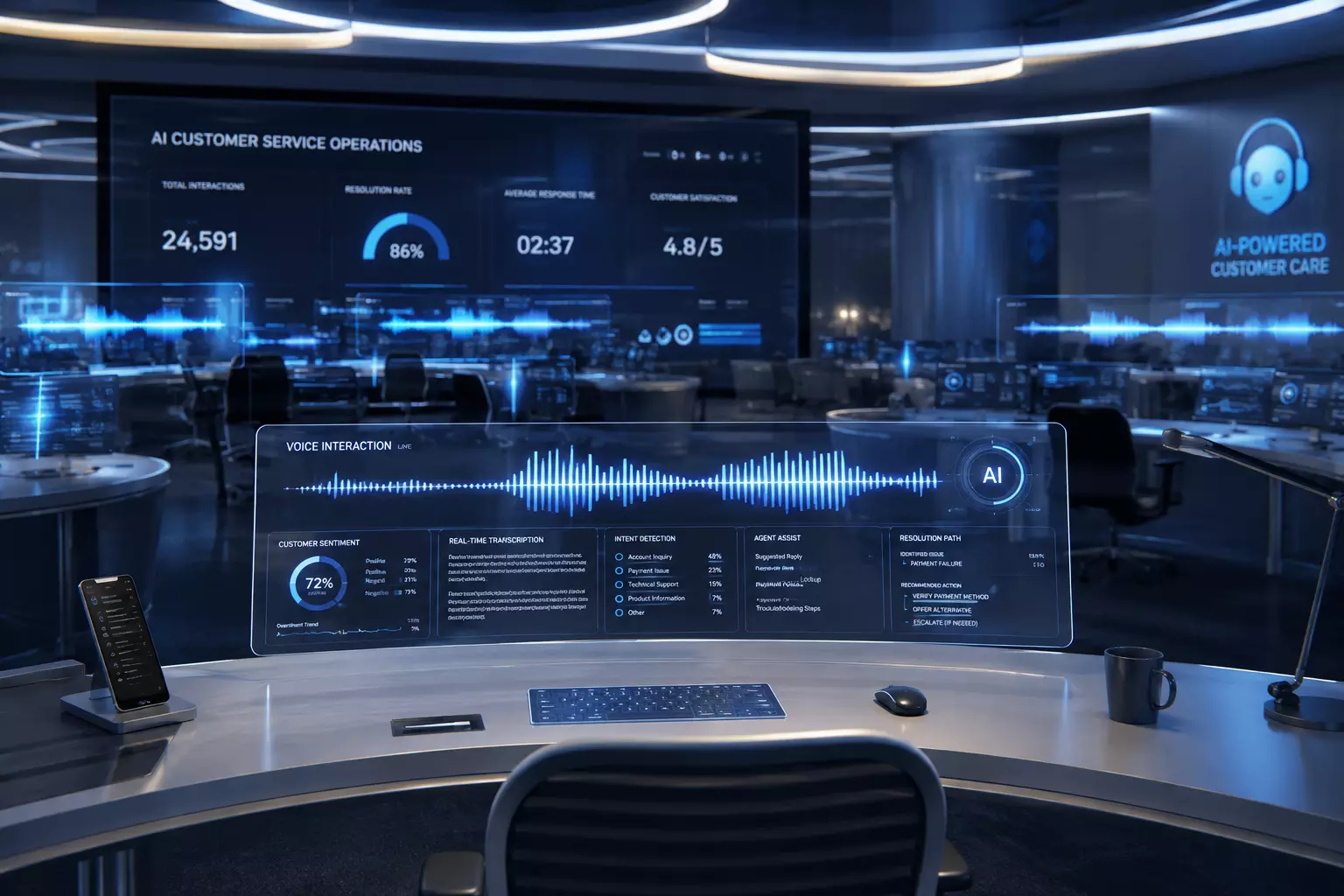
A voice AI platform is a system that answers a phone call, listens to what the customer says, understands what they mean, and responds in a useful way. It doesn't navigate menus. It doesn't make you press anything. It just... talks. Like a person would.
The technology underlying this has been building for years, speech recognition, natural language processing, and real-time database queries, but what's changed recently is that it all works together well enough now to handle real conversations. Not scripted ones. Real ones, where people trail off mid-sentence, mix up two issues at once, or call from a noisy auto-rickshaw on a bad connection.
Old IVR systems, the "press 1 for English" generation, technically counted as voice automation too. But they were brittle. Say anything unexpected, and they collapse immediately. "I'm sorry, I didn't get that. Let me repeat your options." Every person reading this has been on that call. It was maddening.
A proper voice AI platform is built differently. When someone calls and says, "I think there's a wrong charge on my account from last week, maybe the 14th or 15th, I'm not totally sure," the AI doesn't need a perfectly structured input to work with. It picks up the intent, pulls the account data, checks the transaction history around those dates, and responds to the actual problem.
What separates genuinely good voice AI from the older stuff:
- Intent understanding over keyword matching: It gets what someone means, not just what they said.
- Accent and noise resilience: This matters enormously in India, where the acoustic environment in a call is rarely ideal, you know.
- Topic shifting mid-call: Customers don’t stay on one thing; good AI moves along with them kind of fluidly.
- Live system integration: Account info, order status, appointment slots being pulled in real time, not those canned answers.
- Graceful handoff: When the AI hits its limit, it passes the call to a human, without dropping or losing any context at all.
That last point. A handoff where the agent already knows everything the customer just said, that's the difference between a good experience and one where the customer sighs loudly and starts explaining themselves again from the top.
Why the Old Way Is Running Out of Road
Here's the thing about traditional call centers: they haven't gotten worse. The problem is that everything else got so much better, so fast, that the gap became impossible to ignore.
Someone who orders dinner through Swiggy and tracks their delivery to the street level in real time is not going to be patient about waiting on hold for a billing question. The expectation of speed has completely reset. What felt acceptable in 2015 feels like a product failure in 2025.
And the issues go beyond just customer patience.
Volume spikes expose every weakness at once
A festive sale launch. A billing system glitch. A news cycle that sends thousands of anxious customers to the phone simultaneously. When volume spikes hit a human-staffed center, there's no elegant solution.
You extend shifts, pull people from other teams, and watch average wait times climb to numbers that would have been considered unacceptable the week before. The center wasn't built for the spike; it was built for the average. And the average is not when customers judge you.
No two agents give the same answer.
This one's underappreciated as a problem. Walk into any reasonably sized call center and ask different agents the same moderately complex policy question.
You'll get variations. Sometimes minor ones, sometimes ones that directly contradict each other. This isn't a failure of hiring; it's a structural problem. Human beings interpret information differently. They remember training differently.
They have different instincts about when to make exceptions. Some of that variation is fine. But in a customer support context, it creates confusion, complaints, and sometimes real financial exposure.
The cost math doesn't hold up.
When you add up everything, agent salary, provident fund contributions, training cycles that happen every few months because attrition is high, the office space, the QA team monitoring calls, the team leads managing teams, a single agent handling calls costs considerably more than what shows up in the basic salary line.
And a large chunk of what they're handling could be automated. That's not a comfortable math problem to sit with.
Conversations vanish into thin air.
Every call has information in it. Customers tell you what's confusing about your product, which policies generate the most friction, and which questions your FAQ doesn't actually answer. In a traditional center, almost none of that gets captured in any structured way.
Call notes are inconsistent. Tagging is partial. The actual audio of most calls gets deleted after a compliance window. Operationally, it's like running a research program where you throw away the data.
The Sectors Moving Fastest
Banking and financial services have been among the earliest adopters, partly because their call volume is enormous and partly because the query types are often well-structured.
Balance checks, EMI status, credit limit inquiries, and card blocking are perfect for automation. The accuracy requirements are high, but so is the AI's consistency advantage over human agents who might be less certain on the details.
Healthcare is an interesting one. Appointment booking, follow-up reminders, prescription pickup confirmations- these tasks eat up a significant chunk of front desk bandwidth at clinics and hospital chains. When AI handles them, staff can focus on people who are physically present. That's a real quality-of-care improvement, not just an efficiency gain.
E-commerce and logistics, the "where is my order" category alone probably justifies AI investment for companies handling large delivery volumes. Order status, return initiation, and delivery rescheduling. All high volume. All well-structured. All are perfectly suited for a Voice AI Platform to handle without human involvement.
Telecom has adopted heavily, which does have a slightly ironic quality to it. Companies whose entire product is communication are now automating their customer communication. But it works on inquiries, data pack activations, and billing disputes. The volumes are too high for human teams to manage economically.
What's Being Built in India Right Now
The Indian context matters here because it's not just a big market for this technology; it's a genuinely complex one that requires product thinking that doesn't just port over from Western deployments.
The language situation alone is challenging in ways that aren't obvious from the outside. Hindi has enormous regional variation. A speaker from Lucknow and a speaker from Indore are both speaking Hindi, but the vocabulary, the rhythm, and the colloquialisms are quite different.
Then you layer in Tamil, Telugu, Kannada, Marathi, Bengali, each with its own phonology and accent patterns. Building voice AI that handles this well is a hard engineering problem, and it's the one that separates tools built for India from tools adapted for India.
Rootle AI has been built around the assumption that genuinely multilingual means comfortable across Indian linguistic realities, not just a language-switch button. Their focus is on making the AI feel like an extension of the brand's team rather than an obvious bot, which matters a lot in markets where trust in AI is still being established.
Uniphore, out of Chennai, has enterprise deployments across BFSI and healthcare that go well beyond voice emotion detection, real-time agent guidance, and conversation analytics. The demanding clients they've served have pushed the product into genuinely robust territory.
Skit.ai (out of the Vernacular.ai work) has focused specifically on cracking the regional language quality of Tamil, Telugu, and Kannada. It's years of training data and architecture work that doesn't happen overnight, and it shows.
What these companies are collectively demonstrating is that there's a genuinely Indian approach to this problem taking shape, not just technology built elsewhere with a language pack dropped in.

What to Actually Look For (Beyond the Demo)
Sales demos for voice AI products are almost universally impressive. The demo environment is quiet, the queries are clean, and the AI responds crisply. This tells you very little about how the thing will behave when your actual customers call from a moving vehicle with three kids in the background, asking about a billing discrepancy from six weeks ago.
Here's what to probe before signing anything:
Test it with your real audio, your real customers. Ask every vendor for a proof-of-concept that uses recordings from your actual call queue. The difference between a system tuned to your customer demographics and one that isn't is immediately audible. Accent handling in particular falls apart fast when the training data doesn't match reality.
Go deep on integration. Not surface-level "CRM integration" can mean anything from a full bidirectional sync to a webhook that posts a note field. Find out specifically which data the AI can read during a call, which data it writes back afterward, and what happens to the interaction record.
The value of Voice AI for Customer Support is heavily tied to how well it connects to your existing systems. A standalone AI that doesn't talk to your tools is basically an expensive FAQ.
Watch the escalation live, not in a deck. Ask them to demonstrate a live handoff. Watch what the agent actually sees when they receive the call. Is there a summary? Is it accurate? How long does the handoff take? This is the moment that most frequently fails in real deployments, and vendors know it's what customers remember.
Get specific about compliance. DPDP Act compliance is not optional anymore. For anyone in BFSI, the RBI's data localization requirements add another layer. Ask directly: Where is the call audio stored? For how long? Who has access? What's the deletion policy? "We're compliant" is not a sufficient answer; get the specifics in writing.
Understand what customization actually means. There's a wide range between "you can edit the greeting message" and "you can train the model on your product catalog, your policies, your brand's specific way of talking." Both might be marketed as customization. Know what you're getting. Generic AI that talks about your company in generic terms will feel generic to your customers.
Read: Top Voice AI Platforms Driving Customer Experience Innovation
A Few Numbers to Ground This
The projections around conversational AI have been aggressive for years, and not all of them have held up. But the numbers coming out of actual deployments over the last couple of years are more grounded:
- Businesses reporting post-deployment cost data are seeing a 35-45% reduction in per-call handling costs within twelve months.
- Customer wait times in AI-first contact flows drop by 50-65% on average. The range is wide because it depends heavily on how much volume the AI actually absorbs.
- First Call Resolution rates, those which tell if an issue gets solved without a callback, in solid deployments can creep up about 25-30%.
- The overall market for conversational AI is moving toward $32 billion by 2030, and as things mature, voice applications take up a larger portion of it, kind of steadily.
The honest caveat: these outcomes require good implementation. A poorly configured voice AI platform with inadequate training data and weak system integration will underperform these benchmarks significantly. The technology is the enabler, but the implementation is what determines whether you see these results or not.
Conclusion
There's a shift happening in how companies think about what a phone call even is. For most of the last thirty years, a customer call was a cost something to minimize, queue efficiently, and get through as cheaply as possible. The call center was overhead. You managed it, but you didn't really learn from it.
What's interesting about businesses that have genuinely invested in voice automation is that they stop thinking about calls that way. When every conversation is captured, analyzed, and fed back into operations, the call becomes something more useful: a continuous read on what your customers are confused by,
what your product isn't explaining well, and what policies are generating friction. That's a different relationship with customer communication than most companies have ever had.
The agents who remain in these environments tend to be doing more meaningful work. The customers who call tend to resolve faster. And the operations teams finally have data to work with instead of anecdotes.
India's market for this is genuinely exciting because the problems are harder here: the language diversity, the infrastructure variability, the range of customer demographics, and the companies working on those harder problems are building something more durable for it. The tools that work for India will probably work anywhere. That's not a small thing.
If you're still running purely on a traditional call center model, the question isn't really whether this shift is coming to your industry. It already has. The more practical question is how long you want to wait before it applies to you.