Vehicle Camera Market Accelerates to USD 23.5B by 2033 Driven by Safety and Autonomy
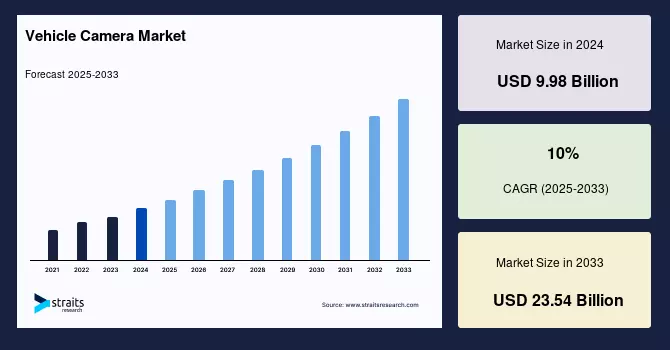
Explore how the global vehicle camera market is roaring ahead—from USD 9.98 billion in 2024 to USD 23.54 billion by 2033—driven by safety regulations, autonomous systems, and widespread adoption in budget vehicles.
Introduction
Vehicle cameras have evolved from luxury conveniences to essential components across nearly every vehicle class. From capturing dashcam footage to assisting with parking, aiding insurance claims, recording road rage incidents, and enabling advanced driver assistance systems (ADAS), these cameras play diverse roles. As safety standards tighten and autonomy takes center stage, the global vehicle camera market is poised for significant growth.
Market Overview
- 2024 Market Size: USD 9.98 billion
- 2025 Forecast: USD 10.98 billion
- 2033 Projection: USD 23.54 billion
- CAGR (2025–2033): 10%
Over the forecast period, the market is expected to more than double, reflecting massive adoption across passenger, commercial, and advanced mobility segments.
Market Drivers
Stricter Safety Regulations & Government Programs
Governments worldwide are mandating advanced safety systems—such as reversing detection, ADAS, and event data recording. Automotive leaders like Tesla, Volvo, and Audi have already integrated autonomous emergency braking systems across their new vehicle lines, meeting or exceeding these safety benchmarks.
Surge in Autonomous Vehicle Development
As vehicles move from driver assistance to full autonomy (SAE Levels 1–5), sensor and camera systems become indispensable. With the autonomous vehicle market growing at approximately 16% CAGR, the demand for vehicle-integrated cameras is on a parallel ascent.
Consumer Demand in Budget Vehicles
Camera technology is no longer exclusive to luxury models. Affordable cars are now rolling out features like rear-view and dash cameras—bringing recorded evidence, collision assistance, and ease of driving to mainstream buyers.
Market Restraints
High Integration Costs
Implementing multi-camera systems—including hardware, mounting, connectivity, and integration with infotainment systems—adds complexity and cost. This especially impacts manufacturers of entry-level models, limiting rapid adoption.
Regional Analysis
RegionDescriptionNorth AmericaLargest market in 2024. Leadership stems from early adoption of safety tech, strong regulatory frameworks, and local innovation in autonomous systems.Asia-PacificFastest-growing region. Growth fueled by strong automotive manufacturing, safety regulations, and the cost-advantage manufacturing hub status.EuropeSteady growth.
Automotive safety and advanced feature adoption remain key regional strengths.LAMEAEmerging market. Growth driven by rising vehicular fleets and demand for improved road safety technology.
Market Segmentation Insights
Camera Type
- Digital Cameras dominate due to affordability and widespread use in compact and mid-size cars.
- Infrared Cameras, though still niche, are gaining traction in luxury and specialized commercial applications.
Vehicle Type
- Passenger Vehicles lead, supported by high production volumes and growing safety expectations.
- Commercial segments continue to expand, especially in logistics and insurance-sensitive operations.
Technological Trends & Future Outlook
Intelligent and Multi-Sensor Systems
Vehicle cameras are swiftly moving from basic recordings to complex data collection tools. HD and infrared imaging, AI-based analytics, and integration with LiDAR and radar enhance safety, monitoring, and driver behavior analysis.
Insurance & Legal Use Cases
Dashcam footage is increasingly recognized by insurers and law enforcement—used to resolve claims and deter fraud—turning vehicle cameras into trusted digital witnesses.
Edge Analytics for Real-Time Insights
Emerging platforms are enabling real-time video processing at the edge—alerting drivers to hazards and distracted behavior instantly. Vision-transformer systems applied to camera feeds are enabling rapid collision risk detection and dynamic driver alerts.
REQUEST SAMPLE:https://straitsresearch.com/report/vehicle-camera-market/request-sample
Conclusion
The Vehicle Camera Market is surging—from USD 9.98 billion in 2024 to USD 23.54 billion by 2033, growing at a 10% CAGR. With safety regulations ramping up, autonomous systems evolving, and camera capabilities expanding across vehicle classes and applications, the future is clear: vehicle cameras are not just helpful—they’re indispensable.