Understanding the Working Process of a Pipe Extrusion Machine
Plastic pipes are used everywhere today. From water supply networks and drainage systems to gas pipelines and industrial fluid transport, plastic pipes have become a standard solution across industries.
Behind these pipes is a structured manufacturing process driven by a pipe extrusion machine. Understanding how this process works helps manufacturers improve quality, reduce waste, and maintain stable production.
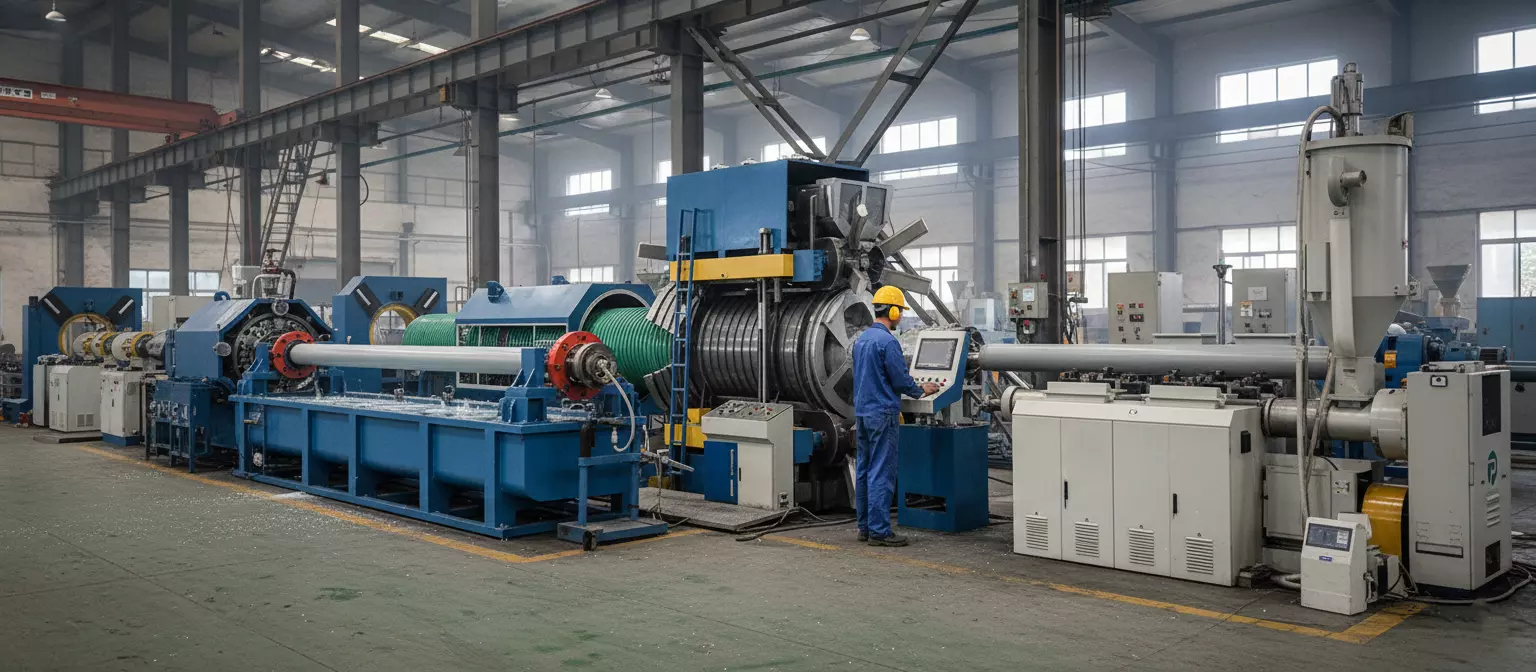
This article explains the working process of a pipe extrusion machine step by step, showing how raw plastic turns into finished pipes inside a real plastic pipe production line.
What Is a Pipe Extrusion Machine and Why It Matters
A pipe extrusion machine is an industrial system designed to produce plastic pipes in a continuous and controlled manner.
Instead of shaping one pipe at a time, the machine works as a nonstop production flow where material moves steadily through heating, shaping, cooling, and cutting stages.
This continuous process allows manufacturers to produce pipes with uniform diameter, consistent wall thickness, and smooth surface finish. Because pipes are often used in pressure-sensitive applications, consistency is critical.
In modern factories, the pipe extrusion machine is not a standalone unit. It operates as part of a complete plastic pipe production line where each section supports the next.
Role of Raw Material in the Extrusion Process
The process begins with raw plastic material, usually in the form of granules or powder. Common materials include PVC, HDPE, LDPE, and PP, depending on the application of the pipe.
These materials are selected based on strength requirements, flexibility, chemical resistance, and temperature tolerance. Before entering the machine, the material may be mixed with stabilizers, color additives, or fillers to enhance performance.
Material consistency at this stage is essential. Any variation in raw material quality can affect the final pipe structure.
Feeding and Melting Inside the Extruder
Once prepared, the plastic material enters the hopper mounted above the extruder. Gravity feeds the material into the barrel, where a rotating screw moves it forward.
As the screw turns, the material passes through multiple heating zones. These zones gradually raise the temperature, allowing the plastic to soften and melt evenly.
Friction created by the screw movement also contributes to the melting process.
In a real plastic pipe production line, temperature control is closely monitored. Too much heat can degrade the plastic. Too little heat can cause poor surface finish or weak pipe walls.
How the Pipe Shape Is Formed
After the plastic reaches a molten state, it moves toward the die head. The die determines the outer diameter and initial shape of the pipe.
Inside the die, the material is evenly distributed around a central mandrel. This creates the hollow structure of the pipe. The precision of the die directly affects pipe dimensions and wall thickness.
Factories producing different pipe sizes use interchangeable dies. This flexibility allows the same pipe extrusion machine to manufacture a wide range of products without major equipment changes.
Calibration and Sizing for Accuracy
As the hot pipe exits the die, it immediately enters the calibration unit. This stage is crucial for dimensional accuracy.
The calibration system uses vacuum pressure to pull the pipe against sizing sleeves. This helps maintain roundness and precise outer diameter while the plastic is still soft.
Without proper calibration, pipes can become oval or uneven. In industrial settings, this stage ensures that pipes meet strict standards required for construction and infrastructure projects.
Cooling the Pipe for Structural Stability
After calibration, the pipe moves into cooling tanks filled with water. Cooling solidifies the plastic and locks the pipe shape.
Cooling must be gradual and uniform.
If the pipe cools too quickly or unevenly, internal stress can develop. This may lead to cracks or deformation later during use.
In modern systems, water temperature and flow rate are carefully controlled. Longer cooling sections are used for thicker pipes to ensure complete solidification.
Haul-Off System and Controlled Movement
Once cooled, the pipe enters the haul-off unit. This system uses belts or rollers to pull the pipe forward at a controlled speed.
The haul-off speed must match the extrusion output. If it pulls too fast, the pipe walls may thin. If it pulls too slowly, material buildup can occur at the die.
This synchronized movement keeps production stable and ensures consistent pipe dimensions throughout the run.
Cutting and Finishing Stage
The final stage of the pipe extrusion process is cutting. Automatic cutting machines are used to cut pipes to the necessary lengths.
Cutting systems are synchronized with the line speed. This allows clean cuts without stopping production. Some systems also include chamfering or marking units for easier installation and identification.
Finished pipes are then stacked or transferred to storage areas for inspection and packaging.
Computer Control Systems in Modern Extrusion Lines
Modern pipe extrusion machines are equipped with computer operating systems that monitor and control every stage of production.
Operators can adjust temperature zones, screw speed, vacuum pressure, and haul-off speed through a digital interface. Real-time data helps detect problems early and maintain consistent quality.
These systems reduce reliance on manual adjustments and allow factories to operate continuously with minimal downtime.
Integration with Other Extrusion Technologies
In advanced manufacturing plants, pipe extrusion technology often operates alongside other extrusion solutions such as a profile extrusion line.
While pipe extrusion focuses on hollow cylindrical products, profile extrusion produces complex shapes used in construction and furniture.
This integration allows factories to expand product ranges while using similar processing principles and shared expertise.
Quality Control During Pipe Production
Quality checks are performed throughout the production process. Operators monitor pipe diameter, wall thickness, surface finish, and material consistency.
Some production lines use laser measurement systems to detect deviations instantly. If a problem appears, adjustments are made without stopping the line.
This proactive approach reduces scrap and ensures pipes meet industry standards.
Comparison Table: Pipe Extrusion Machine Performance in Different Production Setups
Production Aspect
Basic Pipe Extrusion Setup
Advanced Plastic Pipe Production Line
Material Control
Manual monitoring of raw material flow which can lead to minor inconsistencies
Automated material feeding and melt control for stable and uniform pipe quality
Temperature Regulation
Limited heating zones with manual adjustments
Multiple controlled heating zones managed through computer operating systems
Pipe Dimension Accuracy
Acceptable accuracy for low pressure applications
High precision diameter and wall thickness suitable for pressure rated pipes
Cooling Efficiency
Standard water cooling with longer cooling time
Optimized cooling tanks with controlled water flow and temperature
Production Speed
Moderate output suitable for small batch production
High output designed for continuous large scale manufacturing
Waste Management
Higher material waste during startup and adjustments
Reduced waste due to real time monitoring and process optimization
Quality Consistency
Quality varies between production runs
Consistent quality maintained across long production cycles
Operational Reliability
Requires frequent manual intervention
Stable operation with minimal downtime and predictive maintenance support
Top UPVC Pipe and Fittings Supplier for Chemical Industries
Read: Top UPVC Pipe and Fittings Supplier for Chemical Industries
Why Understanding the Process Is Important
For manufacturers, understanding how a pipe extrusion machine works improves decision-making on material selection, machine settings, and maintenance planning.
For operators, process knowledge reduces errors and helps identify issues before they affect output. For business owners, it supports efficient production and long-term cost control.
Conclusion
The working process of a pipe extrusion machine is a carefully balanced system where heat, pressure, speed, and cooling work together to produce reliable plastic pipes.
From raw material feeding to final cutting, each stage plays a vital role in ensuring product quality and production efficiency.
As demand for plastic pipes continues to grow across infrastructure, agriculture, and industry, understanding the plastic pipe production line becomes increasingly important.
With proper control, modern extrusion systems deliver consistent output, reduced waste, and dependable performance that meets the needs of today’s manufacturing environment.
Visit for news and updates at dzinsights.com