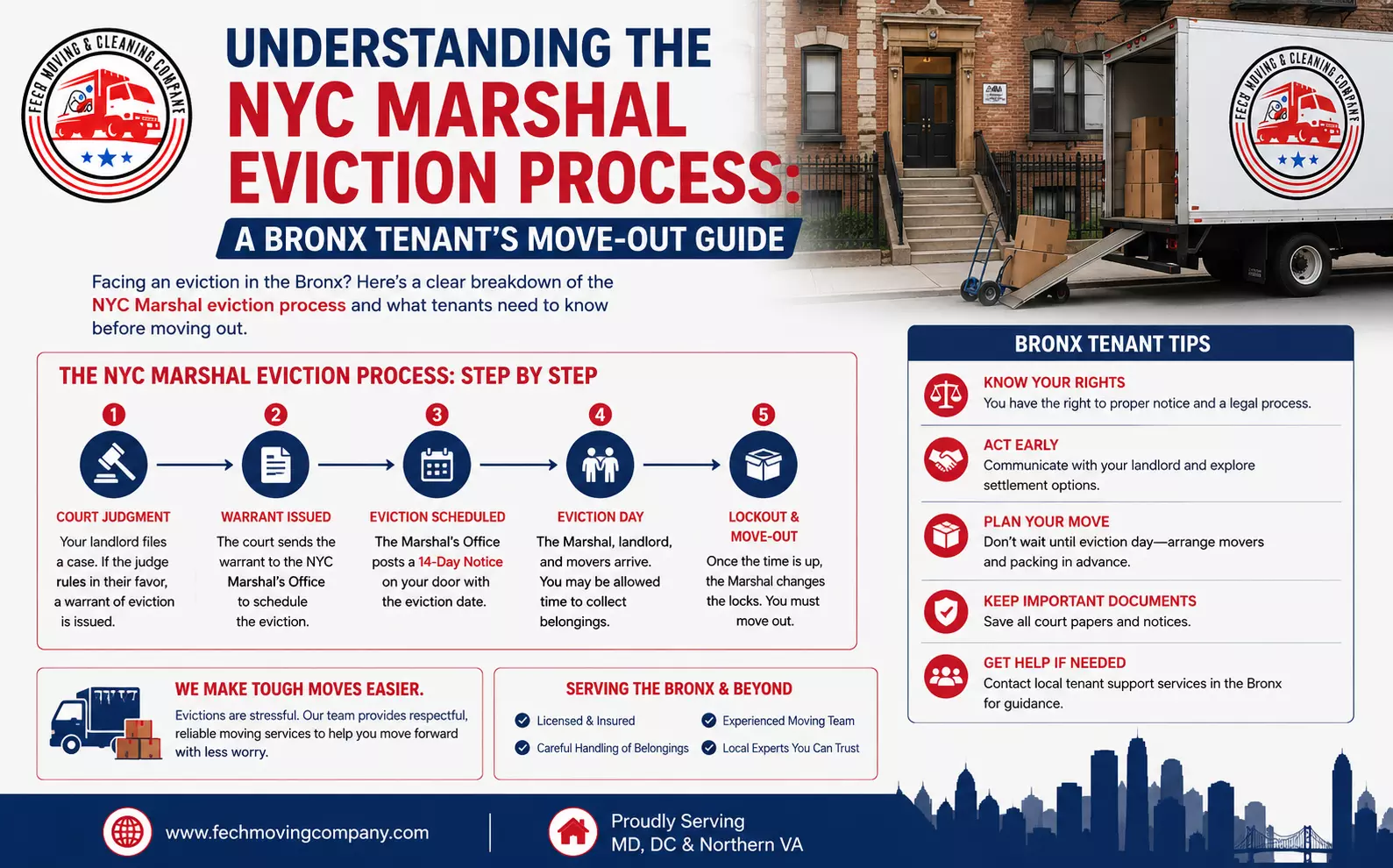
Understanding the NYC Marshal Eviction Process: A Bronx Tenant's Move-Out Guide
New York City's eviction process runs differently than most of the country's, and the Bronx — with its mix of pre-war walk-ups, NYCHA developments, and newer mid-rise buildings — adds its own layer of complexity on top of that.
For tenants facing a marshal's eviction, understanding the actual mechanics of the process is often more useful in the moment than anything else, because it turns an unpredictable situation into one with at least a few knowable steps.
How NYC Marshal Evictions Actually Work
Unlike many states, New York uses city marshals — not sheriffs — to carry out residential evictions, and the process runs through Housing Court rather than District Court.
After a landlord wins a judgment and a Warrant of Eviction is issued, the marshal is required to serve a 14-day notice before the eviction can be executed. That two-week window is legally mandated and gives tenants a defined, if short, runway to arrange a move.
Bronx Housing Court, based on the Grand Concourse, handles a high volume of these cases, and marshals covering
Bronx addresses typically schedule eviction dates within a range of days to a few weeks after that 14-day notice period begins — meaning the realistic total window from notice to lockout is usually longer than 14 days, but rarely more than a month.
What Happens to Belongings During a Marshal Eviction
This is the detail that catches Bronx tenants off guard most often: under NYC's eviction procedures, a marshal typically requires the landlord to hire a licensed moving company to remove the tenant's belongings from the unit on the scheduled date, and those belongings are generally placed on the sidewalk or in city-regulated storage, not simply discarded.
But "placed on the sidewalk" is its own kind of loss — items left curbside in a dense Bronx block can be gone within the hour, whether from weather, city sanitation sweeps, or opportunistic passersby.
This single fact is the strongest argument for moving out before the scheduled marshal date rather than letting the eviction execute with your belongings still inside.
Read: Managing Urgent Property Transitions: A Guide to Rapid
Building a Move-Out Timeline Around the 14-Day Notice
- Mark the notice date the moment you receive it. The 14-day clock starts from service, not from when you happen to open the envelope.
- Call Bronx Housing Court or check your case file for the specific marshal-scheduled date once it's set — it's rarely the same as the last day of the 14-day notice.
- Prioritize what actually matters. In a compressed window, full-household organization isn't realistic — separate what you're keeping from what you're not on day one, not day twelve.
- Arrange a mover with eviction-timeline experience early, ideally as soon as the notice date is confirmed, since short-notice moves fill up fast in a borough this dense.
- Identify a destination before moving day — storage, a family member's apartment, or a new unit — so the moving truck isn't left waiting while decisions get made on the spot.
Why Building Type Changes the Logistics
Bronx housing stock varies block by block, and it changes what a move-out actually requires:
- Pre-war walk-ups (common in Fordham, Mount Hope, and parts of the South Bronx) mean stairs, narrow hallways, and no elevator — all of which slow down a move that's already working against a deadline.
- NYCHA and mid-rise buildings often have freight elevator requirements and specific move-out windows set by building management, which can conflict with a marshal's scheduled time if not coordinated in advance.
- Newer mid-rise developments along the Grand Concourse or near Yankee Stadium may require certificates of insurance from movers, similar to buildings in other boroughs — another step that needs lead time, not same-day scrambling.
Questions Worth Asking Before You Book
Given how tight the timeline usually is, a few direct questions to any moving company can save real stress:
- Have you coordinated moves around a marshal's scheduled eviction date before, and do you understand the 14-day notice framework?
- Can you work with walk-up buildings without freight elevators, and does that change your pricing?
- Do you offer junk removal in the same visit, for items that won't be coming to the next address?
- Is your quote itemized, so there's no ambiguity if sorting on-site takes longer than expected?
Bronx tenants researching options should look for movers who list borough-specific eviction service coverage rather than a single generic NYC page — it's usually a sign the logistics have actually been handled before, not just advertised.
FECH Moving & Cleaning Company's eviction services page outlines this kind of coverage, including service extending into the Bronx alongside its core DMV region work, which is a useful reference point when comparing what a genuinely eviction-experienced mover should offer.
The Emotional Layer Deserves Acknowledgment
An eviction carries a weight that a routine move doesn't, and it's worth saying plainly rather than glossing over: this is a hard, disruptive process, often arriving on top of other financial stress.
The most useful thing a moving company can offer in this situation isn't just labor — it's steadiness, discretion, and no unnecessary judgment about how someone ended up here. That matters as much as the logistics themselves.
Reducing Decisions Made Under Pressure
The tenants who get through a Bronx eviction move with the least added stress are generally the ones who reduced the number of choices they had to make on the marshal's actual date — a mover already booked, a destination already chosen, belongings already sorted.
Everything decided in advance is one less decision made in a hallway with a marshal waiting.
For anyone currently navigating this, working with eviction movers bronx tenants and legal aid organizations commonly refer people to — meaning crews who understand the 14-day notice framework and marshal scheduling specifically — tends to reduce the number of surprises the actual move-out day brings.
Where to Learn More
Tenants further along in the process may find it useful to review a fuller breakdown of eviction-service logistics across the DMV and Bronx region, since building type and borough-specific scheduling norms differ meaningfully from one address to the next.