UK Electronic Travel Authorization (ETA) Requirements for Japanese Citizens
Planning a trip to the UK from Japan? Then it’s a good time to get familiar with the UK Electronic Travel Authorization (ETA) Requirements for Japanese Citizens. As of recent changes, many travellers — including those from Japan — need an ETA before boarding a flight or entering British territory.
An ETA simplifies the process as long as you meet all the requirements, and with the right preparation, your UK adventure can begin with ease. In this guide, I walk you through who needs an ETA, how to apply, what documents you must have, and helpful tips to ensure a smooth UK arrival. Treat this as your travel‑blog style companion for a hassle‑free journey.
Who needs a UK ETA as a Japanese citizen?
If you hold a Japanese passport and plan to travel to the UK for tourism, short visits, business meetings, or transit, you likely fall under the group of travellers needing a UK ETA.
Even if you travel with family — including children or infants — each person must have their own ETA.
However, there are exceptions: for example, if someone already holds a valid visa or another form of permission to stay in the UK, then an ETA is not required.
In short: most Japanese travellers visiting for short‑term stays will need an ETA before their trip — make sure to check ahead.

How can Japanese citizens apply for a UK ETA?
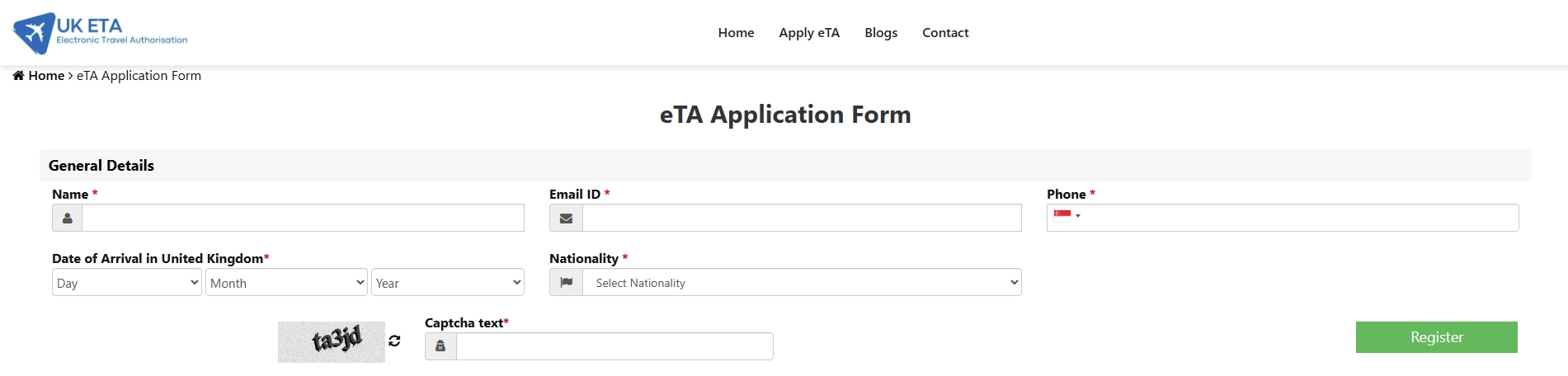
Japanese citizens can apply for a UK Electronic Travel Authorisation (ETA) online, which is a requirement for travelers from visa-exempt countries, including Japan, who wish to visit the UK for short stays (tourism, business, etc.). Here’s a step-by-step guide on how to apply:
- Complete the Online Application:
- You will need to fill out an online form that asks for personal details, travel information, and your passport number.
- Be prepared to provide information such as:
- Passport details (e.g., number, issue date, expiry date)
- Travel dates and planned activities in the UK
- Contact details (email, address, etc.)
- Pay the Application Fee:
- The ETA application typically requires a fee. The UK ETA fee can be paid via credit card or other online payment methods.
- Receive the ETA Approval:
- Once you submit your application, you should receive an ETA approval electronically, usually within a few minutes to a few days.
- Check your email for your approval notice. You may also receive a reference number to confirm your ETA status.
- Travel to the UK:
- You do not need to carry physical paperwork, as the ETA will be linked to your passport electronically.
- Upon arrival in the UK, immigration officers will verify your ETA through the passport details.
What documents are required for a UK ETA application?
For a successful ETA application as a Japanese citizen, you typically need:
- A valid Japanese passport — the one you’ll travel with.
- A clear recent photo of your face (passport‑style), as per the requirements of the application process (photo upload via app or online)
That’s essentially all — no lengthy paperwork, no visits to embassies, and no need for extra documentation for simple tourist or short‑stay visits.

What is the validity period of the UK ETA?
Once approved, a UK ETA Validity for 2 years — or until the passport you applied with expires, whichever comes first.
During this period, you can travel to the UK multiple times.
This makes the ETA suitable not only for a one‑time trip, but for people who might plan repeated visits over a period of time.
How long does it take to process a UK ETA for Japanese citizens?
Processing times are generally very quick. According to guidance, most applicants receive a decision by email within a day.
Because of this speed, many travellers find ETA far more convenient than traditional procedures — especially when you plan.
When does the UK ETA expire for Japanese travelers?
As mentioned, the ETA expires either after 2 years from issuance or when the passport used to apply expires — whichever is earlier.
If your passport expires earlier, you’ll need to get a new passport and then apply anew for an ETA if you want to travel again.
Which airlines require a valid UK ETA for boarding?
Any airline, ferry, or other transport operator that carries passengers to the UK is required to check that you hold a valid ETA (or visa) before boarding. As the ETA rule applies to “all routes and modes of entry,” this includes flights and other international transport — including when transiting through the UK and passing border control.
So if you are flying from Japan (or elsewhere) to the UK, your airline may deny boarding if your ETA is missing or invalid — hence, always ensure ETA is approved before travel.

How does the UK ETA affect visa‑free travel for Japanese citizens?
For many Japanese passport holders, visiting the UK for short stays used to be fairly simple. Now, the ETA adds a mandatory pre‑travel check even for visa‑exempt travellers. It simply authorises you to travel and request entry.
Once you have the ETA, you retain your visa‑free style convenience (for allowed purposes) — but with the added benefit (and responsibility) of the pre‑travel authorisation.
If you don’t get ETA approval, or travel without ETA when required, you may be denied boarding or entry.
What are the UK ETA rules for Japanese students visiting the UK?
If you are a Japanese student planning to visit the UK temporarily (for short‑term study), an ETA can work under certain conditions. ETA allows short stays — for up to 6 months — including for tourism, visiting friends/family, business-related visits, or short‑term study programmes.
But note: ETA is not meant for long‑term study, work, or extended stay. For long‑term courses or working, you may need a different type of permit.
If your plan is a short summer school, a short course, or short-term stay under six months — ETA should cover you.
What is the difference between a UK ETA and a UK visa for Japanese travelers?
The key differences:
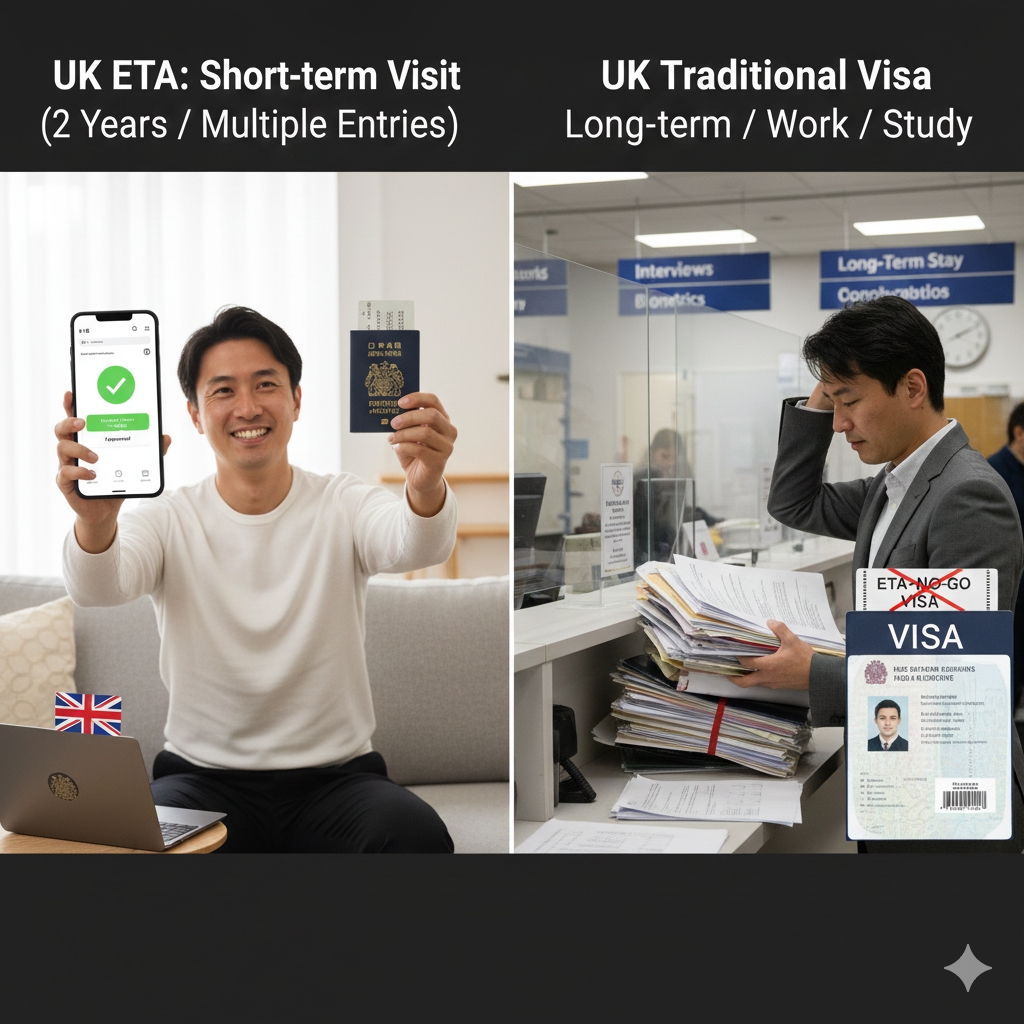
- What they are for: ETA is for short stays — tourism, visiting, short‑term business, short‑term study, transit — up to 6 months per visit.
- Validity & flexibility: ETA is valid for 2 years (or until passport expiry), and allows multiple entries during that period.
- Application process: ETA applications are done online (or via app), no embassy visits required, minimal paperwork. Passport and face photo are enough.
- Limitations: ETA does not allow long-term stay, work, long-term study, or permanent residency. Also, ETA does not guarantee entry — final permission is given on arrival.
- Traditional visa: Required if you plan to stay long, work, study full‑time, or for other permitted purposes beyond short‑term visits.
In short — ETA is simpler, quicker, and ideal for short visits; visa is for longer or more complex stays.
How does the convenience of submitting documents differ between the two options?
government / authorised visa‑centre — how submission works
- For UK visas, the official process is handled by UKVI. You start on the official site of UK Visas and Immigration.
- After filling the online form and paying fees, your application (including supporting documents) is submitted via an authorised visa‑application centre (in many countries) such as VFS Global or similar.
- You then attend an appointment (if required) for biometrics (photo, fingerprints) and submit/upload supporting documents if needed.
- This route is standard, transparent and regarded as “legit/trustworthy” because it’s run or authorised by the government.
Agent / Third‑party site (like the “agent site” you mentioned)
Many visa‑agents or consultant‑type sites (sometimes calling themselves “consultants,” “service providers,” or “agents”) offer to help you with the application — sometimes promising extra “convenience,” “expertise,” or “fast processing.” According to general descriptions of what visa‑agents or consultants do:
- They may claim they will handle your complete application — filling forms, verifying that all required documents are included, and submitting on your behalf.
- They may offer to “streamline” the process for you: if you don’t have time or find the procedure confusing, agents claim to simplify it.
- For complicated cases (work visa, student‑visa, family sponsorship etc.), agents/consultants sometimes claim they can better manage documentation and increase the chance of approval compared to doing it alone.
Read: Everything You Need To Know About Electronic Travel
What are the common mistakes Japanese citizens make when applying for a UK ETA?
Even though ETA is relatively simple, there are common pitfalls some travellers fall into:
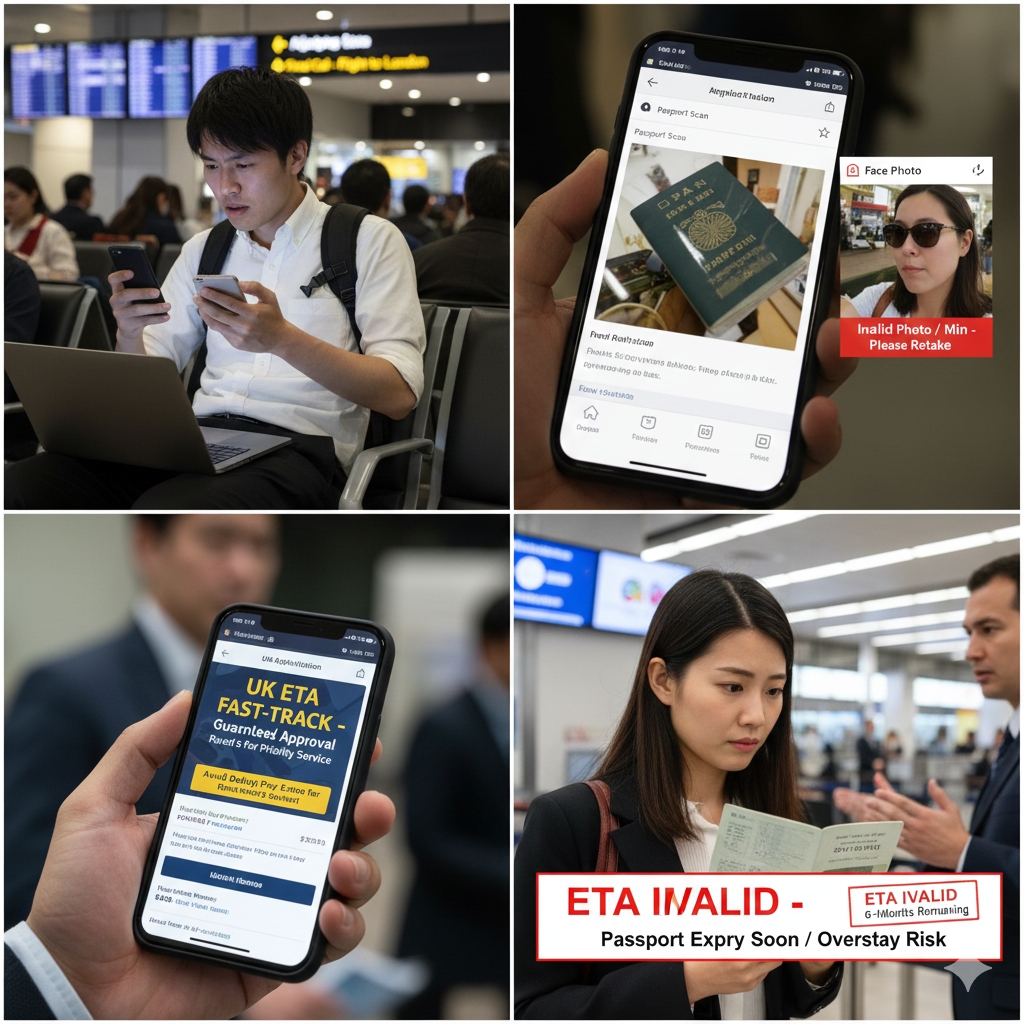
- Applying too late: Because ETA processing can sometimes take hours (or a day), applying only a few hours before flight may be risky. Better to apply at least a couple of days ahead.
- Incorrect passport photo or poor passport scan: If the passport scan or face photo is unclear, outdated, or doesn’t meet required standards — the application may be rejected or delayed.
- Using unofficial third‑party services: Some non‑official agencies may promise “fast‑track” or “guaranteed” approvals, but those aren’t part of the standard ETA process and could lead to fraud or overpayment.
- Not checking passport validity: Since ETA validity is linked to passport validity, if your passport expires soon, ETA may become invalid sooner than 2 years.
- Misunderstanding stay limits: Some travellers think ETA allows longer stays — but each visit under ETA is limited to 6 months. Overstaying or misusing ETA may get you into trouble.
By being aware of these, you can avoid application problems and last‑minute stress.
What travel tips should you know before applying for a UK ETA?
Here are some practical tips I wish I’d known before my first trip under ETA:
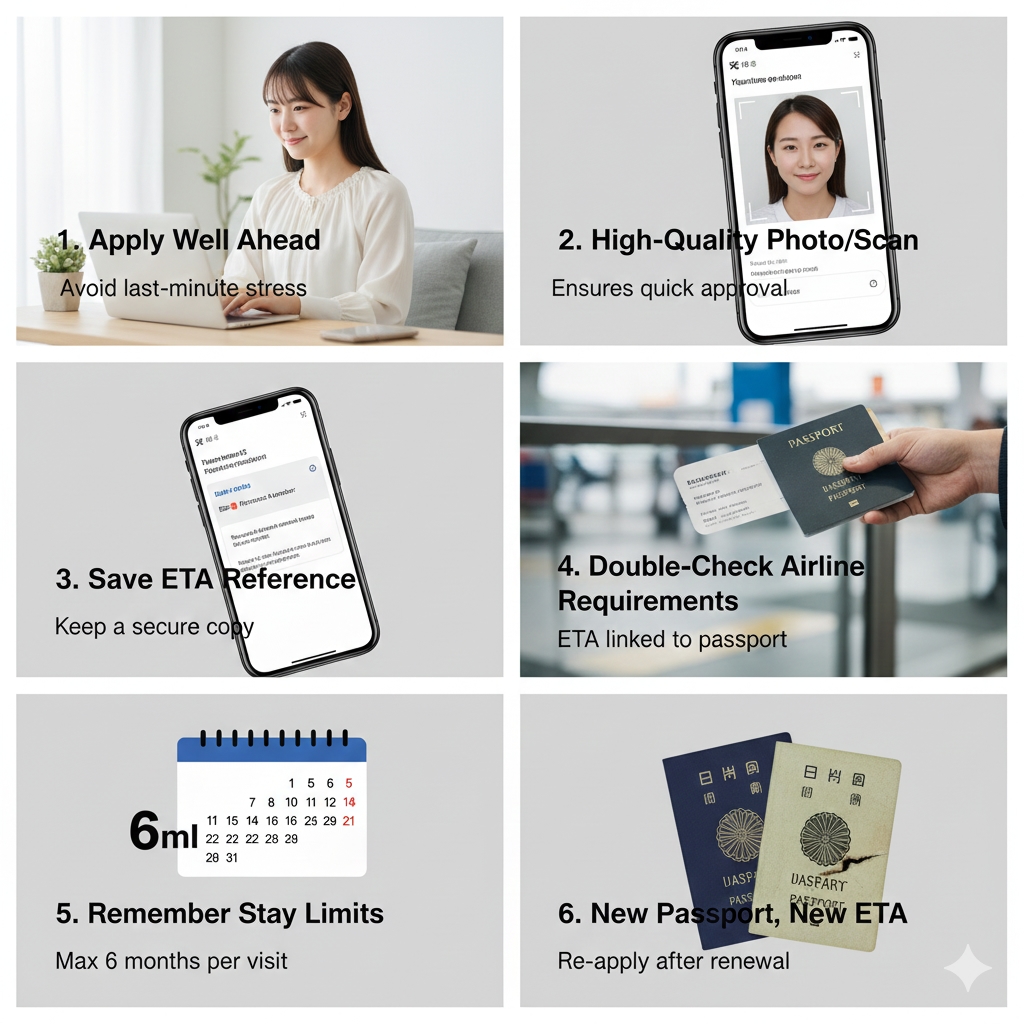
- Apply well ahead of travel date. Give yourself buffer time — though many get approval quickly, unexpected delays (e.g. technical glitches) can happen.
- Use a good-quality scan/photo of passport and face photo. Clean, unexpired passport + clear facial photograph is key — poor quality can delay or reject your application.
- Save the ETA reference carefully. After approval, you receive a reference number — keep that email or note it down somewhere safe.
- Double‑check airline requirements. Airlines will check if you have valid ETA before boarding, so ensure ETA is linked to the exact passport you travel with.
- Remember your stay limits. Each visit under ETA — up to 6 months only. Don’t plan extended stay or long‑term study/work on ETA.
- If passport renews — get a new ETA. ETA is tied to the passport; if you renew passport, you’ll need a fresh application before travelling again.
Conclusion: Your Hassle‑Free Journey to the United Kingdom ETA
For Japanese travellers dreaming of exploring the UK — whether to stroll through London’s historic streets, enjoy countryside getaways, or study for a short course — the UK ETA Requirements for Japanese Citizens offer a smooth, efficient, and traveller‑friendly approach. As long as you prepare properly — valid passport, clean photo, timely application — the ETA gives you the flexibility to visit multiple times over two years, without the hassle of traditional procedures.
With a bit of planning, you can focus on what matters: your UK itinerary, photography plans, sightseeing routes — and less on paperwork stress. Safe travels, and enjoy your UK journey!
FAQs for UK ETA applications for Japanese citizens
Q: Can I apply for an ETA for a friend or family member?
Yes — if you have their passport scan and photo, you can apply on behalf of someone else using the process.
Q: Does ETA guarantee I will be allowed into the UK?
No — ETA allows you to travel to the UK; final entry permission is granted at the border.
Q: Can I stay more than 6 months on ETA?
No — each stay under ETA is limited to a maximum of 6 months. For longer stays, you need a different permit.
Q: Do children need their own ETA?
Yes — every traveller, including infants and children, needs their individual ETA.
Q: What happens if my passport expires during the ETA’s validity?
In that case, your ETA becomes invalid once the passport expires — you’ll need to apply for a new ETA with the new passport before travelling again.