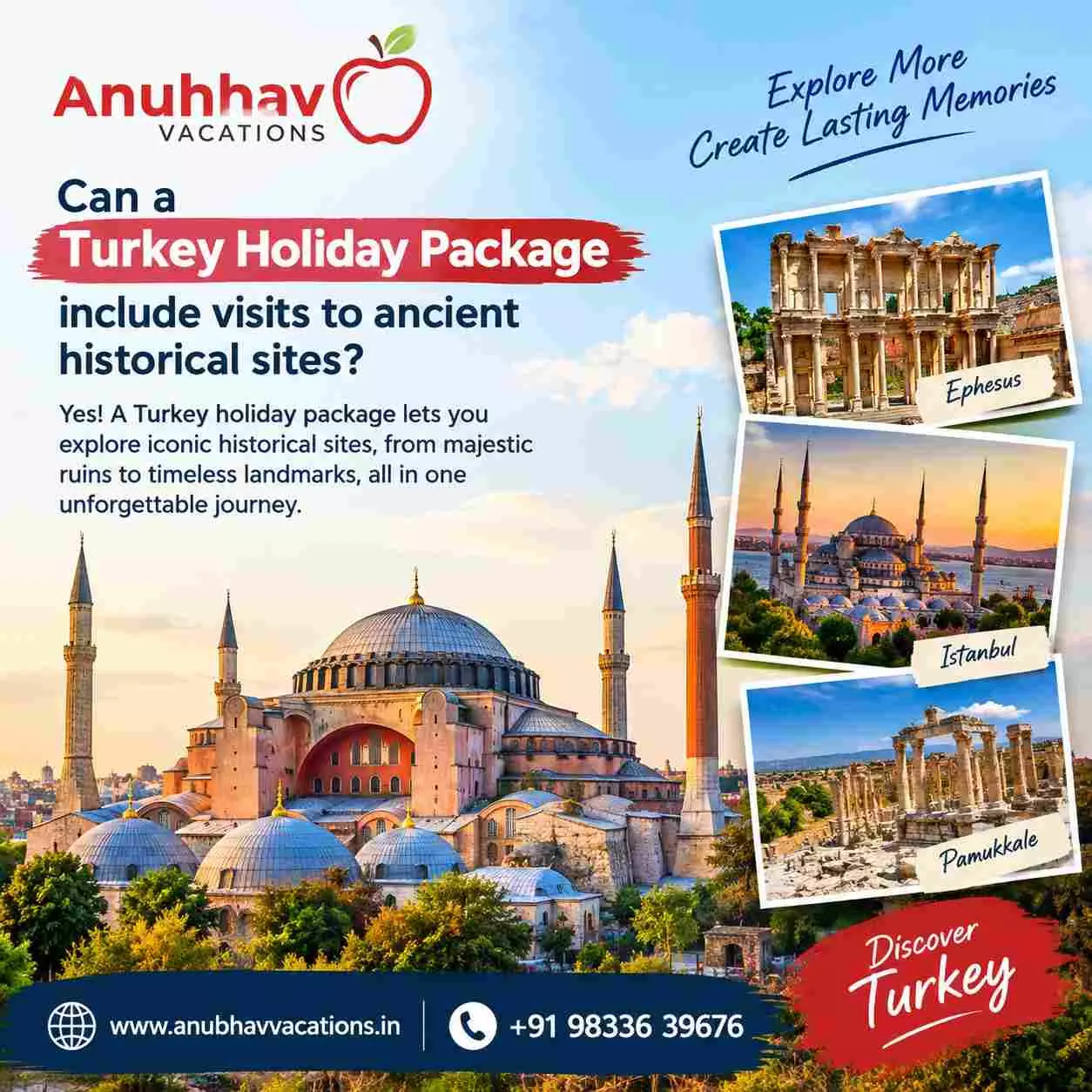
Can a Turkey Holiday Package include visits to ancient historical sites?
Turkey is a fascinating destination where ancient civilizations, remarkable architecture, traditional cultures, and modern city life come together.
Positioned between Europe and Asia, the country has a rich historical heritage shaped by the Greeks, Romans, Byzantines, Ottomans, and many other civilizations.
From monumental ruins and ancient theatres to underground cities and historic religious landmarks, Turkey offers countless opportunities for travellers interested in exploring the past.
A well-planned Turkey Holiday Package can certainly include visits to ancient historical sites, allowing travellers to discover the country's heritage while enjoying its scenic landscapes and vibrant cities.
Destinations such as Ephesus, Troy, Hierapolis, and Cappadocia provide different perspectives on Turkey's historical development. Istanbul also offers magnificent architectural landmarks that reflect centuries of cultural exchange.
Including historical attractions in a holiday itinerary can make the journey more meaningful. Travellers can learn about ancient societies, admire engineering achievements, explore archaeological remains, and understand how historical events shaped the region.
However, the sites included in a particular itinerary depend on the trip duration, selected destinations, transportation arrangements, and sightseeing preferences.
Some itineraries focus on Istanbul and Cappadocia, while others include additional days for exploring the Aegean coast and ancient archaeological sites.
Whether you are interested in Roman cities, ancient Greek ruins, Byzantine architecture, or underground settlements, Turkey offers a variety of experiences for history enthusiasts.
With thoughtful planning, visitors can combine historical exploration with cultural activities, scenic sightseeing, and relaxing experiences throughout the country.
Can a Turkey Holiday Package Include Visits to Ancient Historical Sites?
Yes, a holiday itinerary can include several ancient historical sites across Turkey. The country has an extensive collection of archaeological remains, historic monuments, and preserved settlements that appeal to travellers with different interests.
The key is to select destinations according to your available travel time and preferred historical experiences.
1. Explore Ancient Civilizations
Turkey was home to several important civilizations that contributed to architecture, trade, religion, and urban development.
Visitors can explore ancient settlements, monumental gateways, temples, theatres, and public buildings that reveal how people lived in earlier periods.
Guided sightseeing can make these visits more informative because historical structures often have stories that are not immediately obvious to visitors.
2. Combine History with Scenic Travel
Many historical sites are located in regions known for their natural beauty.
For example, Cappadocia combines unusual rock formations with ancient settlements and underground cities. Pamukkale is known for its white travertine terraces and the nearby archaeological remains of Hierapolis.
These combinations allow travellers to experience both cultural heritage and natural landscapes during the same journey.
3. Discover Different Historical Periods
Turkey's historical attractions are not limited to a single civilization.
Travellers can discover remains associated with ancient Greek cities, Roman administration, Byzantine religious traditions, and Ottoman architecture.
Visiting different locations provides a broader understanding of the country's cultural development.
4. Choose Guided or Independent Sightseeing
Some travellers prefer guided tours because local experts can explain the historical background of archaeological sites.
Others prefer exploring independently and spending more time at particular landmarks.
Both approaches can work well, provided visitors review access arrangements, transportation options, and opening information before travelling.
Which Ancient Historical Sites Should You Visit in Turkey?
Turkey offers numerous archaeological destinations, each with distinctive historical significance. The following attractions are particularly worthwhile for travellers interested in ancient history.
1. Ephesus: Discover an Ancient Roman City
Ephesus is one of Turkey's most famous archaeological sites and an important destination for history enthusiasts.
Located near Selçuk in western Turkey, the ancient city contains impressive remains of streets, public buildings, monuments, and religious structures.
Ephesus flourished as an important centre of commerce and culture during antiquity. Its location helped connect regional trade routes, contributing to its development as a significant urban settlement.
One of the site's most recognisable landmarks is the Library of Celsus. Its elaborate façade demonstrates the architectural ambitions of the Roman period.
Visitors can also explore the Great Theatre, which illustrates the importance of public gatherings and entertainment in ancient urban life.
The remains of paved streets, monumental structures, and residential areas provide insights into the organisation of the city.
Travellers who enjoy archaeology can spend several hours exploring the site and learning about its historical importance.
When planning a visit, consider the walking distance, exposure to sunlight, and uneven surfaces. Comfortable footwear and sufficient drinking water can make the experience more enjoyable.
Read: Best Muslim-Friendly Holiday Destinations Around the World
2. Troy: Explore a Legendary Ancient Settlement
Troy is another important destination for travellers interested in ancient history.
Located in northwestern Turkey, the archaeological site is associated with the legendary Trojan War described in ancient Greek literature.
Although the literary accounts and archaeological evidence must be understood separately, excavations have revealed multiple layers of settlement spanning different periods.
These layers demonstrate that Troy was inhabited and developed repeatedly over many centuries.
Visitors can explore archaeological remains, reconstructed features, and interpretive displays that explain the site's historical significance.
The destination is especially interesting for travellers who enjoy ancient literature, archaeology, and the relationship between historical evidence and legendary narratives.
Because the site contains several layers of settlement, a guided visit can help explain how different periods are represented within the archaeological landscape.
3. Hierapolis: Discover the Ancient City of Pamukkale
Hierapolis is an ancient city located near Pamukkale, a destination famous for its striking white travertine terraces.
The archaeological area contains remains of public buildings, streets, burial grounds, and other structures that reflect the city's historical development.
The site became an important settlement during the Hellenistic and Roman periods and continued to hold significance in later centuries.
Visitors can explore the archaeological remains while enjoying views of the surrounding landscape.
The nearby travertine terraces create an unusual natural setting, making the area particularly appealing to travellers who want to combine historical sightseeing with scenic experiences.
The archaeological site and natural terraces have different visitor requirements, so travellers should check current access rules before planning their visit.
Allowing enough time for both attractions can make the experience more rewarding.
4. Pergamon: Explore an Ancient Centre of Learning
Pergamon, near modern-day Bergama, is an important archaeological destination in western Turkey.
The ancient city became a significant political, cultural, and intellectual centre during the Hellenistic period.
Its archaeological remains include the Acropolis, monumental structures, and evidence of sophisticated urban planning.
The elevated location provides impressive views of the surrounding countryside.
Visitors can learn about the city's historical role in architecture, learning, and cultural development.
Pergamon is particularly appealing to travellers interested in ancient Greek history and the development of major urban centres.
Because some areas involve slopes and uneven pathways, visitors should consider their physical comfort when planning the visit.
5. Aphrodisias: Discover Ancient Art and Architecture
Aphrodisias is a remarkable archaeological site in southwestern Turkey.
The ancient city was associated with the worship of Aphrodite and became well known for its sculptural traditions.
Its remains include a stadium, temple structures, public buildings, and other features that demonstrate the city's artistic and architectural achievements.
The site is particularly interesting for visitors who want to learn about ancient sculpture and the role of artistic production in urban life.
The surviving structures also reveal how public spaces were organised within an ancient city.
Aphrodisias may be suitable for travellers who have additional time to explore beyond the most commonly visited historical destinations.
Can You Combine Ancient Sites with Istanbul and Cappadocia?
Yes, combining archaeological attractions with Istanbul and Cappadocia can create a varied holiday experience.
However, these destinations are spread across different regions, so the itinerary should account for travel time and transportation connections.
Explore Istanbul's Historic Heritage
Istanbul is one of Turkey's most historically significant cities.
Its position between Europe and Asia contributed to its importance as a centre of trade, administration, and cultural exchange.
The city contains architectural landmarks associated with the Byzantine and Ottoman periods.
Hagia Sophia is one of its most recognisable monuments, reflecting several layers of religious and architectural history.
The Blue Mosque is another important landmark known for its distinctive domes, minarets, and interior decoration.
Topkapi Palace offers insights into the administration and lifestyle of the Ottoman imperial court.
Visitors can also explore historic neighbourhoods, museums, and traditional markets.
Although Istanbul's most famous landmarks are not all ancient archaeological ruins, they are valuable destinations for understanding the country's broader historical development.
Discover Cappadocia's Underground Cities
Cappadocia is famous for its unusual rock formations, cave dwellings, and underground settlements.
The region's distinctive landscape developed through volcanic activity and erosion.
Over centuries, communities created dwellings, storage areas, religious spaces, and other structures within the soft rock.
Underground cities such as Derinkuyu and Kaymakli demonstrate how people adapted to the landscape and developed complex spaces beneath the surface.
Visitors can explore permitted sections of these settlements and learn about their historical uses.
Some passages are narrow or steep, so travellers should consider their comfort with enclosed spaces and stairs.
Cappadocia also offers opportunities to discover rock-cut churches, historic villages, and traditional architecture.
Combining the region with ancient archaeological destinations can provide a broader understanding of Turkey's diverse cultural heritage.
Include Pamukkale and Ephesus
Travellers interested in ancient cities may choose to include Pamukkale and Ephesus in the same itinerary.
Both destinations are located in western Turkey, although travel between them still requires planning.
Visitors can explore the ruins of Hierapolis, admire the travertine terraces, and discover the architectural remains of Ephesus.
The exact order depends on transportation connections, accommodation arrangements, and the amount of time available.
A carefully planned route helps minimise unnecessary travel and allows visitors to spend more time exploring the attractions.
How Many Days Are Needed to Explore Turkey's Historical Sites?
The ideal duration depends on how many regions you want to visit and how deeply you wish to explore each destination.
A Short Historical Holiday
A shorter itinerary may focus on Istanbul and one additional destination.
Visitors could explore the city's historic landmarks and then travel to Cappadocia for its underground settlements and rock-cut heritage.
This approach is suitable for travellers who have limited time but want to experience more than one historical environment.
However, it may not leave enough time for Ephesus, Troy, and other archaeological destinations.
A One-Week Journey
A week can provide an introduction to several major destinations, depending on flight schedules and transportation arrangements.
Travellers may combine Istanbul with Cappadocia or organise a western Turkey itinerary featuring Ephesus and Pamukkale.
Trying to include every major site in a single week can result in long travel days and limited sightseeing time.
It is generally better to prioritise destinations according to your interests.
A Longer Historical Exploration
A longer holiday provides greater flexibility for exploring multiple archaeological sites.
Travellers can include Istanbul, Cappadocia, Ephesus, Pamukkale, and selected ancient settlements in a broader itinerary.
Additional time allows visitors to explore museums, participate in guided tours, and enjoy local cultural experiences.
It can also provide more flexibility for transportation changes and rest.
What Activities Can You Enjoy at Ancient Historical Sites?
Historical sightseeing involves much more than simply viewing old buildings.
Turkey offers opportunities to engage with its heritage through different activities.
1. Join Archaeological Walking Tours
Guided walking tours can help visitors understand the purpose of ancient buildings, the organisation of settlements, and the historical events associated with particular locations.
A knowledgeable guide can explain architectural features and connect individual ruins with broader historical developments.
Travellers should choose tours that match their interests and preferred walking pace.
2. Visit Archaeological Museums
Museums provide additional context for understanding the sites.
Exhibitions may include sculptures, inscriptions, ceramics, architectural fragments, and other objects associated with ancient communities.
Visiting a museum before or after an archaeological site can help travellers understand the artefacts and structures they encounter.
3. Learn About Ancient Engineering
Many historical attractions demonstrate impressive engineering achievements.
Roman cities included organised streets, public buildings, and infrastructure designed to support large populations.
In Cappadocia, underground settlements illustrate how communities adapted buildings to the surrounding geology.
Observing these features can provide insight into how people solved practical challenges in earlier periods.
4. Explore Traditional Markets and Villages
Historical destinations are often surrounded by communities with distinctive cultural traditions.
Travellers can explore local markets, discover regional crafts, and sample traditional dishes.
These experiences provide opportunities to learn about contemporary life as well as the past.
Visitors should respect local customs and ask permission before photographing people or private spaces.
5. Enjoy Historical Photography
Turkey's archaeological sites offer impressive opportunities for photography.
Ancient columns, monumental gateways, stone streets, and historic architecture create visually striking scenes.
Visitors should follow photography rules and avoid climbing on ruins or entering restricted areas to obtain particular images.
Responsible photography helps protect archaeological heritage for future generations.
How Can You Plan a Comfortable Historical Holiday?
Careful planning can make a significant difference when visiting multiple archaeological destinations.
Choose Destinations According to Your Interests
Begin by identifying the historical periods and attractions that interest you most.
Travellers fascinated by Roman cities may prioritise Ephesus and Hierapolis.
Visitors interested in ancient Greek history may prefer Troy, Pergamon, or Aphrodisias.
Those who enjoy Byzantine and Ottoman architecture may spend more time in Istanbul.
Selecting destinations according to personal interests can make the itinerary more meaningful.
Review Transportation Connections
Turkey's historical attractions are spread across several regions.
Travellers may need domestic flights, intercity buses, trains, or private transfers to reach selected destinations.
Check the travel time between attractions and avoid scheduling too many distant locations on consecutive days.
Confirm Entry Arrangements
Some archaeological sites and museums require entrance tickets or specific visitor arrangements.
Check current opening information, ticket conditions, and any access restrictions before departure.
Some attractions may have areas closed for conservation or restoration.
Consider Guided Visits
A guided visit can be especially valuable at large archaeological sites.
Guides can explain historical context and help visitors understand architectural details that might otherwise be overlooked.
Independent exploration can also be rewarding, particularly for travellers who prefer a flexible schedule.
Allow Time for Rest
Historical sightseeing can involve extensive walking and exposure to sun or changing weather.
Plan regular breaks, carry water, and choose comfortable footwear.
Travellers with mobility concerns should check site accessibility before confirming excursions.
What Should You Pack for Visiting Ancient Sites in Turkey?
Packing appropriately can make historical sightseeing more comfortable.
Consider bringing:
- Comfortable walking shoes: Useful for uneven stone pathways and archaeological grounds.
- Lightweight clothing: Choose garments appropriate for the season and destination.
- Sun protection: Carry sunscreen, sunglasses, and a hat.
- Water bottle: Stay hydrated during outdoor sightseeing.
- Light rain protection: Useful when weather conditions are changeable.
- Camera or smartphone: Helpful for documenting architectural details and landscapes.
- Small day bag: Convenient for carrying personal essentials.
- Essential medication: Carry personal medication and seek professional advice when needed.
- Travel documents: Keep passports, booking confirmations, and other required documents secure.
Visitors should also review clothing expectations for religious landmarks. Modest clothing may be required at certain places of worship, and additional visitor instructions may apply.
When Is the Best Time to Visit Turkey's Historical Sites?
- Turkey can be visited throughout the year, but seasonal conditions influence sightseeing comfort.
- Spring, particularly April and May, often offers pleasant conditions for outdoor exploration in many parts of the country.
- Autumn, especially September and October, can also be suitable for visiting archaeological sites and historic cities.
- Summer can bring high temperatures, particularly in inland and coastal areas. Travellers visiting outdoor ruins during this period should plan activities carefully and avoid prolonged exposure to the midday sun when possible.
- Winter may offer a quieter experience at some destinations, but weather conditions can affect transportation and outdoor sightseeing.
- The most suitable travel period depends on the destinations included in your itinerary, personal preferences, and current local conditions.
Is Turkey Suitable for First-Time Visitors Interested in History?
- Turkey is an appealing destination for first-time visitors who want to explore ancient civilizations and historic architecture.
- The country offers a wide range of experiences, from major archaeological sites to museums, historic neighbourhoods, and traditional villages.
- Travellers can choose a focused itinerary or combine historical attractions with scenic destinations and cultural activities.
- First-time visitors may benefit from organised transportation and guided sightseeing, particularly when travelling between distant regions.
- It is also important to allow enough time to explore each destination without rushing.
- A thoughtfully organised itinerary can make Turkey's extensive historical heritage more accessible and enjoyable.
Conclusion
- A well-planned Turkey Holiday Packages can include visits to some of the country's most remarkable ancient historical sites. From the Roman streets of Ephesus and the legendary settlement of Troy to the archaeological remains of Hierapolis and the underground cities of Cappadocia, Turkey offers an extraordinary journey through different periods of human history.
- Travellers can also explore Istanbul's Byzantine and Ottoman landmarks, discover traditional communities, and enjoy scenic landscapes throughout the country.
- The best itinerary depends on your available travel time, historical interests, preferred sightseeing style, and transportation arrangements. Rather than trying to visit every attraction in a short period, prioritising destinations can provide a more relaxed and meaningful experience.
- By reviewing entry requirements, choosing suitable accommodation, allowing enough time for travel, and considering guided tours, visitors can make the most of their historical holiday.
- Whether you are fascinated by ancient Roman architecture, Greek settlements, underground cities, or imperial monuments, Turkey provides countless opportunities to discover the past while enjoying a diverse and memorable travel experience.