Trust Through Proof: The Next Wave of Digital Ecosystems
As technology evolves, so does the tension between power and privacy. We expect AI to learn, assist, and predict but not at the expense of exposing our personal lives. We rely on blockchain to decentralize control but too often it trades privacy for transparency. A new wave of infrastructure is trying to change that. Rather than forcing users to choose between privacy and utility, architectures built around zkp blockchain and proof devices are aiming to deliver both simultaneously.
This is more than incremental improvement. It is a philosophical shift: from “trust us” platforms toward “verify for yourself” systems. In what follows, we’ll explore how this vision is being constructed — its building blocks, its use cases, the challenges ahead and why it may deeply reshape how we think about digital trust in AI and crypto systems.
The Foundations: How Privacy + Proof Coexist
To understand this landscape, we need to unpack how these architectures reconcile privacy and verifiability.
Proof Devices: From Users to Participants
One visible piece is devices sometimes called “proof pods.” Rather than passively feeding data into a black box, users regain agency. These hardware or software endpoints let you:
- Decide which signals or data you share (e.g. usage metrics, anonymized telemetry, etc.)
- Keep control over when and how often data is shared
- Stay anonymous or pseudonymous, with privacy built into defaults
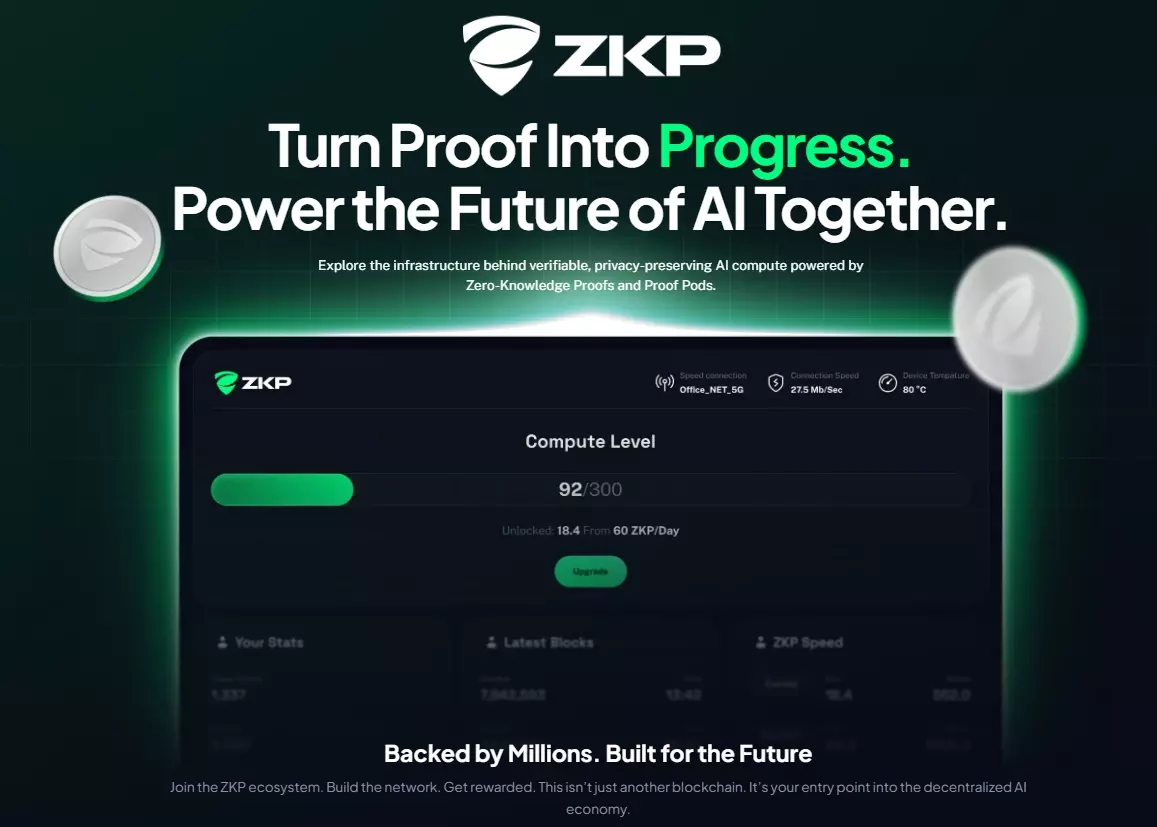
- Watch your real impact via dashboards — how your contributions feed into training, verification, or model improvement
Instead of being mere data sources, people become stakeholders in the system itself.
Verifiable Compute & Confidential Proofs
Simply collecting private data isn’t enough. The magic happens when computations AI model training, inference, data processing can be verified without exposing sensitive inputs. That’s where cryptographic tools such as zero-knowledge proofs enter the picture. These allow someone to prove that a computation was carried out correctly, without revealing the raw data used.
In practical terms, you can confirm that a model’s output is valid, or that a consensus node is behaving honestly, without needing to see the private inputs. This bridges the gap between privacy and correctness.
Modular Architecture & Hybrid Consensus
To scale this model, the architecture is often layered and modular:
- Consensus & validation layers: nodes verify both storage and compute via proofs, not blind trust
- Application/runtime layers: supporting multiple execution environments smart contracts, AI routines, etc.
- Off-chain storage & integrity proofs: large datasets don’t live entirely on chain; they live off-chain with cryptographic anchoring (e.g. Merkle proofs) so they remain verifiable
- Interoperability & cross-chain bridges: proof mechanisms extend to cross-chain messaging securely, preserving privacy as messages traverse networks
This layered design supports flexibility, scalability, and upgradeability without sacrificing the core proof guarantees.
Where Privacy + Proof Are Changing Real Domains
These aren’t just theoretical ideas. Increasingly, privacy-first, proof-driven systems are applied in settings where the stakes are high.
Health & Medical AI
Medical data is among the most sensitive there is. Hospitals, labs, and clinics often hesitate to share patient records even when pooling data could improve diagnostics. With proof devices and private computation, multiple institutions can jointly train or validate models (for disease detection, treatment optimization, etc.) without exposing patient-level records. Verifiable proofs can confirm model integrity while privacy remains intact.
Enterprise & Intellectual Property Collaboration
Many companies guard their data fiercely for good reason. But innovation sometimes demands collaboration, audit, or external validation. A proof-driven infrastructure makes it possible to share insights or models without exposing core proprietary datasets. Outcomes can be audited, models verified, and contributions rewarded all while data remains sheltered.
Public Systems & Regulated AI
When AI is used in public services justice, social welfare, regulation fairness, transparency, and accountability become essential. But raw data behind such systems often can’t be exposed for privacy or legal reasons. Proof systems let regulators, oversight bodies, or public auditors verify outputs, check fairness metrics, or examine decision logic without having to peek into everyone’s private information.
IoT, Edge Devices & Distributed Data
Sensors and devices worldwide gather massive streams of data — climate sensors, smart meters, wearable health devices. Privacy-sensitive use cases demand that such data never leak. Proof architectures can let edge devices contribute to global AI models or aggregate intelligence, while ensuring data is never exposed. In fact, recent research explores using ZKP techniques to secure IoT devices and firmware integrity on distributed networks (e.g. zk-IoT frameworks).
The Promise — and the Pitfalls
The potential is huge, but the path is rough. These are challenges that must be met for the vision to scale.
- Proof Overhead: Generating and verifying proofs (especially for large models or real-time inference) consumes computational power. Efficiency is vital.
- Device Cost & Accessibility: Devices like proof pods must be affordable and user-friendly, otherwise adoption might stay limited to early tech adopters.
- UX & Privacy Literacy: Giving users granular control is good; making that control understandable is harder. Confusing privacy settings can lead to misconfigurations or disengagement.
- Regulatory & Legal Complexity: Privacy laws, cryptographic export controls, data jurisdictions — these vary globally. Proof architectures must be adaptable.
- Economic Incentives & Tokenomics: Rewarding contributions fairly — whether data, compute, validation — without privileging early whales or enabling centralization, is a subtle design exercise.
- Balance of Exposure & Opacity: Some parts of AI need transparency (model explainability, audit), others need secrecy. Deciding what to reveal and to whom is not always obvious.
- Interoperability & Standards: As more proof-based systems emerge, interoperability and shared standards will be crucial so no one ecosystem becomes isolated.
Indicators That We’re on the Right Track
What signs will show us proof-driven blockchain AI is moving from vision to reality?
- Proof Devices in User Hands
- When non-technical users adopt proof pods or devices, contributing safely under privacy defaults.
- Live Apps in Sensitive Domains
- Deployments in healthcare, regulated finance, public systems using proof for privacy + accountability.
- Proof Efficiency Milestones
- Proof generation becoming faster, cheaper, low-latency — enabling real-time inference.
- Legal & Regulatory Recognition
- Authorities accepting cryptographic proofs or verification logs as valid compliance or audit evidence.
- User-Empowering Governance
- Ecosystems where contributors vote on privacy defaults, reward systems, data usage — full stakeholder involvement.
- Cross-Chain Proof Messaging
- Secure, private proofs traveling across blockchains to support complex multi-chain AI applications. SurferMonkey’s cross-chain proof architecture is one example of aiming for anonymity + interoperability.
Final Thoughts
We’re entering more than a new technological iteration we’re entering a new philosophical approach to digital trust. In a world of smart machines and data flows, “privacy or progress” is a false choice. Proof-based architectures built on zkp blockchain, contributing devices, modular networks, and economic incentives aim to unify them.