Transforming Learning: The Growth and Impact of IoT in Education Market
The Internet of Things (IoT) at the heart of this evolution. IoT in education refers to the integration of interconnected devices, smart tools, and data-driven systems that enhance teaching, streamline administrative processes, and personalize student learning experiences. With the rise of digital classrooms, e-learning platforms, and connected devices, the IoT in education market is gaining strong momentum worldwide.
This article explores the current market landscape, key drivers, challenges, and future opportunities shaping the growth of IoT in education.
Understanding IoT in Education
IoT in education involves the use of connected devices and sensors—such as smart whiteboards, tablets, RFID-enabled ID cards, biometric systems, virtual labs, and AI-powered platforms—that collect, analyze, and transmit data to improve educational processes. These technologies help create smart classrooms where teachers, students, and administrators interact seamlessly with digital infrastructure.
For example:
- Smartboards and interactive displays facilitate collaborative and immersive learning.
- RFID and biometric attendance systems streamline tracking and security.
- IoT-enabled tablets and wearables personalize learning experiences and track student progress.
- Campus management solutions optimize energy usage, classroom occupancy, and facility management.
The adoption of IoT not only enhances the quality of education but also makes institutions more efficient and student-friendly.
Market Growth and Trends
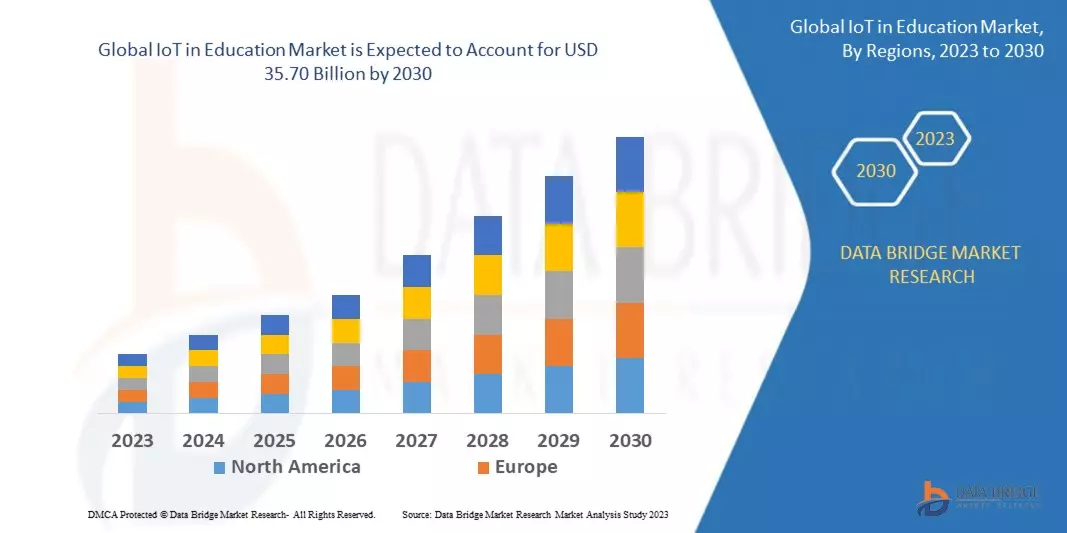
The IoT in education market has grown significantly in recent years, driven by increasing digitalization, rising adoption of e-learning, and government initiatives for smart education infrastructure. According to industry estimates, the market is projected to grow at a robust CAGR of more than 14% from 2024 to 2032, reaching several billions in valuation.
Key Market Trends
- Smart Classrooms and Virtual Learning: Educational institutions are investing heavily in smart classroom infrastructure equipped with IoT-based interactive learning tools.
- Wearable Devices for Learning: Smartwatches and wearables are being used to monitor students’ health, learning habits, and participation levels.
- Cloud-Based Learning Platforms: IoT combined with cloud technology enables seamless access to course materials, real-time collaboration, and digital resource sharing.
- AI and IoT Integration: Artificial intelligence is being integrated with IoT solutions to enable adaptive learning systems and predictive analytics for student performance.
- Data-Driven Decision Making: Schools and universities are leveraging IoT data analytics to optimize resource allocation, assess teaching methods, and improve student outcomes.
Key Drivers of Market Growth
Several factors are fueling the rapid growth of IoT in education:
- Rising Demand for Digital Learning Solutions
- The COVID-19 pandemic accelerated the adoption of e-learning and remote classrooms, which highlighted the importance of IoT in bridging the gap between physical and digital education.
- Government Initiatives for Smart Education
- Many countries are investing in smart education programs. For instance, India’s Digital India initiative and the U.S. push for EdTech funding have boosted IoT adoption in schools and universities.
- Improved Connectivity with 5G and Cloud Technology
- The expansion of 5G and cloud services supports seamless IoT device integration, enabling faster data exchange and uninterrupted learning experiences.
- Personalized Learning Experiences
- IoT empowers educators to design customized curricula based on real-time student performance analytics, improving engagement and learning outcomes.
- Focus on Security and Campus Safety
- IoT-based surveillance, access control systems, and smart ID solutions enhance student safety, a growing priority for institutions worldwide.
Challenges Facing the Market
Despite its vast potential, IoT adoption in education also faces significant challenges:
- High Implementation Costs – Setting up IoT infrastructure, devices, and maintenance can be expensive for schools in developing regions.
- Data Privacy and Security Concerns – With increased data collection, student information becomes vulnerable to cyber threats if not managed properly.
- Lack of Skilled Professionals – Schools often lack the IT expertise required to manage and maintain IoT ecosystems.
- Digital Divide – Unequal access to high-speed internet and IoT devices can create disparities between urban and rural educational institutions.
Market Segmentation
The IoT in education market can be segmented into the following categories:
- By Component: Hardware (smartboards, sensors, tablets), Software (learning management systems, analytics tools), and Services (consulting, maintenance, integration).
- By Application: Classroom management, learning analytics, campus management, administrative efficiency, security & surveillance.
- By End User: K-12 schools, higher education institutions, corporate training centers.
- By Region: North America, Europe, Asia-Pacific, Latin America, and Middle East & Africa.
North America currently dominates the market due to strong digital infrastructure and heavy EdTech investments. However, Asia-Pacific is expected to register the fastest growth due to large student populations and increasing government initiatives in India, China, and Southeast Asia.
Key Players in the Market
Some of the major players in the IoT in education market include:
- Cisco Systems, Inc.
- IBM Corporation
- Intel Corporation
- Google LLC
- Amazon Web Services (AWS)
- Oracle Corporation
- Samsung Electronics
- Huawei Technologies Co., Ltd.
- Microsoft Corporation
These companies are focusing on strategic collaborations, cloud integration, and AI-based platforms to strengthen their foothold in the education technology space.
Future Outlook
The IoT in education market is set to witness exponential growth as institutions continue to adopt digital-first strategies. By 2030, classrooms are expected to be fully integrated with IoT-driven tools, offering immersive learning experiences powered by augmented reality (AR), virtual reality (VR), and AI analytics.
The future will also see:
- Greater use of IoT-powered adaptive learning platforms that adjust in real-time to students’ needs.
- Expansion of IoT-based smart campuses with intelligent energy management, digital attendance, and enhanced safety systems.
- Integration of blockchain with IoT in education for secure credential verification and transparent data management.
Ultimately, IoT in education will play a vital role in creating inclusive, efficient, and personalized learning ecosystems across the globe.
Get More Details:
https://www.databridgemarketresearch.com/reports/global-iot-in-education-market
Conclusion
The IoT in education market represents a revolutionary step toward smart, data-driven learning environments. By enabling seamless connectivity, real-time analytics, and personalized learning experiences, IoT is reshaping how students learn, how teachers teach, and how institutions operate. While challenges like cost and data security remain, continuous innovation, government support, and technological advancements will drive sustained market growth in the coming years.