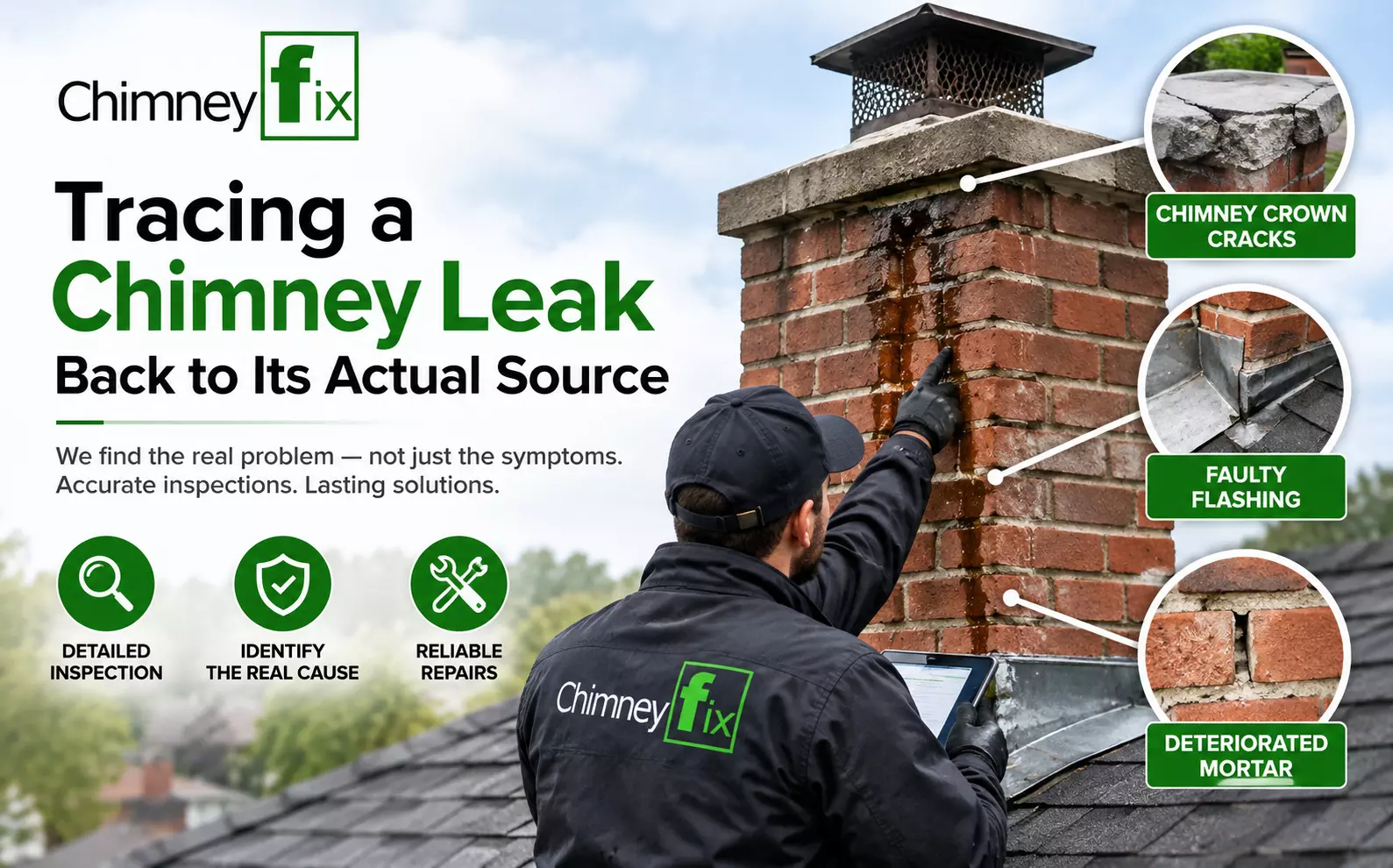
Tracing a Chimney Leak Back to Its Actual Source
One of the more frustrating experiences for a homeowner is sealing what looks like an obvious chimney leak, only to see the same stain reappear a few storms later.
This happens more often than people expect, and it's rarely because the repair was done poorly — it's because water travels sideways and downward inside a structure before it ever shows up as a visible stain. The spot on your ceiling almost never marks the actual entry point.
Why Chimney Leaks Are Deceptive by Nature
Water doesn't fall straight down through a structure the way people picture it.
Once it gets past an exterior barrier — flashing, mortar, a cracked crown — it follows gravity along whatever surface it lands on next: a rafter, a piece of sheathing, the outside of the flue liner. By the time it's visible as a stain or a drip, it may have traveled several feet horizontally from where it actually entered.
This is exactly why DIY attempts to "seal the spot where it's dripping" so often fail — the visible drip point and the actual breach point are two different locations.
The Four Most Common Entry Points
Flashing Where the Chimney Meets the Roof
This junction is one of the most failure-prone areas on any home, chimney or otherwise. Flashing is designed to shed water around the base of the chimney, but it can lift, corrode, or separate from age, exposing a gap that channels water directly into the attic space.
A Cracked or Deteriorating Crown
The crown is the concrete cap sealing the top of the chimney. Hairline cracks that seem cosmetic actually let water seep into the masonry below, where it can travel down through mortar joints far from where the crack itself is located.
Porous or Unsealed Brick
Masonry is naturally porous, and older chimneys without a water-repellent sealant absorb rainwater directly into the brick over time.
In Central Florida's humid, storm-heavy climate, this absorption happens faster than in drier regions, and the water can migrate through the brick itself before ever reaching an interior surface.
A Damaged or Missing Cap
Without a functioning cap, rain falls straight down the open flue, saturating the damper and firebox area — a very different leak pattern from the flashing or crown scenarios, but often confused with them since the resulting interior stains can look similar.
Why the Same Stain Can Have Different Causes
Two homes with an identical-looking ceiling stain near the chimney might have entirely different root causes — one a flashing failure, the other a cracked crown two feet away.
This is the core reason generic advice like "just reseal it" so often falls short: sealing the wrong spot leaves the actual entry point untouched, and the stain simply returns after the next significant storm.
Read: A Homeowner's Guide to Identifying and Fixing Chimney Leaks
How Professionals Actually Trace the Source
A proper diagnosis doesn't start with the interior stain — it starts with ruling things out systematically from the top down.
- Exterior visual assessment of the crown, flashing, and visible masonry for obvious cracks or separation
- Water testing, where a controlled amount of water is applied to isolated sections of the exterior — flashing first, then crown, then brick face — while someone monitors the interior for when and where moisture appears
- Interior camera inspection of the flue itself, to rule out or confirm a cap or liner issue as the source
- Attic and chase inspection, checking framing and sheathing near the chimney for staining patterns that indicate the water's travel path
This process of elimination is what separates an actual diagnosis from a guess, and it's the reason a leak that's been "fixed" twice without success usually needed this kind of methodical testing from the start.
A Real-World Pattern Worth Knowing
A leak that only appears during wind-driven rain, rather than every time it rains, often points to flashing rather than the crown — wind pushes water sideways into a flashing gap that a straight-down rain wouldn't reach.
Conversely, a leak that shows up consistently regardless of wind direction more often traces back to a crown crack or porous brick absorbing water directly.
Neither pattern is definitive on its own, but noting when a leak occurs relative to weather conditions gives a technician useful information before they even start testing.
Why Guessing Costs More Than Diagnosing
It's tempting to have someone reseal the most visible crack and call it done, especially when the repair looks straightforward.
But a repair aimed at the wrong entry point delays the real fix while the underlying damage continues — softened mortar, saturated insulation, or a slowly deteriorating flue liner don't pause just because a patch was applied elsewhere.
Homeowners dealing with a recurring chimney water leak Lakeland properties commonly experience are almost always better served by proper water testing upfront than by a second or third attempt at guessing.
Getting an Accurate Diagnosis
For anyone who's already tried sealing a visible crack without success, a systematic approach that tests flashing, crown, and brick separately — rather than assuming the first visible flaw is the culprit — is worth insisting on before paying for another repair.
A qualified provider offering chimney water leak lakeland diagnostic testing should be able to walk you through exactly which entry point their testing confirmed, with documentation, rather than a general "we sealed it and it should be fine."
The Bottom Line
Chimney leaks are rarely as simple as the visible stain suggests, and the homeowners who end up paying for repeat repairs are usually the ones who addressed the symptom instead of the source.
Water testing and a proper interior scan take more time upfront than a quick visual patch, but they're the difference between a leak that's actually resolved and one that's just been temporarily hidden until the next storm proves otherwise.