Top Reasons to Use an Accessibility Checker for Website in 2026
If it is about creating a site for everyone that really works, then just fast loading and visually nice pages are not enough.
Since the internet has become people's main source for activities such as banking, education, etc., thus, digital inclusion is more important than ever.
Among the great ways to make sure your site is accessible to everyone, not only those with disabilities, is to run your site through an Accessibility Checker for Website regularly.
It is a smart user, and business, friendly strategy in 2026 when accessibility standards will keep changing that it is no longer optional but wise to do this.
Why Accessibility Matters More Than You Think
You may find it surprising that the majority of websites are still inconvenient to use for people with different abilities.
Accessibility professionals revealed in a study that almost 90% of websites are not accessible enough if they are measured by the current standards such as WCAG (Web Content Accessibility Guidelines).
This implies that millions of people who are differently, abled may face difficulties in using many sites on a daily basis.
Meanwhile, worldwide internet usage has soared to more than 6.4 billion active users and close to 1 out of 6 of these persons has a disability in one form or another.
This is not a tiny market; it is a community that corresponds to billions of prospective clients, readers, or followers. By making your website accessible, you are helping more people equally and completely.
What an Accessibility Checker for Website Actually Does
An accessibility checker is a software that examines your web pages and locates sections, which might be difficult for people with disabilities to access or use independently.
The best accessibility checkers, among which there are also many free accessibility testing tools, compare your website against the WCAG standards, which address various aspects of visibility, operability, comprehension, and assistive technology compatibility.
For instance, a tool could highlight that images lack alternative text or keyboard navigation is not working on some pages.
Such issues may appear trivial to us, but they can mean a lot to a person who is switching a screen reader or a keyboard instead of using a mouse.
Boost Your Website’s Reach and Usability
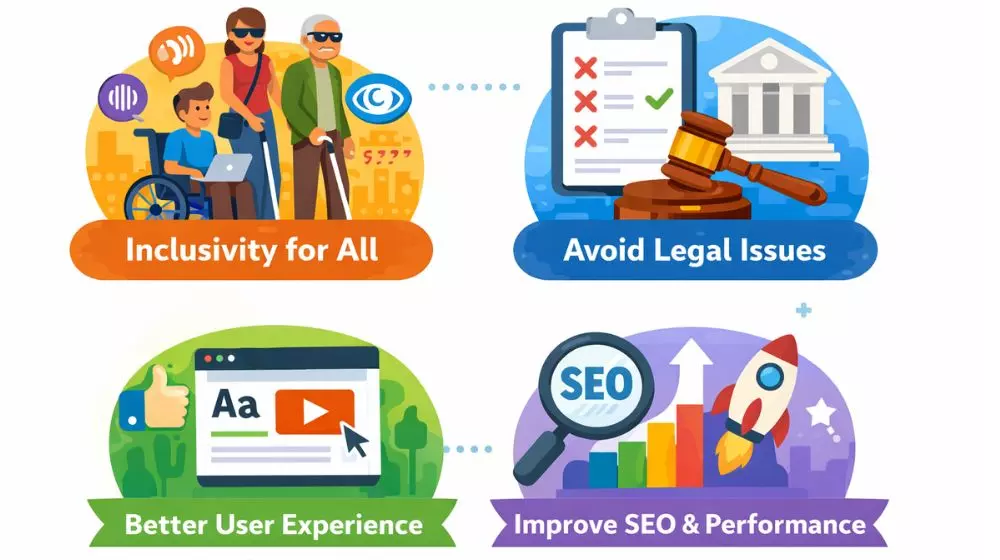
Using an Accessibility Checker for Website means that you are essentially enhancing the experience of your online content for people.
This means that it also caters to people with low vision, hearing impairments, limited mobility, and various cognitive abilities.
By resolving the problems that an accessibility audit identifies, you will be making your site more accessible to people with different abilities.
It would also be easier to understand and more enjoyable to use, no matter whether one is using a phone, a laptop, or a device for assistance.
Most of the time, making a site more accessible is also making it technically better. So, these changes can additionally give your site an SEO push.
For instance, when you give precise explanations to the pictures, it does not only mean that people using screen readers are the ones that get a better experience, the web crawlers that index your site also find your content more understandable.
This can in turn lead to higher rankings in the search results.
Stay Ahead of Legal and Compliance Risks
Digital accessibility is more than just the right thing to do; it is increasingly becoming a legal requirement in many parts of the world.
Governments and regulatory bodies in the U.S., Europe, and some other parts of the world are setting that websites comply with the recognized standards of accessibility like WCAG.
Failure to comply has resulted in actual lawsuits from organizations that have not taken accessibility seriously.
When you use a Website Accessibility Checker, it benefits not only you but also your business.
Carrying out periodic scans and fixing errors while they are still small effectively cuts down on the risk of litigation and shows your commitment to taking responsibility without being asked For most companies, particularly those whose operations extend beyond the borders of one country, this has become an indispensable element of their online strategy.
Save Time and Resources with Effective Tools
In the past, accessibility testing was mostly a very manual activity for experts, and those checks are still important. However, technology has improved drastically.
Most of the accessibility testing tools that are freely available nowadays allow you to instantly perform an automated scan that identifies the typical obstacles on your site.
Such tests can be the initial filtering before you get into thorough testing or manual reviews.
Browser extensions or web scanners identify the areas of your website that are not compliant with WCAG standards and give you clear guidance on how to fix these issues.
Additionally, some of them can generate reports that you can share with your team to improve planning and collaboration.
Read: Why Mobile App Development is Key to Business Growth?
Make Accessibility a Habit, Not an Afterthought
One of the most common mistakes websites make is to consider accessibility as a single task only. Accessibility is not a thing you handle once and forget.
Content updates, redesign, and publishing new pages can periodically create barriers. An accessibility tool used regularly will keep you informed of issues that emerge. Gradually, this will be considered as a part of good digital maintenance practice.
When your team starts with the idea of accessibility for every project at first from layout to content writing you naturally make a user, friendly site architecture that serves everyone.
Bringing It All Together in 2026
Accessibility is now one of the key aspects of excellent web design and responsible digital communication in 2026.
Regardless of whether you are managing a small business, a nonprofit, or a global platform, one of the best things you can do is to use an
Accessibility Checker for Website not only for inclusiveness but also for performance, reputation, and sustainable success. Its hardly news to most of us that we should be making our websites more accessible