Top Orthopedic Instruments Manufacturer in India for Precision Surgery
A reduction clamp that slips or a rongeur that has lost its bite can turn a planned procedure into an avoidable delay.
Hospitals should evaluate Orthopedic Instruments as clinical assets, not catalogue items. Precision Orthopedic Instruments Manufacturers must be judged on evidence, not polished sales language.
WHO’s Surgical Safety Checklist contains 19 items and has been linked with reductions of more than 30% in complications and mortality, proving that small control points can materially affect surgical safety.
Most buyers know instruments must be “surgical grade.” Few ask what that means on the supplied item. And yet, precision surgery depends on repeatable grip, stable cutting geometry, proper balance, and predictable performance after reprocessing.
What Precision Orthopedic Instruments Must Prove
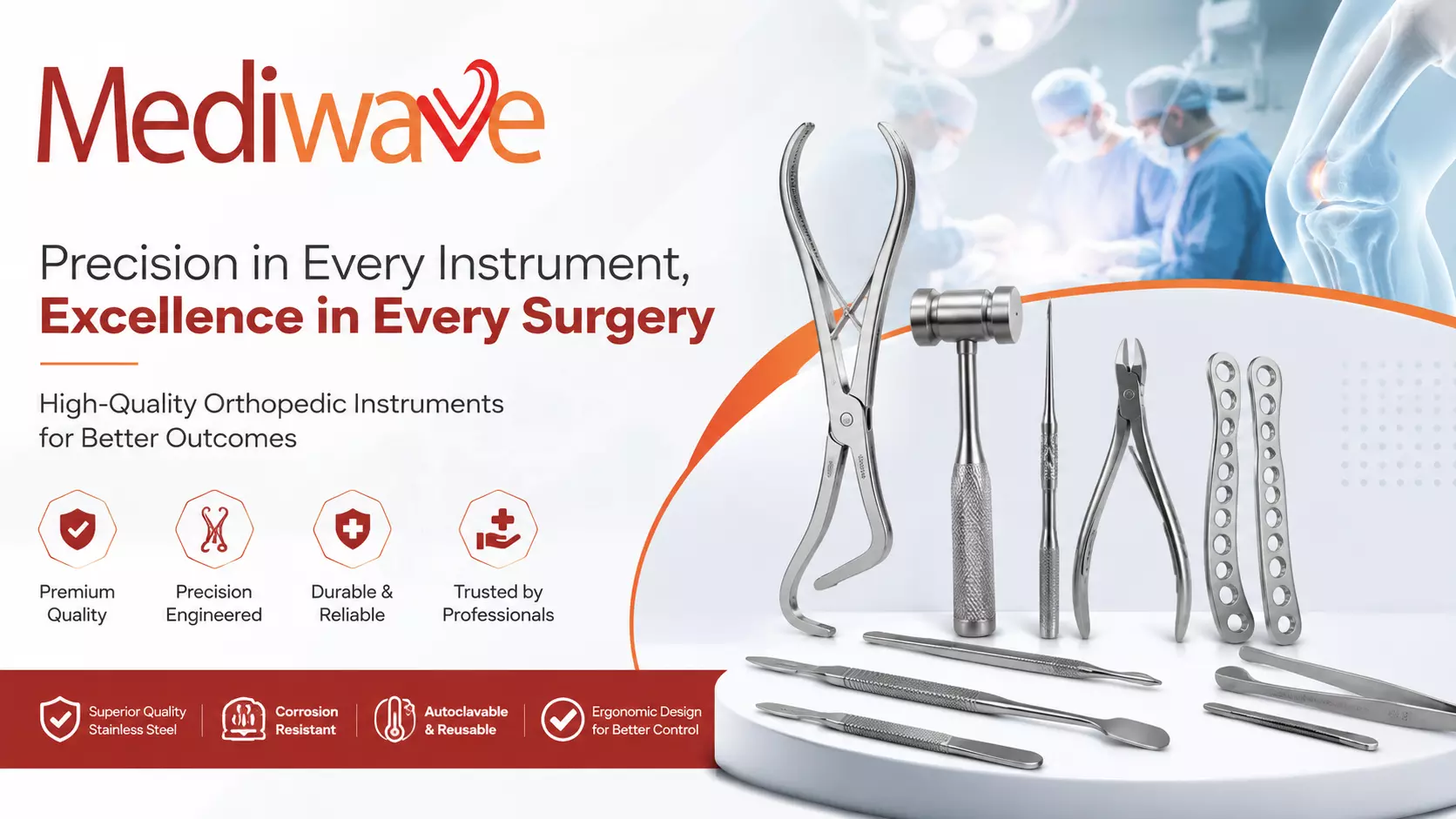
Mediwave’s published range covers six groups: bone cutting, bone holding, bone drilling, curettes and files, retractors and elevators, and trauma and spine instruments.
Its specifications list medical-grade stainless steel, three finish options, corrosion resistance, autoclave compatibility, reusability, and strength for bone handling.
Cutting, Holding, Drilling, and Exposure Tools
Cutters and rongeurs need controlled edges. Holding instruments require aligned jaws and stable grip. Drilling tools need accurate engagement, while retractors and elevators must provide exposure without awkward hand pressure.
Here’s the overlooked detail: surface finish affects more than appearance. Rough transitions, scratches, and inaccessible joints make cleaning harder. FDA guidance notes that complex reusable devices can be difficult to reprocess and requires usable, validated instructions.
The Spec Detail Most Buyers Skip
Ask for the exact instrument list, sizes, finish, sterilization method, and pack configuration. “Standard orthopedic set” is not a specification. It often hides substitutions or missing sizes that appear only during tray preparation.
Five Supplier Tests That Expose Weak Quotations
1. Material and Finish Evidence
A good answer identifies material, finish, corrosion control, and inspection method. “Hospital quality” without documents or samples is a bad answer.
2. Functional Inspection
Ask how jaw alignment, ratchet engagement, cutting action, joint movement, and surface defects are checked. “Visually inspected” means little without acceptance criteria.
3. Reprocessing Information
Request cleaning, inspection, lubrication, packaging, and sterilization instructions. FDA guidance lists six criteria reusable-device instructions should address; “autoclave safe” on a quotation is not enough.
4. Certificate Scope and Validity
Mediwave’s site displays ISO 13485:2016, ISO 9001:2015, Good Manufacturing Practices, and a Certificate of Compliance. Buyers should still request current copies, scope, issuer, and validity. A supplier who shares certificates only after payment is creating risk.
5. Defect and Replacement Handling
A credible quotation explains shortages, transit damage, defects, and replacements. “Case by case” is not a policy; it is a negotiation waiting to happen after delivery.
Read: Which Surgical Instruments Manufacturers in Lahore Offer
Where Better Instruments Protect Clinical Budgets
Fewer Procedure Interruptions
Consistent grip, alignment, and edge condition reduce emergency substitutions. In the original eight-hospital checklist study, complications fell from 11.0% to 7.0%, while deaths fell from 1.5% to 0.8%.
Longer Useful Service Life
Corrosion-resistant material, smooth joints, and correct maintenance reduce premature replacement.
Faster Tray Preparation
Standardized sets help CSSD and operating-room teams identify missing tools. Mediwave’s six-category structure also makes requirement lists easier to verify.
Lower Reprocessing Risk
Smooth surfaces and accessible joints support cleaning. Nobody tells you the hardest instrument to sterilize is often the one with a crevice, damaged surface, or stiff box lock.
Better Surgeon Control
Balanced handles and predictable working ends reduce unnecessary hand correction during cutting, reduction, drilling, curettage, and retraction.
Stronger Procurement Control
Clear specifications make comparison fair. Buying the cheapest mixed set without checking sizes and patterns is lazy procurement, and hospitals pay through repeat purchases and delayed cases.
Orthopedic Instrument Supply Across India
Mediwave operates from A-74, New Dashmesh Nagar, Jalandhar–144003, Punjab, and its site covers 10 major product categories, including orthopedic, surgical, dental, ENT, neurosurgery, urology, and trays.
Hospitals comparing Orthopedic Instruments Manufacturers in India should treat location as a supply-chain factor because freight and replacement movement affect availability.
Orthopedic Instruments Suppliers in India should also be judged on packing, documents, dispatch planning, and multi-category consolidation. And yet, a nearby Precision Orthopedic Instruments Manufacturer is not automatically safer; documented consistency comes first.
How We Reduce Multi-Category Sourcing Work
We have served healthcare buyers since 2017 under Mediwave–Jamba Enterprises, with our orthopedic range organised into six procurement groups.
We also support multiple surgical and medical categories, reducing the number of vendors involved in institutional purchasing.
Here’s what experience teaches us: a tray can look complete on a purchase order and still fail during preparation because one retractor size or reduction clamp was never confirmed.
We ask for the surgeon-approved list, quantity, finish, sterilization requirement, and packing preference before finalising the offer. Our Mediwave Orthopedic Instruments range is structured for repeat use and easier category-wise buying.
Send Us the List We Can Quote Correctly
Send us the instrument names, sizes, quantities, set composition, finish, delivery city, certificate needs, and packing instructions.
We publish a 24/7 contact number for immediate discussion. Our MOQ is not one fixed number because it varies by instrument, set, and packing requirement; we confirm it after reviewing the SKU list. We also ask for photographs or reference codes where patterns could be confused.
Buy for the Next Sterilization Cycle
Selecting Orthopedic Instruments requires more discipline than comparing unit prices. Material, inspection, reprocessing information, certificate scope, and defect handling should be settled before the purchase order.
Mediwave already structures its orthopedic range into six groups; future procurement will favour suppliers that prove consistency across every set.
FAQs
1. What are some of the common Orthopedic Instruments used for Precision Surgery?
Some examples would be cutting, clamping, drilling, curettes, files, retractors, elevators, and trauma or spine instruments. The actual selection of instruments will have to come from the surgeon's approved procedure list.
2. Why do hospitals need to examine Precision Orthopedic Instruments Manufacturers?
There is always a possibility that there may be small discrepancies with the alignment, gripping action, range of motion, and cutting edge.
3. In what way does the Mediwave Orthopedic Instruments differ from the mix of the traders?
The range of products listed is divided into six categories of orthopedic instruments. Note: buyers have to check all the SKUs, sizes, finishes, and the scope of certificates anyway.
4. How do I compare the Orthopedic Instruments Manufacturers in India?
Before comparing prices, compare the materials, finish of the working ends, inspection, sterilization process instructions, validity of the certificates, packaging, dispatch plans, and conditions for replacements.
5. Do the Orthopedic Instruments Suppliers in India make custom sets?
Yes, some do; for instance, Mediwave confirms that they provide customization. Custom sets are usually supplied based on confirmed patterns and quantities.