Top Benefits of Using Spherical Roller Bearings in Modern Manufacturing Industries
A production manager at a components plant once asked us why his line kept losing two shifts a month to bearing changeouts — not failures, just routine swaps that somehow always landed mid-run instead of during scheduled maintenance.
Turned out the plant was running standard ball bearings on assemblies that were seeing real axial load, and nobody had ever priced out what switching to Spherical Roller Bearings would actually save. Manufacturing doesn't reward the cheapest component. It rewards the one that survives long enough to stop being a line item you think about every week.
Specification — What Manufacturing Lines Actually Need From a Bearing
Modern manufacturing assemblies rarely run in one clean direction of load. Gearboxes vibrate, shafts flex, and alignment drifts a little the moment the machine's been running a few thousand hours.
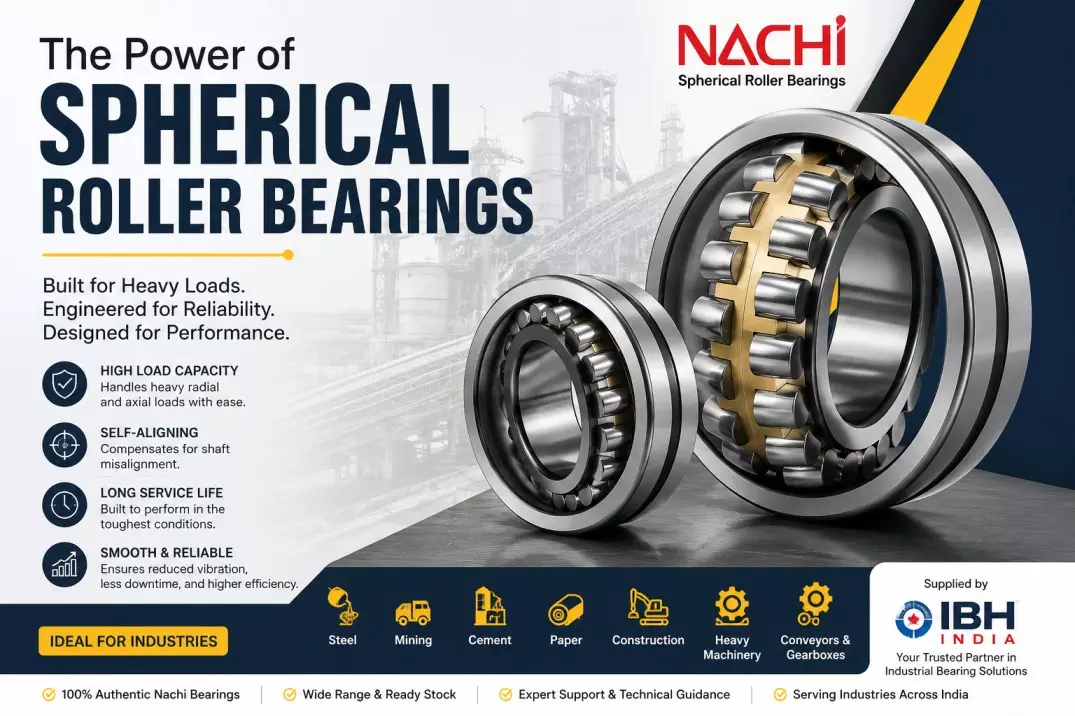
A spherical roller bearing's dual-row barrel design, riding on a shared spherical raceway, is built exactly for that — it carries radial and axial load together and keeps working even when the shaft isn't perfectly true anymore.
Series Range for Manufacturing Applications
Nachi's spherical roller line spans the 213, 222, 223, 230, 231, 232, and 240 series, which covers most bore sizes manufacturing plants actually order — anywhere from small conveyor drives up to heavy press and mill assemblies.
The Detail Manufacturing Buyers Skip Most
Radial internal clearance, again — it comes up in almost every conversation we have with a new manufacturing client. Standard CN or C3 clearance suits most ambient-temperature lines.
But plants running hot processes, or mounting bearings with an interference fit, usually need C4. Skip that check and the bearing runs pre-loaded before it's even broken in, which quietly shortens its life in a way that never shows up until the failure does.
Cage and Sealing Choices for Production Environments
Pressed steel cages work fine for standard-duty lines. Higher-speed or shock-load assemblies do better with machined brass cages. And sealed variants matter a lot more than manufacturing buyers usually assume — dust and metal fines from machining operations get into open bearings faster than most people expect.
Objective — 5 Criteria for Evaluating a Manufacturing Bearing Supplier
Benefits on a spec sheet mean nothing if the supplier behind them can't deliver consistently. Here's what actually separates a supplier worth keeping from one that'll cost you a production stoppage:
- Manufacturer traceability. A supplier who can produce batch numbers and a certificate tied directly to Nachi is doing it right. "We source from a network of channels" is a dodge dressed up as an answer.
- A written defect policy. Timelines and replacement terms on paper beat "we'll handle it case by case" — that phrase isn't flexibility, it's a fight you'll have after your line's already stopped.
- Application-first quoting. Good suppliers ask about load type, shaft speed, and contamination before pricing. Bad ones quote off a bare part number and call it service.
- Real stock, confirmed for your size. Not a catalogue PDF. Ask them to confirm what's actually sitting in the warehouse for your specific bore size before you place the order.
- Straight answers about counterfeit risk. Suppliers who explain etching, seals, and dealer certification without being pushed clearly aren't worried about the question. Ones who get cagey usually have a reason.
Read: Engine Rebuilding Service in the UK: Complete Guide to Cost
Benefits — Why Manufacturing Plants Are Switching to Spherical Roller Bearings
Downtime drops first, and it drops the most. A bearing correctly matched to its clearance class and load direction runs its full fatigue life instead of failing early from preload or contamination — which means fewer surprise changeouts pulling a shift off schedule.
Then there's the cost side, which most plants underestimate until someone runs the numbers properly. A bearing priced ₹1,500 lower that fails in five months isn't actually cheaper — measure it per operating hour instead of per invoice, and the pricier bearing usually wins that comparison without much of a fight.
Misalignment tolerance matters more on a production line than people assume, too — spherical roller bearings handle roughly 2–3° of shaft misalignment, which covers the small drift that happens on every long shaft run once a machine's been in service a while.
A few more benefits worth naming directly: combined radial and axial capacity in a single component, which simplifies stocking across a plant running multiple assembly types; a documented paper trail if something does fail, assuming the
supplier could actually trace the batch; and failure patterns that follow a predictable curve instead of showing up at random, which is what actually lets a maintenance team plan instead of react.
Availability — Getting Spherical Roller Bearings to Manufacturing Plants Across India
Manufacturing runs on schedules, and a supplier's location decides whether you hit yours or scramble around it. We're based in Delhi NCR, which keeps us on solid logistics routes into the manufacturing belt around the capital region, the steel corridor further east, and cement and heavy engineering clusters across the north and west.
Here's something worth saying plainly: plants further from NCR — deep in the paper belt, or manufacturing hubs in the south — should add a day or two onto whatever a courier tracking page promises.
Bearing housings for manufacturing assemblies move on freight, not parcel logistics, and plants that plan procurement around the optimistic delivery estimate are the ones improvising with the wrong interim part when the real shipment runs late.
We operate as an authorized Nachi Spherical Roller Bearings supplier and distributor with dispatch reach across India — built for repeat manufacturing orders, not one-off catalogue browsing.
About Us
We're IBH Bearings, working as an authorized Nachi distributor across ball, cylindrical roller, tapered roller, spherical roller, and plummer block housing lines.
We started asking detailed questions before quoting because we kept seeing the same manufacturing complaint land back on our desk — a bearing that matched every number on the spec sheet, still failing early, because nobody had checked whether the clearance class actually suited the line's operating conditions.
So now we ask. Shaft speed, load direction, ambient temperature, contamination exposure — before we quote, not after a plant's already dealing with a failure.
We've also noticed something over the years working manufacturing accounts: the plants that treat bearing selection as an engineering question, not a procurement one, are the ones that stop calling us about the same problem twice.
Call to Action
Send us the bearing size or part number, the assembly it's going into — machine type, shaft speed, operating environment — and how many units you need. We'll confirm pricing and stock availability within one business day.
No minimum order on standard catalogue sizes; bulk pricing applies above 10 units per SKU. Reach IBH Bearings Pvt. Ltd. at +91-11-40110440, email [email protected], or send your enquiry through ibhindia.in.
Conclusion
The real benefit of Spherical Roller Bearings in manufacturing isn't the load rating on the spec sheet — it's what stops happening once the right bearing is in place. Fewer surprise changeouts.
Fewer arguments about whose fault a failure was. A maintenance schedule that actually holds. Plants that get this right stop thinking about bearings altogether, which, honestly, is the entire point.
FAQs
hat's the main benefit of Spherical Roller Bearings over standard bearings in manufacturing lines?
They carry radial and axial load together while tolerating shaft misalignment that would wear out a standard bearing fast — which matters because most manufacturing assemblies see some misalignment eventually, no matter how carefully they were installed.
How do I compare Nachi Spherical Roller Bearings suppliers in India for a manufacturing account with repeat orders?
Check for manufacturer batch traceability and a written defect policy before anything else. A supplier who's vague on either of those isn't built for a repeat relationship, whatever their first quote looks like.
Do Nachi Spherical Roller Bearings distributors and dealers in India offer the same technical support?
Not always — the terms get used loosely, so ask directly rather than assume. What matters is whether they're actually asking about your application before quoting, not what they've labeled themselves.
Can Spherical Roller Bearings reduce unplanned downtime in a manufacturing plant, or is that overstated?
It's real, but only if the bearing's correctly specified for clearance and sealing in the first place. A mismatched bearing will still fail early no matter how good the underlying design is — that part doesn't fix itself.
What lead time should manufacturing plants expect from Nachi Spherical Roller Bearings dealers in India?
24 to 48 hours for sizes we hold in ready stock. Less common bore sizes take longer, and we'd rather flag that upfront than promise a date we might miss on a production-critical order.