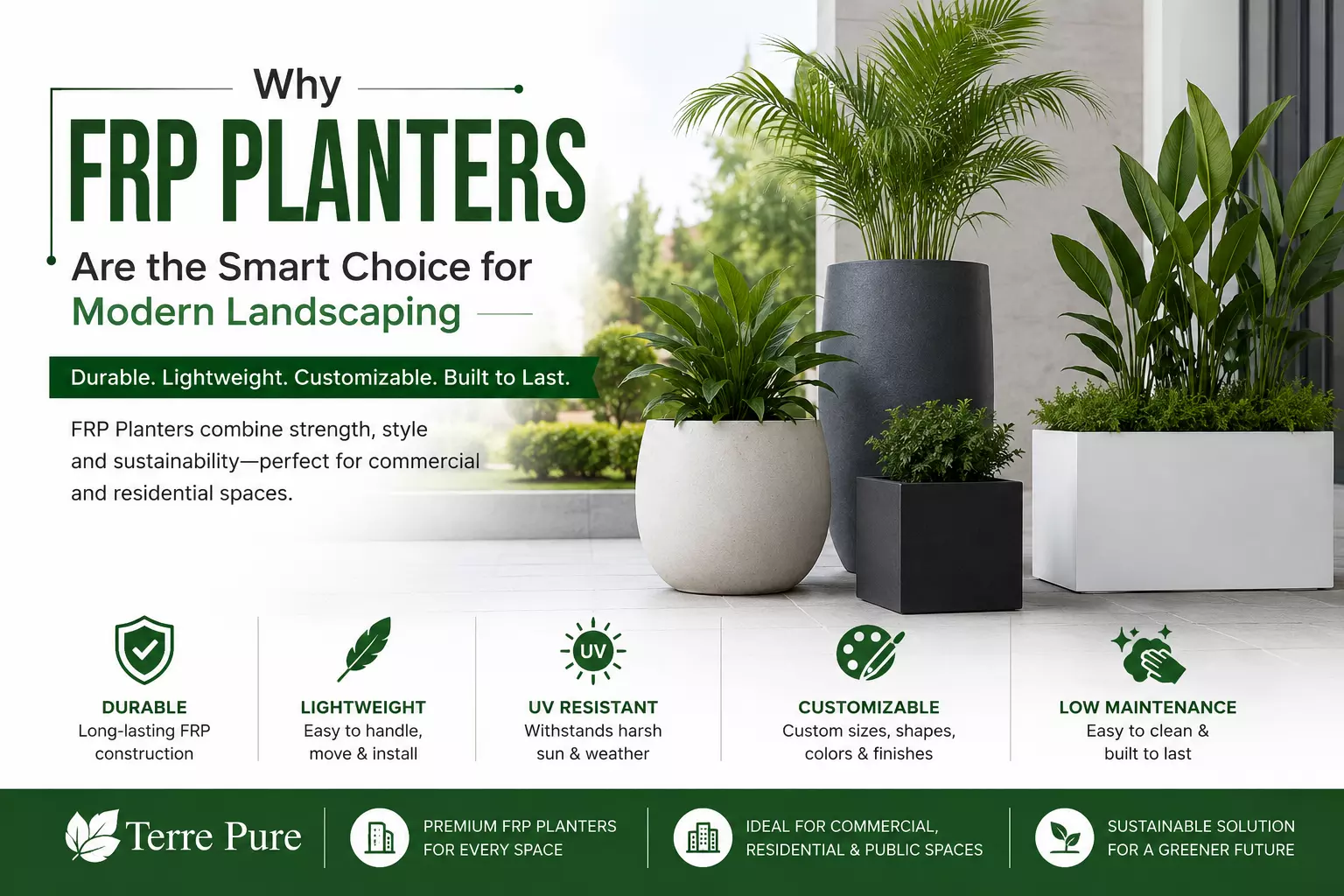
Top Benefits of Using FRP Planters for Residential and Commercial Projects
My favorite story comes from a Pune-based landscaping contractor, who told us he gave up using concrete planters completely: of five his company shipped, three cracked on the way to the job site and two more split after a single monsoon.
It‘s stories like these that get consumers to switch to FRP planters (fiberglass reinforced plastic, that outlasts concrete, terracotta, and cheap plastic).
When you are choosing planters for a hotel, a corporate campus, fifty balconies in a housing project it‘s the material that determines whether you solve the problem once or order again in two years.
The Spec Detail Most Buyers Skip
Wall Thickness and Resin Ratio
The majority of buyers inquire regarding size, color and cost. Very few inquire about wall thickness or the ratio between resin-to-fiberglass and that‘s exactly what cheap FRP planters lack. A 3mm wall FRP planter and a 5mm wall FRP planter may appear to look the same in a photograph. Only one can withstand the test of a five year outdoor environment.
Gel Coat and UV Stabilization
Not every FRP planter gets UV-stabilized gel coat. Skip that step and colors fade within 8 to 10 months under direct sun — not the two or three years buyers assume. We test every batch against 1,000 hours of accelerated UV exposure before it ships.
Available Formats
FRP planters at Terre Pure come in round, square, cylindrical, tapered, and fully custom mold formats, ranging from 300mm tabletop units to 1800mm commercial-grade planters for plazas and building exteriors.
The Five Questions That Actually Separate Good Suppliers From Bad Ones
Anyone can claim quality. Here's what to check before a purchase order gets signed.
- Do they show batch-wise UV and load-test data? A bad answer sounds like "our planters are tested for durability." A good answer names the standard, the hours, and the load in kilograms.
- What's their tooling and mold ownership policy? Bad: "we'll figure that out after the order." Good: a documented mold fee, amortization schedule, and ownership terms in writing before production starts.
- How do they handle color-matching across large orders? Bad: "close enough, don't worry." Good: a Pantone or RAL reference sample approved before the full batch runs.
- What's their actual export documentation experience? Bad: vague reassurance. Good: named ports, average transit windows, and the correct HS code for FRP planters.
- What happens when a shipment arrives damaged? A supplier who says "we'll handle defects case by case" doesn't have a policy. That's a negotiation you'll lose after the container is already unloaded and the site manager is asking questions.
Why FRP Planters Protect Margins, Not Just Aesthetics
- Weight savings cut freight cost. FRP planters weigh roughly one-fifth of equivalent concrete units, which means more pieces per container and lower per-unit shipping cost.
- Zero rebar, zero rust stains. Concrete planters with embedded rebar eventually show rust bleed through the surface. FRP has no metal core to corrode.
- Mold-injected consistency cuts install-site rejects. Every unit from the same mold matches — no sorting through mismatched pieces on site.
- UV-stable gel coat protects resale and re-lease value. Property managers care how planters look in year three, not just at handover.
- Custom branding survives pressure washing. Logos, colors, and finishes get built into the mold rather than painted on afterward.
- Faster lead times than stone or precast concrete. Molds get reused within days, not the weeks a custom concrete cast requires.
Read: Modern Planter Trends for Homes, Gardens, and Commercial
Why Location Is a Supply Chain Decision, Not Just an Address
Terre Pure manufactures FRP planters in India, and that matters more than most buyers think when comparing quotes.
Domestic sourcing from an Indian FRP planters manufacturer cuts shipping time for projects across the country to days, not the six-to-eight-week ocean freight window from overseas suppliers.
For export buyers, India's port access through Nhava Sheva and Mundra keeps container costs predictable across most Middle East, European, and Southeast Asian routes. Working with FRP planters suppliers in India also means faster mold revisions.
A design change that takes three weeks with an overseas factory can take four or five days here, because the tooling team is a phone call away, not a fourteen-hour time difference away.
About Terre Pure
We've been manufacturing FRP planters since 2013, and that's not a tagline — it's on our incorporation papers. We stopped using a particular polyester resin blend in 2021 after three separate buyers flagged fading in high-UV Gulf markets within a year of installation. We switched suppliers, rebuilt our gel coat formula, and re-tested before offering it again.
That's what a decade of export feedback actually looks like. Today we manufacture for OEM partners, wholesale distributors, and commercial landscaping firms, and we ship to 31 countries from our facility.
Get a Quote From Terre Pure
Send us your planter dimensions, quantity, and finish preference, and we'll respond within 24 hours with pricing and lead time. Our minimum order quantity starts at 50 units for standard molds; custom tooling projects are quoted separately.
Share your requirement sheet or drawing with our team through frpplanters.com, and mention whether you need UV-stabilized gel coat — it changes both price and production time.
Conclusion
FRP planters solve a problem concrete, terracotta, and basic plastic can't: they hold their shape, color, and structural integrity across years of outdoor exposure without the weight or the fragility. Buyers who compare only price end up reordering. Buyers who ask about resin ratio, UV testing, and mold ownership end up with planters still standing in year five.
FAQs
1. How do FRP planters differ from the fiberglass planters sold loosely online?
Resin ratio and wall thickness. Generic fiberglass planters will often use the minimum resin necessary to save money, resulting in a thinner wall built to decompose faster in the sun. FRP planters made for cast production that are tested in a line closely resemble the same object in a photograph.
2. Will FRP planters be able to withstand heavy soil loads and not crack?
Yes, if you are within the design size. An 1800mm commercial planter can be several hundred kg when filled with wet soil and a ‘planted’ tree we don‘t pretend every mold can take that sort of weight without load-bearing ribbing, but you can bet will build load-supporting ribs into large-format molds for that purpose!
3. Do FRP Planters Suppliers in India offer custom colors and branding?
Most FRP planters suppliers in India like us offer RAL or Pantone coloring as well as mold integrated branding for hospitality and retail clients. Painted on branding wears off with pressure wash; molded branding does not.
4. How long a lead time is normal?
A normal mold order is shipped in 15 to 20 days depending on the quantity. Customized mold creation takes an additional 3 to 4 weeks initially, as tooling needs to be built and sample-approval has to be done. We will not quote a shorter lead time just to get the sale.
5. Can FRP plant containers be used in the ocean front and other regions with high-humidity?
Yes. There is no rebar in the FRP plant container compared to the metal-inforced suppliers which will corrode in the salt air. However, the quality of the gel coat is a deciding factor in the salt air climates, thus inquire about the manufacturer‘s UV and salt spray testing before moving forward.