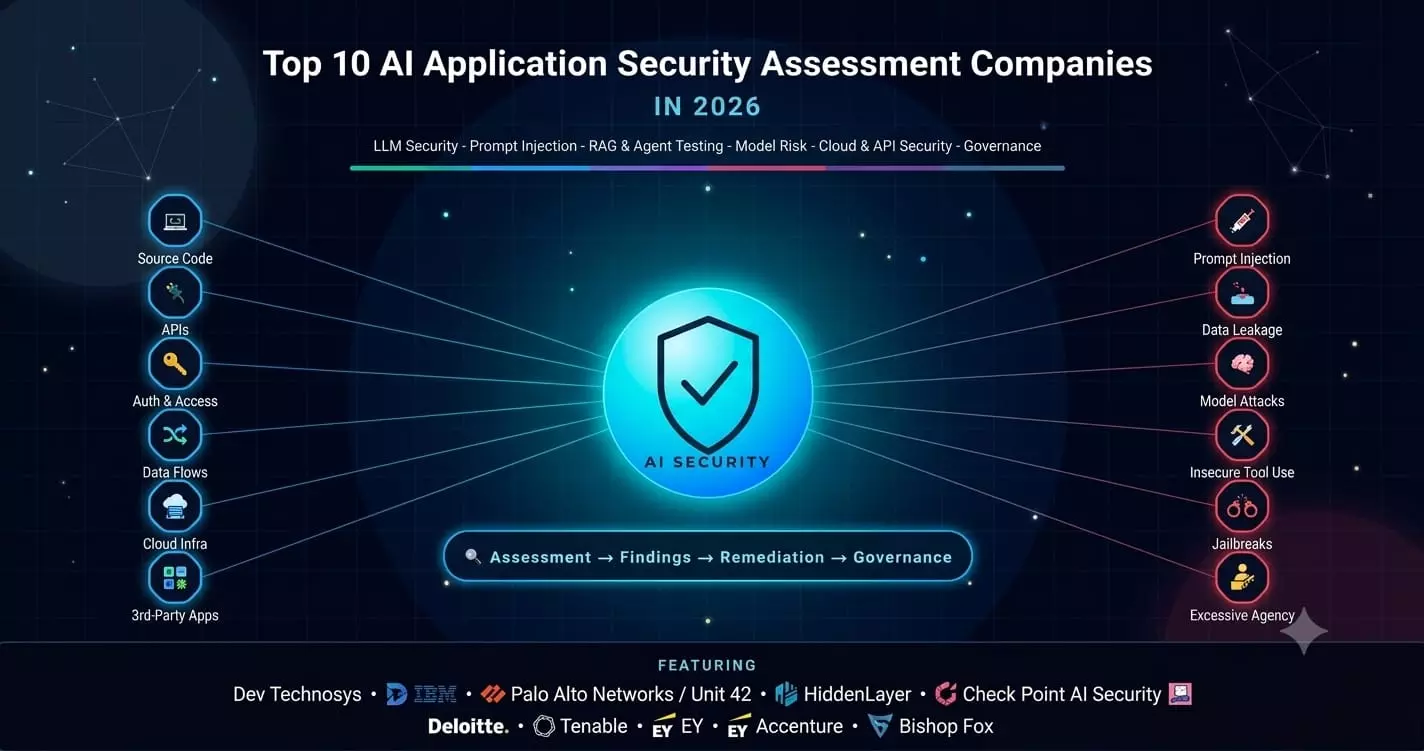
Top 10 AI Application Security Assessment Companies in 2026
Artificial intelligence applications are becoming part of customer service, healthcare, finance, education, enterprise operations, and software products.
As AI systems become more connected to sensitive data, APIs, business applications, and autonomous workflows, traditional application security practices alone may not cover every new risk.
AI application security assessment helps organizations identify weaknesses across AI models, applications, APIs, data flows, authentication, cloud infrastructure, third-party integrations, RAG pipelines, and AI agents.
Security teams may also need to evaluate AI-specific threats such as prompt injection, sensitive data exposure, insecure tool use, model manipulation, excessive agency, jailbreaks, and weaknesses in AI supply chains.
This article highlights 10 AI application security assessment companies to consider in 2026. The list is intended as a practical starting point rather than an objective industry ranking.
What Is an AI Application Security Assessment?
An AI application security assessment is a structured evaluation of an AI-powered application's security posture.
Unlike conventional application testing, an AI assessment may examine both the traditional software layer and AI-specific components.
Depending on the project, an assessment may cover:
- AI applications
- Large language models
- Machine learning models
- AI APIs
- RAG pipelines
- AI agents
- Prompt and instruction handling
- Authentication and authorization
- Data flows
- Cloud infrastructure
- Third-party AI services
- Model endpoints
- Vector databases
- Tool integrations
- Application APIs
- Security controls
- AI governance
The objective is to identify vulnerabilities, understand their potential impact, and provide practical recommendations for improving the security of the AI system.
Top 10 AI Application Security Assessment Companies to Consider in 2026
1. Dev Technosys
Dev Technosys provides dedicated AI Application Security Assessment services designed to evaluate the security of AI-powered applications and their supporting infrastructure.
Its assessment approach covers application code, APIs, authentication, data flows, AI models, third-party integrations, and infrastructure. The company also describes security testing for applications using LLMs, machine learning models, RAG pipelines, AI agents, and AI APIs.
The assessment can help organizations identify risks such as sensitive data exposure, prompt injection, insecure access controls, API vulnerabilities, and weaknesses in AI integrations.
Key capabilities
- AI application security assessment
- LLM security assessment
- AI API security testing
- AI vulnerability assessment
- RAG security assessment
- AI agent security testing
- Authentication and authorization testing
- Data-flow security assessment
- Cloud security assessment
- Third-party integration assessment
- Security risk prioritization
- Remediation guidance
Dev Technosys can be considered by businesses looking for a customized assessment of an AI application and its surrounding technology stack.
2. IBM
IBM provides security services for AI transformation covering security assessment and governance, secure posture management, secure integration, and security testing.
IBM's AI security approach addresses enterprise AI environments rather than focusing only on an individual model. Its services can be relevant for organizations that need to assess AI applications, data, infrastructure, governance, and security controls.
IBM and Palo Alto Networks also introduced a Rapid AI Security Assessment in 2026 designed to discover, assess, and prioritize AI security risks across cloud environments.
Key capabilities
- AI security assessment
- AI security governance
- Security posture management
- AI security testing
- Cloud security
- Data security
- AI infrastructure assessment
- AI risk management
- Security monitoring
- Enterprise security integration
IBM may be suitable for larger organizations looking for AI security assessment alongside broader cybersecurity and cloud-security programs.
3. Palo Alto Networks / Unit 42
Palo Alto Networks' Unit 42 provides a dedicated AI Security Assessment for organizations using, developing, and deploying AI systems.
Its assessment can examine AI applications, models, data flows, identities, third-party services, and governance controls.
The service also includes evaluation of AI development infrastructure, runtime security, threat modeling, and security governance.
Key capabilities
- AI security assessment
- AI application security
- AI threat modeling
- AI runtime security
- AI infrastructure assessment
- Data-flow analysis
- Identity and access assessment
- Third-party service assessment
- AI governance
- Threat-informed security recommendations
Unit 42 can be considered when an organization needs AI security assessment combined with broader threat intelligence and cybersecurity expertise.
4. HiddenLayer
HiddenLayer specializes in AI security and provides professional services for organizations building or deploying advanced AI systems.
Its professional services include AI red teaming and AI risk assessments. The company's AI risk assessment approach examines exposure across AI ecosystems, including data pipelines, model lineage, and the AI supply chain.
HiddenLayer also provides model scanning designed to identify vulnerabilities, malware, backdoors, and integrity issues in AI models.
Key capabilities
- AI risk assessment
- AI red teaming
- AI application testing
- Model security
- AI supply-chain security
- Model scanning
- Vulnerability assessment
- Malware detection
- Model integrity analysis
- AI security training
HiddenLayer can be particularly relevant for organizations concerned about model security and AI supply-chain risks in addition to application-level vulnerabilities.
5. Check Point AI Security
Check Point AI Security, which incorporates Lakera's AI security technology, provides AI agent security and AI red teaming capabilities.
Its AI red teaming platform is designed to assess GenAI applications and identify vulnerabilities through adversarial testing.
Assessments can examine risks including prompt attacks, data leakage, instruction override, context extraction, indirect poisoning, and vulnerabilities involving complex agentic systems.
Key capabilities
- AI red teaming
- AI security assessment
- AI agent security
- GenAI application testing
- Prompt-injection testing
- Data-leakage testing
- Agent security assessment
- Risk scoring
- Vulnerability reporting
- Remediation guidance
Check Point AI Security can be considered by organizations that want automated and expert-led AI security testing for applications and agents.
6. Deloitte
Deloitte provides cybersecurity and AI security services covering application security, DevSecOps, identity and access management, data protection, and AI infrastructure and cloud security.
Its AI application-security approach incorporates security controls into the software development lifecycle.
Deloitte also works across AI governance, data protection, cybersecurity, and enterprise security environments.
Key capabilities
- AI application security
- Secure software development
- AI-aware DevSecOps
- AI infrastructure security
- Cloud security
- Identity and access management
- AI governance
- Data protection
- Security automation
- AI security controls
Deloitte may be appropriate for enterprises that want AI application security assessment integrated with a broader cybersecurity transformation program.
7. Tenable
Tenable provides AI security capabilities through its broader exposure-management platform.
Tenable AI Aware can identify AI software, libraries, browser plugins, and AI-related vulnerabilities across an organization's environment. It also supports assessment of AI-related exposure in applications and infrastructure.
Its AI security capabilities extend to AI workloads, models, services, identities, cloud environments, and supporting infrastructure.
Key capabilities
- AI exposure assessment
- AI vulnerability detection
- AI asset discovery
- AI application assessment
- AI software discovery
- Cloud AI security
- AI-SPM
- Exposure management
- Vulnerability prioritization
- AI risk visibility
Tenable can be considered by organizations that want AI security assessment integrated with an existing vulnerability and exposure-management program.
Read: What Are AI Development Services and Why Do Businesses
8. EY
EY provides dedicated AI security and AI risk-management services.
Its Enterprise 360° AI Security offering includes AI security assessment, AI security testing, AI threat modeling, governance, regulatory compliance review, and managed AI security services.
EY's assessment approach can examine AI inventory, architecture, supporting infrastructure, identity and access controls, applications, LLMs, APIs, and model-specific risks.
Key capabilities
- AI security assessment
- AI security testing
- AI threat modeling
- AI risk assessment
- LLM security testing
- AI architecture review
- AI governance
- Regulatory compliance
- Identity and access assessment
- AI red teaming
- Managed AI security
EY can be relevant for enterprises that need AI security assessment alongside governance, compliance, risk management, and regulatory requirements.
9. Accenture
Accenture provides secure AI and agentic AI services covering governance, AI environments, threat defense, cybersecurity testing, and AI security.
Its approach focuses on embedding security and trust into AI programs across the lifecycle.
Accenture also describes security testing and red-team capabilities for AI environments, making it relevant to organizations deploying generative AI, AI agents, and enterprise AI applications.
Key capabilities
- Secure AI development
- AI security assessments
- AI governance
- AI threat defense
- AI security architecture
- AI red teaming
- Generative AI security
- Agentic AI security
- Data and model protection
- Cybersecurity testing
Accenture can be considered by organizations that need AI security services as part of a large-scale digital transformation or enterprise AI program.
10. Bishop Fox
Bishop Fox provides specialized AI and LLM security testing and penetration-testing services.
Its AI/LLM security assessments are designed to test user interactions, guardrails, model behavior, data, infrastructure, and AI-specific attack surfaces.
The company's AI security testing approach can address traditional application vulnerabilities alongside AI-specific weaknesses.
Key capabilities
- AI security assessments
- LLM security testing
- AI penetration testing
- AI red teaming
- Application penetration testing
- Guardrail testing
- Model behavior testing
- Prompt-injection testing
- AI infrastructure testing
- AI attack-surface analysis
Bishop Fox can be useful for organizations looking for specialized offensive security testing of AI applications and LLM-based systems.
What Does an AI Application Security Assessment Cover?
The exact scope depends on the application's architecture, but a comprehensive assessment can include several areas.
1. Application Security
Traditional application-security testing remains important.
Security teams may evaluate:
- Application logic
- Authentication
- Authorization
- Session management
- API security
- Input validation
- Access controls
- Dependency vulnerabilities
- Configuration issues
AI features do not eliminate conventional application vulnerabilities.
2. LLM Security
Large language models introduce additional security considerations.
Testing may examine:
- Prompt injection
- System-prompt exposure
- Jailbreaks
- Sensitive information disclosure
- Unsafe output handling
- Model manipulation
- Inappropriate tool usage
- Data leakage
3. RAG Security
Retrieval-Augmented Generation systems introduce additional attack surfaces.
An assessment may examine:
- Document access controls
- Retrieval permissions
- Vector database security
- Data poisoning
- Unauthorized retrieval
- Cross-user data exposure
- Prompt injection through retrieved content
- Document ingestion pipelines
4. AI Agent Security
AI agents can interact with tools, APIs, databases, and business systems.
Security testing may therefore examine:
- Tool permissions
- Agent identity
- Privilege levels
- Tool-call validation
- Memory security
- Goal manipulation
- Unauthorized actions
- Excessive agency
- Cross-system access
5. API and Integration Security
AI applications often depend on multiple external services.
Testing can cover:
- API authentication
- API authorization
- API keys
- Third-party services
- Webhooks
- External model providers
- Plugin integrations
- MCP connections
- Data exchange
6. Data Security
AI applications frequently process large volumes of business and customer information.
An assessment may examine:
- Personally identifiable information
- Confidential documents
- Training data
- Prompt data
- Conversation history
- Logs
- Database access
- Data retention
- Data leakage
Common AI Security Risks
Organizations should understand the threats that make AI application security assessment different from traditional application security.
Prompt Injection
An attacker attempts to manipulate an AI system through specially crafted instructions.
Sensitive Data Exposure
An AI application may unintentionally reveal confidential information through responses, logs, retrieval systems, or poorly configured access controls.
Excessive Agency
An AI agent with excessive permissions may perform actions beyond what is necessary for its intended purpose.
Insecure Integrations
Weakly protected APIs, plugins, tools, or third-party services can create additional attack paths.
RAG Poisoning
Malicious or misleading information inserted into a retrieval system can influence AI responses.
Model or Supply-Chain Risks
Third-party models, packages, datasets, and dependencies can introduce vulnerabilities or integrity problems.
Authentication and Authorization Weaknesses
AI systems still require strong identity and access controls, particularly when they interact with sensitive enterprise resources.
Why Businesses Need AI Application Security Assessment
AI systems can interact with more than just users.
They may have access to:
- Customer records
- Internal documents
- Databases
- APIs
- Cloud resources
- Business applications
- Payment systems
- Enterprise tools
- Communication platforms
A vulnerability in the AI layer can therefore have consequences beyond an incorrect response.
Security assessment helps organizations understand where AI-related risks exist before those weaknesses are exploited.
How to Choose an AI Application Security Assessment Company
1. Look for AI-Specific Testing Experience
Traditional penetration testing is useful, but AI applications require additional testing techniques.
Ask whether the provider has experience with LLMs, RAG, AI agents, AI APIs, and model-related risks.
2. Review the Assessment Scope
Make sure the assessment covers the parts of your system that actually matter.
For example, an application using RAG should not be evaluated only at the chatbot interface.
3. Ask About Testing Methodology
Understand whether the provider uses:
- Automated scanning
- Manual testing
- AI red teaming
- Threat modeling
- Penetration testing
- Code review
- Architecture review
- Adversarial testing
A combination may provide broader coverage.
4. Check Reporting Quality
A useful security report should explain:
- Vulnerability
- Severity
- Affected component
- Business impact
- Evidence
- Reproduction details where appropriate
- Recommended remediation
5. Consider Compliance Requirements
Depending on the industry, you may need to consider frameworks and regulations such as:
- NIST AI RMF
- ISO/IEC 42001
- ISO/IEC 23894
- OWASP guidance
- EU AI Act requirements
- Industry-specific security standards
6. Evaluate Remediation Support
Finding vulnerabilities is only one part of the process.
Ask whether the provider can help your development and security teams understand and remediate findings.
AI Application Security Assessment vs Traditional Application Security
Traditional application security focuses primarily on software, APIs, infrastructure, authentication, dependencies, and conventional vulnerabilities.
AI application security adds another layer.
It may need to evaluate:
- Model behavior
- Prompts
- AI outputs
- RAG pipelines
- Agent behavior
- Tool usage
- Model integrations
- AI-specific attack techniques
- Data and model supply chains
For this reason, organizations should consider AI security assessment as an extension of their application-security strategy rather than a complete replacement for traditional AppSec.
How Much Does an AI Application Security Assessment Cost?
There is no single price for an AI application security assessment.
The cost depends on the size and complexity of the environment.
Important factors include:
- Number of AI applications
- Number of models
- Number of APIs
- RAG implementation
- Number of agents
- Cloud environment
- Data sensitivity
- Number of integrations
- Testing depth
- Manual red teaming
- Compliance requirements
- Reporting requirements
- Remediation support
A basic AI application assessment can have a significantly different scope from an enterprise-wide AI security program covering dozens of applications, models, agents, and cloud environments.
Businesses should therefore request a scope-based assessment rather than relying on a generic cost estimate.
Common AI Application Security Assessment Use Cases
Enterprise AI Assistants
Assess AI assistants that access internal company information, databases, or enterprise applications.
Customer-Service AI
Test customer-facing AI systems for data leakage, prompt manipulation, unauthorized access, and unsafe responses.
RAG Applications
Evaluate document ingestion, retrieval, access control, vector databases, and prompt-injection risks.
AI Agents
Assess agents that can interact with tools, APIs, databases, and other systems.
Healthcare AI
Evaluate AI applications that process sensitive healthcare or patient-related information.
Financial AI
Assess AI applications connected to financial data, customer information, transactions, or regulated workflows.
AI SaaS Products
Security-test AI products before they are released to customers or expanded to enterprise environments.
Questions to Ask Before Hiring an AI Security Assessment Company
- Do you test LLM-based applications?
- Can you assess RAG pipelines?
- Do you test AI agents and tool usage?
- Do you evaluate prompt-injection risks?
- Can you test APIs and third-party AI integrations?
- Do you perform manual AI red teaming?
- Which security frameworks do you use?
- Can you assess cloud infrastructure?
- How do you evaluate data leakage?
- Will the final report include remediation recommendations?
- Can you retest vulnerabilities after remediation?
- Can you support compliance and AI governance requirements?
Final Thoughts
AI application security requires organizations to look beyond traditional software vulnerabilities.
Modern AI applications may combine models, APIs, databases, RAG pipelines, cloud infrastructure, third-party services, and autonomous agents. Each additional component can introduce new security considerations.
The companies covered in this list take different approaches. Some specialize in AI security and red teaming, while others combine AI assessments with broader cybersecurity, governance, cloud, and enterprise security services.
When selecting a provider in 2026, businesses should focus on the provider's actual testing methodology, AI-specific expertise, assessment scope, reporting quality, remediation support, security frameworks, and ability to understand the application's architecture.
The goal should not simply be to find vulnerabilities. A useful AI application security assessment should help an organization understand its exposure, prioritize meaningful risks, and build a stronger security foundation for continued AI adoption.