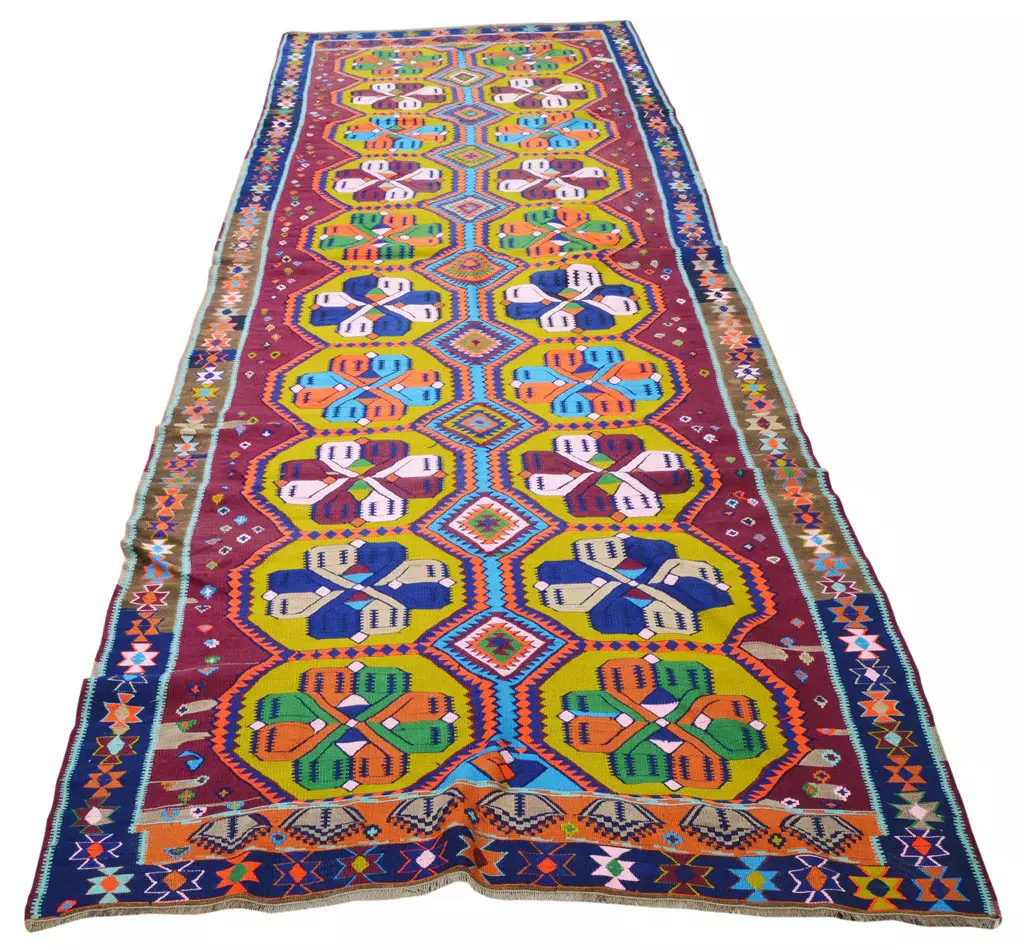
Timeless Heritage: The History and Artistry Behind Traditional Kilims and Flatweaves
Long before flatweave rugs became a fixture of contemporary interior design, they were something far more essential: a technology of survival, identity, and artistry woven by nomadic and village communities across a vast swath of the world.
To understand the kilim — the most storied of all flatweave traditions — is to understand centuries of human ingenuity compressed into wool, dye, and geometry.
Born of Necessity, Perfected as Art
The flatweave technique predates the knotted pile rug by thousands of years, and for good reason: it requires no specialized loom modifications, produces a lightweight and portable textile, and can be woven relatively quickly by skilled hands using simple horizontal looms. For nomadic tribes across Anatolia, Persia, the Caucasus, and Central Asia, this portability was essential.
A kilim could be rolled, packed onto a camel or horse, and unrolled again at the next campsite to insulate a tent floor, cover a saddle, or serve as a dowry textile marking a woman's skill and status within her community.
What began as pure utility evolved, over generations, into a sophisticated visual language. Because the flatweave technique — built from interlocking weft threads rather than knotted pile —
naturally produces bold, angular shapes, weavers developed an entire vocabulary of geometric motifs: stepped diamonds, hooked medallions, stylized birds and scorpions believed to ward off harm, and repeating bands that often encoded tribal affiliation, marital status, or regional identity.
Unlike the curvilinear, courtly patterns of city-workshop pile rugs, kilim motifs are unmistakably the product of the loom itself — geometry born directly from the structural logic of the weave.
Regional Signatures Worth Knowing
Anatolian kilims, woven across Turkey's varied regions, are prized for their bold color blocking and slit-tapestry technique, in which adjacent color areas are woven separately and left with a small gap, producing crisp, graphic edges between hues.
Persian kilims, particularly those from the Fars and Qashqai regions, tend toward more intricate, densely patterned fields, often incorporating small motifs repeated across the entire ground in a manner that rewards close inspection.
Caucasian flatweaves, including the soumak technique — which adds a supplementary wrapped thread for a slightly raised, embroidered appearance — represent a more technically complex evolution of the basic kilim structure, prized by collectors for their added dimensionality.
Natural Dyes and the Patience of Tradition
Before synthetic dyes arrived in the late 19th century, every color in a traditional kilim came from the surrounding landscape: madder root for deep reds, indigo for blues, walnut husks for browns, and pomegranate rind for golden yellows.
This dependence on natural, hand-processed dye sources meant that color variation between weaving batches was inevitable — and today, that gentle inconsistency, along with the soft fading that comes from decades of sun exposure, is precisely what gives antique and vintage kilims their prized, lived-in character.
Read: Rug Size Guide: What Works Best for Your Space?
Why This History Still Matters Today
Understanding this heritage changes how you look at a flatweave rug entirely. A geometric pattern that might read as simply "graphic" or "modern" to an untrained eye is often, in fact, a centuries-old tribal motif carrying real symbolic weight.
This depth of meaning is part of why flatweaves have found such enthusiastic adoption among design-conscious homeowners who want their interiors to carry genuine cultural resonance rather than purely decorative pattern.
For those drawn to this rich tradition, exploring a thoughtfully assembled kilim and flatweave collection offers a tangible connection to this history — pieces that carry forward techniques and motifs passed down through generations of weavers, long before "flatweave" became a design term at all.
Every fold and slit-woven edge in a well-made kilim is a small piece of inherited knowledge, and a considered selection of traditional flatweaves makes that heritage available to anyone building a home with real depth of character.