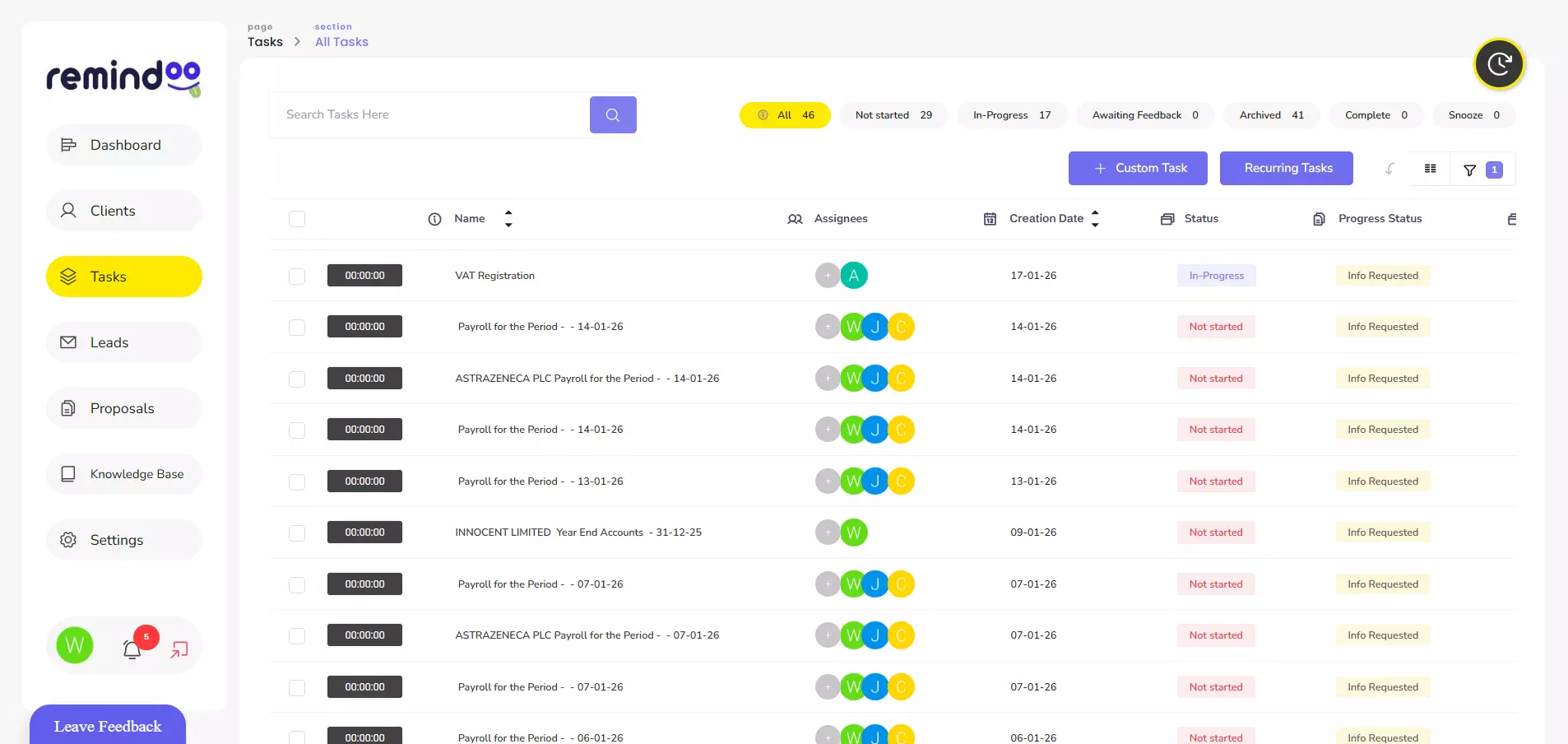
How Time Tracking Works With Task Management for Accountants
Time tracking and task management work together to give accounting firms a clearer view of what work is being done, how long it takes, who is responsible for it, and whether client work is being completed on time.
For firms handling recurring services such as bookkeeping, VAT returns, payroll, Self Assessment and annual accounts, combining time tracking with task management can make day-to-day work easier to organise and review.
This guide explains how time tracking works alongside task management software for accountants, how it supports task management for accountants, and why task tracking software for accountants can be useful for managing client work.
What Is Time Tracking for Accountants?
Time tracking records the amount of time an accountant or team member spends working on a particular task, client or service.
For example, an accounting firm may record time spent on:
- Bookkeeping
- VAT return preparation
- Payroll processing
- Self Assessment
- Corporation Tax work
- Annual accounts
- Client onboarding
- Reviewing accounts
- Client communication
- Document collection
- Internal administration
Instead of relying on memory or separate spreadsheets, team members can record their working time against specific tasks.
This creates a connection between the work that needs to be completed and the time actually spent completing it.
How Does Time Tracking Work With Task Management?
Time tracking becomes more useful when it is connected directly to tasks.
A typical process looks like this:
Client → Service → Task → Assigned Team Member → Time Recorded → Task Completed
For example, a VAT return workflow might contain several tasks:
- Request client records.
- Review bookkeeping data.
- Check VAT transactions.
- Prepare the VAT return.
- Review the return.
- Submit the return.
- Record completion.
A team member can track the time spent on each relevant task.
This gives the firm more than a simple record of hours. It creates a history of what work was performed and how much time the work required.
Why Do Accountants Need Task Management and Time Tracking Together?
Task management answers:
What needs to be done?
Time tracking answers:
How long did it take?
When these functions are connected, accounting firms can understand both sides of their workload.
For example, a practice manager may see that a Corporation Tax task was completed, but time tracking can provide additional information about the effort involved.
This can help firms identify:
- Tasks that regularly take longer than expected
- Services requiring additional resources
- Workloads across employees
- Delays in recurring workflows
- Administrative tasks taking excessive time
- Clients requiring more support
- Opportunities to improve processes
How Task Management Software for Accountants Supports Time Tracking
A dedicated task management software for accountants can connect time records directly to client work.
Instead of recording time in one system and managing tasks in another, firms can keep the information connected.
For example:
Client Work
Task
Time Recorded
Client A
Bookkeeping review
1 hr 20 mins
Client A
VAT preparation
45 mins
Client B
Payroll processing
30 mins
Client C
Accounts review
1 hr 10 mins
This makes it easier to understand how team members are spending their working hours.
It also gives managers a more detailed view of work than a simple completed/not-completed task status.
How Task Management for Accountants Improves Work Visibility
Accounting firms often manage hundreds of tasks across multiple clients.
A task may have:
- A client
- A service
- An employee
- A deadline
- A priority
- A status
- Subtasks
- Estimated time
- Actual time
- Notes or comments
When time tracking is connected to these task details, managers can see how work progresses from assignment to completion.
For example:
VAT Return → Assigned → In Progress → 45 Minutes Recorded → Review → Completed
This creates a clearer workflow for recurring accounting work.
Estimated Time vs Actual Time
One useful feature of combining task management and time tracking is comparing estimated time with actual time.
Suppose a firm estimates that a bookkeeping review should take 60 minutes.
After several completed tasks, the firm might find that similar reviews regularly take 90 minutes.
That difference provides useful operational information.
The firm can investigate whether:
- The original estimate was unrealistic.
- The client records require additional work.
- The workflow contains unnecessary steps.
- Employees need additional training.
- The task should be divided into smaller stages.
- More resources are required during busy periods.
This is one reason time tracking can be valuable beyond simply recording hours.
Read: Exploring the best Project Management Software to
How Time Tracking Helps Manage Accounting Team Workloads
Managers need to understand not only how many tasks employees have but also how much work those tasks represent.
Consider two employees:
Employee A
- 20 tasks
- Average task time: 20 minutes
Employee B
- 10 tasks
- Average task time: 2 hours
Looking only at task numbers could suggest that Employee A has the heavier workload.
Time information provides another perspective.
This is where task tracking software for accountants can help managers look at workload alongside task volume and recorded working time.
Time Tracking for Recurring Accounting Tasks
Many accounting services are recurring.
Examples include:
- Monthly bookkeeping
- Quarterly VAT returns
- Monthly payroll
- Annual accounts
- Corporation Tax
- Self Assessment
- Client follow-ups
- Management accounts
A task management system can create recurring tasks according to the firm's workflow.
Time tracking can then record how much time employees spend completing those recurring tasks.
Over time, the firm can identify patterns.
For example:
Monthly bookkeeping
- January: 2 hours
- February: 1 hour 45 minutes
- March: 2 hours 10 minutes
- April: 3 hours
A manager can investigate why April required more time instead of treating every month's work as identical.
How Time Tracking Helps With Workflow Improvement
Time tracking can reveal where a workflow is taking longer than expected.
Suppose a firm's client onboarding workflow contains:
- Client information collection
- AML checks
- Engagement documentation
- Software setup
- Internal review
- Welcome communication
If the firm records time against these tasks, it can identify which stages consume the most resources.
The firm can then review the process and determine whether automation, templates, better instructions or task allocation could reduce unnecessary work.
This turns time tracking into a source of operational information.
Can Time Tracking Help Accountants Identify Bottlenecks?
Yes.
A bottleneck occurs when one part of a workflow slows down the overall process.
For example:
Client documents received → Bookkeeping → Manager review → VAT preparation → Final review → Completion
If manager review regularly takes several days, the issue may not be the number of bookkeeping tasks. The bottleneck may be the review stage.
Task status, deadlines and time records can be reviewed together to identify where work is slowing down.
Time Tracking and Client Work
Accounting firms often need to understand how much work different clients require.
Time tracking can associate work with specific client tasks.
For example:
Client
Service
Time
Client A
Bookkeeping
4 hours
Client B
Bookkeeping
2 hours
Client C
VAT
1.5 hours
Client D
Payroll
45 minutes
This can help the firm understand its operational workload and identify clients or services that require significantly different amounts of staff time.
It should not be treated as the only measure of client value or service quality, but it can provide useful operational data.
How Task Tracking Software for Accountants Supports Accountability
A task management system can show:
- Who owns a task
- When it was assigned
- Its deadline
- Current status
- Related subtasks
- Time recorded
- Completion date
- Relevant notes or updates
This gives team members and managers a shared record of work.
Instead of asking:
"Has this been completed?"
Managers can review the task record and see its current status and activity.
That can reduce the need for repeated internal messages and manual follow-ups.
Time Tracking Can Help Improve Future Estimates
Historical time data can help accounting firms make more informed estimates for similar work.
For example, if a particular type of accounts preparation consistently takes between 3 and 4 hours, that information can help managers plan future workloads.
The same principle can be applied to:
- VAT preparation
- Bookkeeping
- Payroll
- Tax returns
- Annual accounts
- Client onboarding
- Reviews
The more consistent the task structure, the easier it becomes to compare similar work.
Time Tracking and Team Performance
Time tracking should be used carefully.
The goal should not simply be to measure employees by the number of hours recorded.
Instead, accounting firms can use time data alongside:
- Task completion
- Deadlines
- Workload
- Service complexity
- Client requirements
- Quality checks
- Workflow delays
For example, an employee completing fewer tasks may be handling more complex client work.
Therefore, time tracking works best as one source of operational information, rather than a standalone productivity measurement.
How Remindoo Connects Task Management and Time Tracking
For accounting firms using Remindoo, task management and time-related information can be connected within the wider practice workflow.
Remindoo is designed around accounting work such as recurring tasks, workflows, deadlines, task assignments and team workload management.
For example, an accounting firm can structure recurring client work around services such as bookkeeping, VAT, payroll and tax work, assign tasks to team members and track progress through the workflow.
Time-related information can then provide additional visibility into the work being completed.
This gives managers a broader picture of tasks, workloads, deadlines and time spent rather than managing each area separately.
What Should Accountants Look for in Task Management Software?
When evaluating task management software for accountants, firms should consider whether the platform supports their actual accounting workflows.
Useful capabilities can include:
1. Task Assignment
Tasks should be assignable to specific team members so everyone knows who is responsible for the work.
2. Recurring Tasks
Accounting firms need recurring workflows for services such as VAT, payroll and bookkeeping.
3. Time Tracking
Employees should be able to record time against relevant work without maintaining a separate manual system.
4. Deadlines
The system should make upcoming and overdue work visible.
5. Subtasks
Complex accounting jobs can be divided into smaller steps.
6. Workload Visibility
Managers should be able to understand how work is distributed across the team.
7. Client Association
Tasks should be connected to the relevant client and service.
8. Reporting
Historical task and time information can help managers understand workload and workflow performance.
Time Tracking vs Task Tracking: What Is the Difference?
Although they work closely together, they serve different purposes.
Task Tracking
Time Tracking
Shows what needs to be done
Shows how long work takes
Tracks task status
Records working time
Shows ownership
Shows time spent
Tracks deadlines
Helps analyse effort
Manages workflow
Supports workload analysis
Using both together gives accounting firms a more complete view of their operational work.
How to Implement Time Tracking in an Accounting Firm
A simple implementation process can make adoption easier.
Step 1: Define Your Main Services
Start with common workflows such as:
- Bookkeeping
- VAT
- Payroll
- Self Assessment
- Corporation Tax
- Annual accounts
Step 2: Break Services Into Tasks
Create repeatable task structures for each service.
Step 3: Assign Responsibilities
Give each task a clear owner.
Step 4: Set Expected Time
Where useful, create an estimated time for recurring tasks.
Step 5: Record Actual Time
Team members record time against the relevant task.
Step 6: Review the Data
Managers can compare estimated and actual time and identify recurring delays.
Step 7: Improve the Workflow
Use the information to refine task sequences, templates, assignments and workload planning.
Common Mistakes When Using Time Tracking
Time tracking becomes less useful when firms:
- Ask employees to record time days later
- Use separate spreadsheets for every client
- Track time without connecting it to tasks
- Create too many unnecessary categories
- Focus only on hours instead of completed work
- Ignore differences in task complexity
- Collect time data but never review it
The system should make recording time simple enough to become part of the normal workflow.
FAQs
What is task management software for accountants?
Task management software for accountants helps firms organise, assign and track client and internal accounting work. It can support recurring tasks, deadlines, workflows, team collaboration and workload management.
Why is time tracking important for accountants?
Time tracking helps firms understand how much time is being spent on different tasks, clients and services. This information can support workload planning and workflow improvement.
What is task management for accountants?
Task management for accountants involves organising accounting work into tasks, assigning responsibilities, setting deadlines and tracking progress through completion.
What is task tracking software for accountants?
Task tracking software for accountants provides a central way to monitor accounting tasks, including their owners, deadlines, status and progress. Some systems also connect task records with time tracking and workload information.
Can time tracking help accounting firms manage workloads?
Yes. Time records can provide additional context about the effort required for different tasks. When combined with task volumes and deadlines, this can help managers review team workloads.
Should accountants track time for every task?
It depends on the firm's workflow and objectives. Time tracking is generally most useful when the information will be used for workload planning, process analysis, reporting or other operational purposes.
Conclusion
Time tracking and task management solve different problems, but they become more useful when connected.
Remindoo Task management for accountants provides visibility over what needs to be done, who is responsible and when work is due.
Task tracking software for accountants can add status, ownership and workflow history, while time tracking shows how much effort is being spent on that work.
For accounting firms managing recurring VAT, payroll, bookkeeping, tax and year-end work, bringing these functions together can provide a clearer view of tasks, deadlines, workloads and time spent.
A dedicated task management software for accountants can therefore become more than a simple task list. When task, workflow and time information are connected, accounting firms can use that information to organise work and continuously improve their processes.