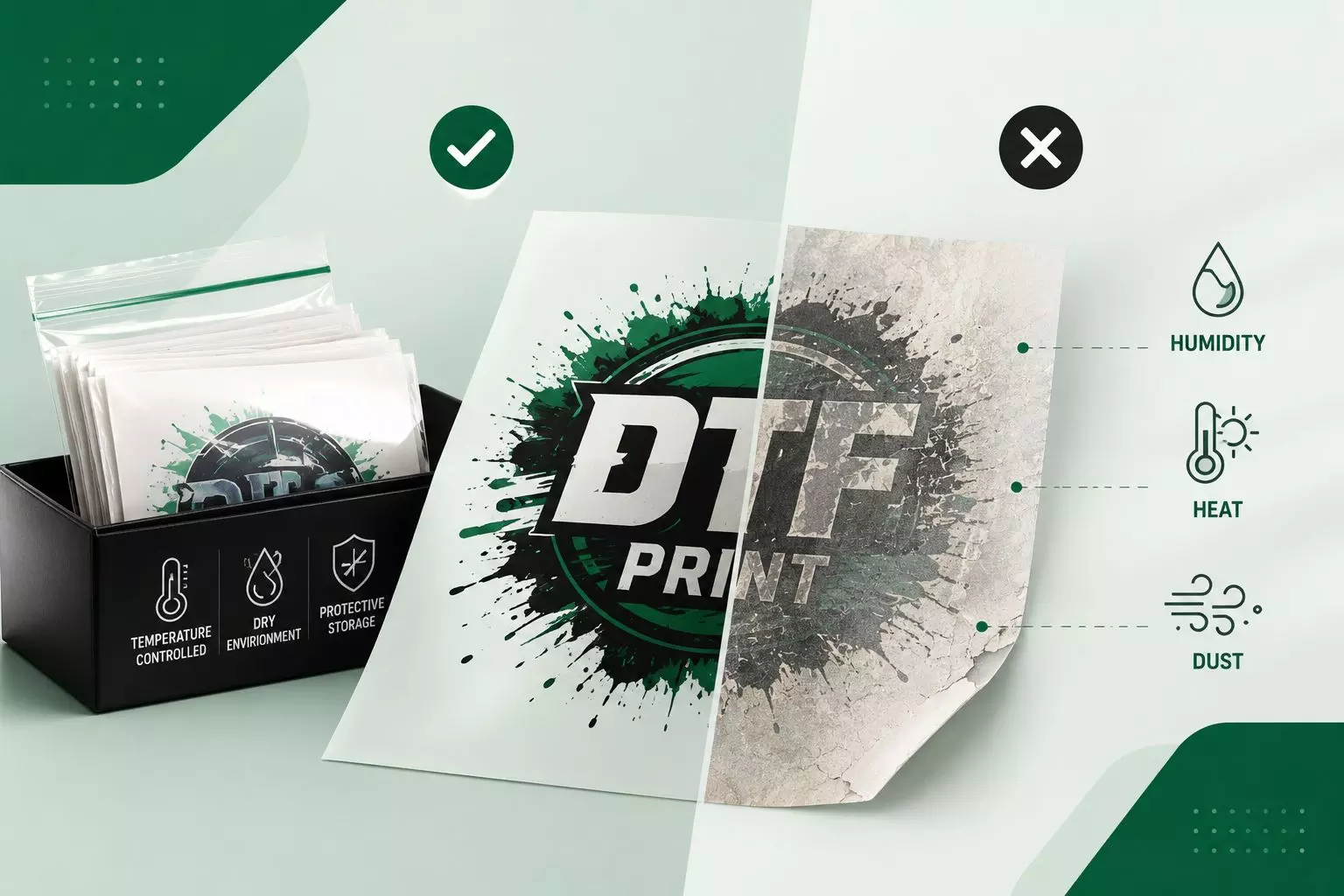
The Storage Science: How Ambient Climate Destroys DTF Prints
In the digital textile space, millions of dollars are poured into acquiring ultra-precise print engines, high-density color gamuts, and fast curing ovens. Yet, the literal glue holding your decoration business together is a simple tub of thermoplastic powder.
If you are fighting a losing battle with your graphics lifting after a single laundry cycle, your problem likely isn’t your printer settings or your heat press machine. It's almost always a failure of environmental discipline. For commercial print shops and scaling creators alike, ignoring the climate science behind your consumables is the quickest path to expensive DTF printing mistakes.
The Invisible Threat: Humidity vs. Resin Stability
To understand why you are experiencing DTF transfer quality issues, you have to look closely at the physical properties of your adhesive. DTF powder is highly hygroscopic—meaning it actively extracts moisture right out of the ambient air.
When your production room exceeds 60% relative humidity, or if your materials are left unsealed, you will immediately witness DTF adhesive powder clumping.
Instead of cascading smoothly across your PET film like dry flour, the moisture-laden particles bind into microscopic clusters. When these damp clumps pass through the drying tunnel, they fail to liquefy evenly, leaving a rough, uneven texture across your design.
This uneven melting phase leaves microscopic gaps across the back of your graphic, ultimately resulting in your finished dtf transfer not sticking to the garment during application.
Read: Complete Guide to Digital Printing Services
Calibrating Your Shop for Uniform Spread
Achieving a durable, retail-ready apparel line requires mastering how to apply DTF powder evenly by treating your workspace like a controlled laboratory.
If you notice your DTF powder not sticking to specific graphic borders, check your production layout pacing. When large designs are output slowly, the white ink layer can skim over and dry before the film reaches the powder tray. This leaves bald spots completely vulnerable to edge lifting.
To eliminate these layout-driven errors, review these foundational DTF powder application tips:
- Seal Your Assets: Always return unused powder to an airtight container immediately after coating. Never leave a powder bin uncovered overnight.
- Maintain the Sweet Spot: Keep an active dehumidifier running to maintain a steady ambient humidity level between 45% and 60% in your print room.
- Audit Your Spacing: Keep graphic spacing generous. Packing vector paths too closely can trap loose adhesive along the margins, which is a major culprit detailed in our breakdown of common DTF gang sheet mistakes.
For businesses that cannot constantly monitor local climate shifts, shifting your print queue to bulk wholesale printing channels allows you to source premium, pre-powdered custom DTF transfers that offer flawless consistency regardless of local weather.
Standardizing the Melt to Protect Your Margins
Once your powder is uniformly spread, your final defense against a DTF powder uneven spread is calibrating your curing heat.
Under-cooking your film leaves raw, dry dust that brushes away, while over-cooking burns off the essential chemical polymer compounds required to fuse with the shirt. To lock in the perfect, smooth orange-peel finish every single time, calibrate your equipment using our standard protocol for how to cure DTF powder with a heat press.
Ultimately, operational consistency is what separates profitable shops from those buried under high scrap rates. Whether you operate a regional white label production facility or manage high-volume, multi-asset gang sheet printing runs,
locking down your powder management protocol is the most effective safeguard against unexpected DTF transfer powder issues. Protect your inputs, master the physics of the melt, and build an apparel brand that outlasts the competition.