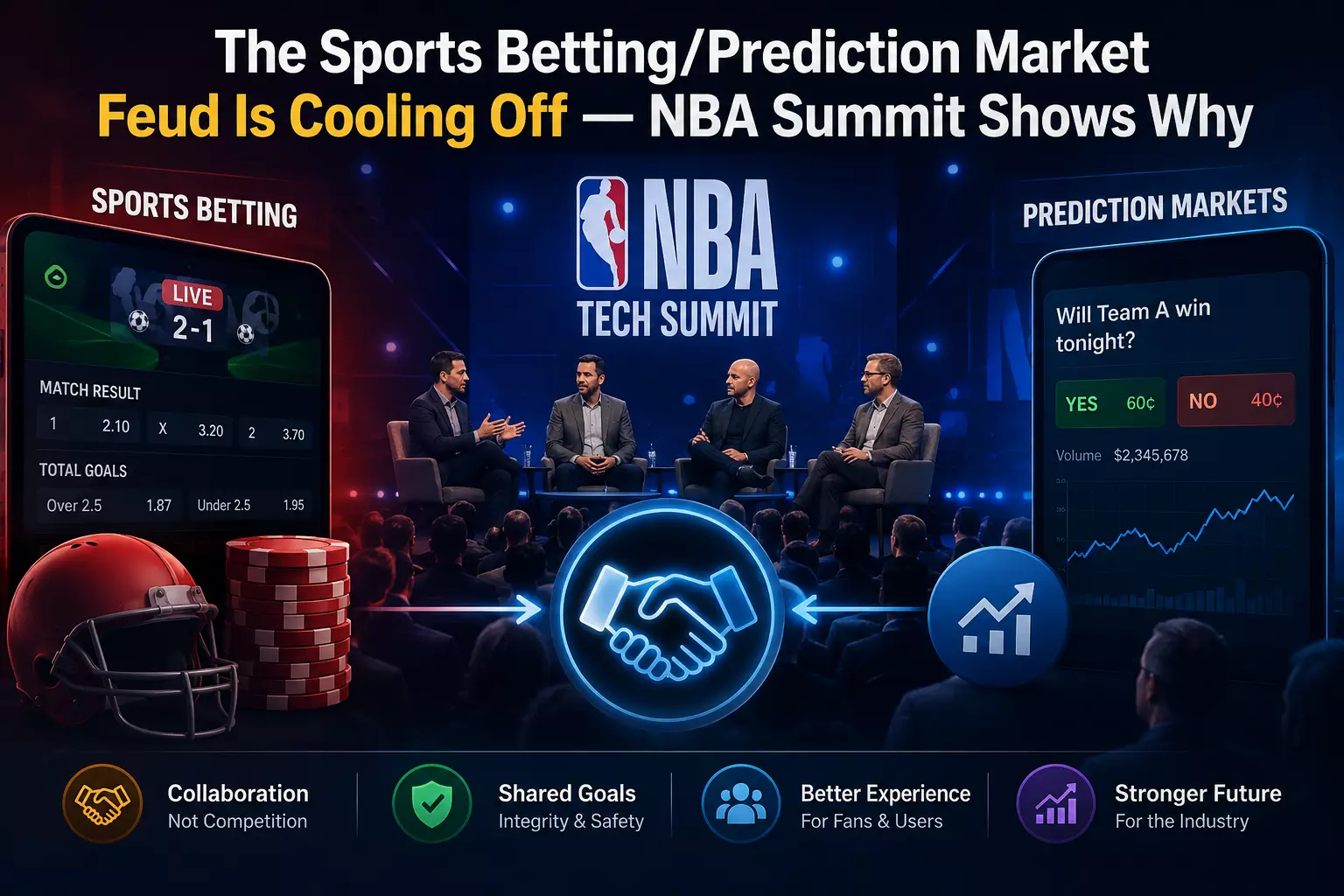
The Sports Betting/Prediction Market Feud Is Cooling Off — NBA Summit Shows Why
For years, sportsbooks and prediction market platforms have treated each other as rivals operating in different worlds — one licensed and regulated state by state, the other trading on continuous, exchange-style pricing that regulators are still figuring out how to classify. That framing just took a hit.
At the NBA All-Star Technology Summit in February, an invite-only, off-the-record panel put seven of the most powerful people in sports gambling and prediction markets in the same room.
According to reporting from Sports Business Journal, the conversation didn't just acknowledge the overlap between these two industries — it treated it as the new baseline.
Who Was On the Panel
- Tarek Mansour and Luana Lopes Lara — Co-founders, Kalshi
- Shayne Coplan — Founder, Polymarket
- Amy Howe — CEO, FanDuel
- Paul Liberman — Co-founder, DraftKings
- Bill Hornbuckle — CEO, MGM Resorts
- Carsten Koerl — CEO, Sportradar
That's a rare lineup — direct competitors and supposed adversaries sharing a stage, closed-door or not.
Why the Old Argument Stopped Working
The traditional pushback from leagues and sportsbooks alike was straightforward: event contracts on platforms like Kalshi and Polymarket should be held to the same regulatory standard as licensed sportsbook products.
That argument gets a lot harder to make once DraftKings and FanDuel start building their own prediction-market-style offerings.
That's effectively what's happened. A few key developments set the stage for the panel:
- Just hours before the discussion, DraftKings CEO Jason Robins publicly called prediction markets a major growth opportunity and said his company expects to lead the category.
- That posture carried straight into the closed-door session, where the sharp line between "legitimate sportsbook" and "unregulated exchange" started to blur in real time.
- Mansour, Lopes Lara, and Coplan pushed back on the idea that their platforms exist to dodge gambling rules, pointing instead to continuous trading and transparent pricing as genuine product differentiators that attract a different kind of user.
The tension didn't fully disappear, though. MGM's Bill Hornbuckle challenged the group directly over activity happening in states without licensed products, arguing it creates an uneven playing field. It's a notable position for MGM to hold, given the company hasn't entered the prediction market space itself.
Read: How Crowd Forecasting Is Reshaping Digital Intelligence in 2026
Integrity and Consumer Protection Took Center Stage
If there was one topic that pulled every executive into serious territory, it was integrity risk. The panel spent significant time on how open trading around game outcomes could create new pressure points for players, officials, and the data feeds that power both industries.
A few positions stood out:
- Hornbuckle's warning: Platforms operating outside licensed states, he argued, threaten safeguards that sportsbooks and leagues have spent years building together.
- The Kalshi/Polymarket counter: Visible, continuous pricing can actually help surface suspicious activity faster than traditional sportsbook models, according to the exchange founders.
- The middle ground from Liberman and Howe: Both acknowledged the potential upside of prediction markets while insisting any expansion needs strong controls against insider trading and outcome manipulation.
- Koerl's practical framing: Sportradar's CEO kept the group focused on how to supply accurate data to both sportsbooks and prediction platforms without opening up arbitrage opportunities between the two.
Notably, clean data access was one of the few things everyone in the room actually agreed on.
What This Means Going Forward
Nobody left the panel claiming the path forward is settled. But the tone has clearly shifted:
- Sportsbooks are no longer positioning themselves as pure skeptics of prediction markets — many are now active builders in the space.
- Prediction market platforms are no longer negotiating from the outside; they're doing it with real trading volume and mainstream visibility behind them.
- Existing NHL and UFC arrangements were floated as possible templates for how the NBA could eventually engage.
The NBA hasn't said whether it will follow the NHL and UFC toward a formal relationship with prediction market platforms, but dedicating an entire session to the topic — even behind closed doors — signals the league is taking the conversation seriously.
The Bottom Line
For now, the story is one of cautious convergence rather than resolution: two industries that spent years defining themselves in opposition to each other are increasingly negotiating over how to share the same players, the same data, and the same customers.
Whether that ends in formal league partnerships, tighter joint regulation, or continued friction is still an open question — but the days of pure opposition appear to be over.