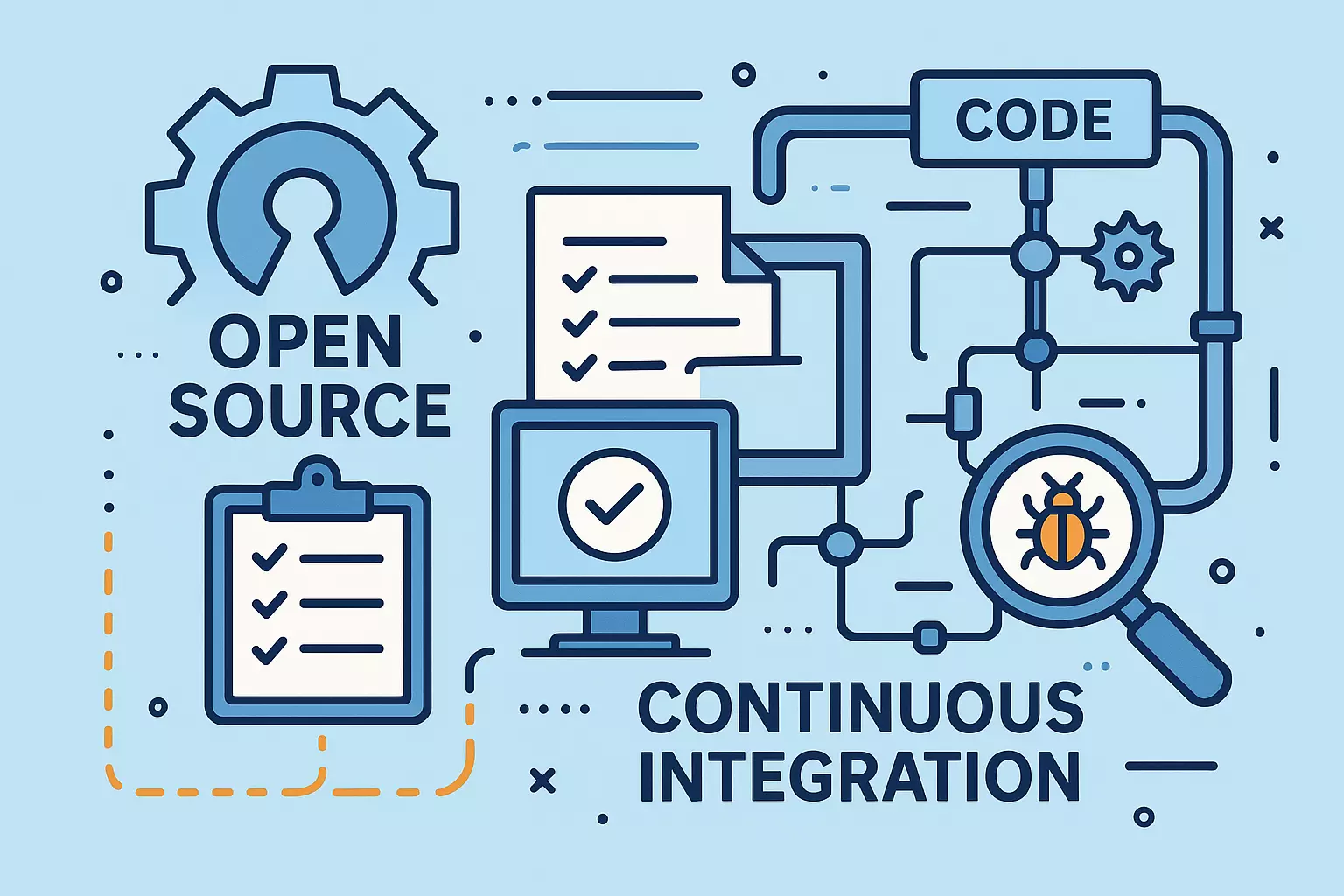
The Role of Open Source Testing Tools in Continuous Integration Pipelines
In the rapidly evolving world of software development, the most vital component of a Continuous Integration (CI) pipeline is testing. The use of open source testing tools has revolutionised the daily CI/CD activities of developers and companies by offering affordable, transparent resources for maintaining quality of software delivery at speed and scale.
The CI Testing Landscape
CI pipelines are automated highways where developers transport code changes across a series of phased workflows until they wind up in production. Testing occurs at each step of this highway journey as quality checkpoints ensuring that only trusted, bug-free code reaches these end users. Open source testing tools have changed this highway, in that they offer enterprise-level testing frameworks without the enterprise-level price tag.
Open source testing tools also provide developers with the beauty in collaboration. When you have thousands and thousands of developers helping to grow a testing framework, there is a higher chance that it will be more robust, feature rich, and flexible to accommodate change than a closed source product. Moreover, open source development is agile, so the tools will change as quickly as new testing patterns emerge or as compliance and industry standards shift.
Forms of Open Source Testing Tools Types in CI
Unit Testing Frameworks are the most basic building block of any effective test program. Tools such as the Java testing framework JUnit, Python's pytest, and JavaScript's Jest, have become vital for validating independent pieces of the application (the units).
Unit testing frameworks can use libraries within CI pipelines to have the tester immediately produce feedback about the code's quality and functionality. Integration Testing and API Testing tools are critical to the development of modern applications.
Through integration and API testing, developers can validate that the various pieces of a particular application talk to each other. Use open source testing tools such as Postman Newman, REST Assured, and SoapUI to automatically test APIs and services, which are common in microservices architectures of modern applications.
End-to-end testing frameworks (a.k.a., E2E test frameworks) such as Selenium WebDriver, Playwright, or Cypress (to name just a few) have changed how teams approach browser automation and user journey testing. End to end testing frameworks can automatically simulate the actions of a real person and are capable of testing a user flows and performs functions of the application across different browsers and devices.
Performance and load testing frameworks such as Apache JMeter, k6, and Locust (for Python) help teams understand how applications are likely to respond to stress. Performance testing tools can also identify risk for users early on (in CI pipelines) by automatically detecting performance regressions.
The Strategic Benefits of Open Source Testing
Cost effectiveness is perhaps the most obvious advantage of open source testing tools. Organizations can spend money on customization, training and infrastructure rather than licensing fees. This is a huge financial benefit for start-ups and other companies with limited budgets.
Flexibility and customization are the two most unique aspects of open source tools over proprietary tools. Development teams can modify tools to meet the objectives of specific projects, create custom plugins, or use existing workflows without the vendor constraints, making it easier to adapt testing strategies to match application architectures.
The community IT participation and sharing of knowledge creates an invaluable ecosystem around popular open source testing tools. When teams get stuck, they benefit from the combined expertise of the community, extensive documentation, and the availability of almost seamless solutions by the global development community.
Recent Developments in Open Source Testing
The way we test is continuing to change, with methods that address current issues. Keploy is one example, a new breed of modern testing tools to automatically generate test cases through API requests, while also minimizing the manual steps involved to achieve a complete testing coverage. This type of intelligent testing generation illustrates the open source innovation trajectory pushing the limits of automated testing capabilities.
AI-assisted testing solutions are getting more advanced, with tools incorporating predictive analysis to predict failure points, tools that can help you optimize the suite execution order, and suggest improvements to opinionated test suites. These robust testing capabilities were confined to proprietary commercial solutions in the former decade, luckily, improving your testing suite is possible with the use of open source.
Implementation Best Practices
To successfully implement open source testing tools, teams need to plan, including thoughtful implementation. Teams should develop a strategy for testing that outlines what types of testing will run at various pipeline stages that ensure testing coverage is balanced with how long testing takes to execute.
When selecting tools, teams should consider existing technology stacks and team knowledge, as well as additional long-term maintenance work. Just because a particular open source tool has a fantastic feature set doesn’t mean it is the right tool if the team does not have (or want to develop) the specific knowledge needed to be successful.
Finally, monitoring and collecting metrics can help teams know that their testing processes lead to measurable quality. Although open source tools tend to provide a more bulky reporting mechanism, reporting will help the teams identify areas of trends, bottlenecks, and improvement opportunities.
The Future of Open Source Testing in CI
With software development accelerating, open source testing tools will be fundamental to maintain quality and reliability at speed. This will be facilitated by the convergence of a wide range of artificial intelligence and machine learning capabilities, with some traditional testing methodologies, resulting in ever-increasing sophisticated automation capabilities, and making software delivery of high quality more accessible for organizations of any size.
The collaborative nature of open source development means that there will be ongoing collaboration and development of these tools to meet new challenges. In many cases, open source testing tools are not only a legitimate alternative to commercially available tools, but often times they are the only real option for working in modern CI/CD environments.