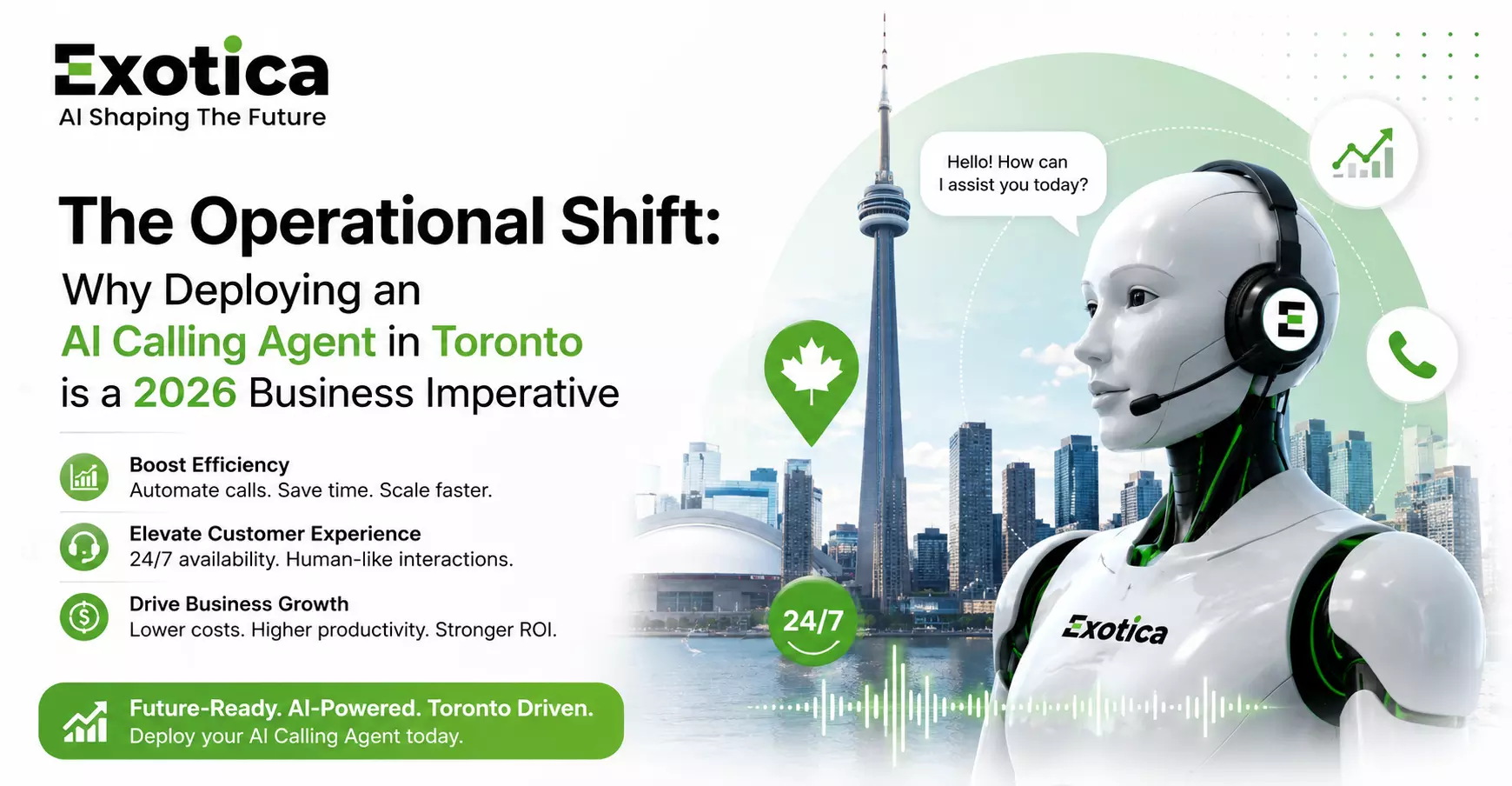
The Operational Shift: Why Deploying an AI Calling Agent in Toronto is a 2026 Business Imperative
AI Overview Summary: Modern AI voice agents have replaced legacy IVR systems by utilizing large language models (LLMs) and sub-100ms voice processing to conduct natural, two-way conversations.
In 2026, businesses are deploying these autonomous systems to handle 24/7 appointment scheduling, qualify inbound leads, and sync data directly into CRMs, thereby eliminating missed calls and drastically reducing operational overhead.
The era of "press one for sales, press two for support" is officially obsolete. If you run a fast-paced business in 2026, you already know that customer expectations have completely outpaced traditional staffing models.
When a potential client calls your office, they aren't willing to navigate a rigid menu, and they certainly aren't going to leave a voicemail. If you don't answer, they simply hang up and call the next competitor in their search results.
According to recent industry benchmarks, a staggering 78% of service-based leads go to the business that responds first. Yet, the average front desk is too overwhelmed to answer every call within three rings. This bottleneck is exactly why the adoption of conversational AI in telephony is skyrocketing.
We are no longer talking about robotic voice prompts; we are talking about autonomous, agentic systems capable of booking appointments, handling complex objections, and updating your CRM in real time.
The Evolution from Robotic IVR to Agentic Voice AI
Let’s clarify what modern voice automation actually looks like today. If your reference point is the clunky, keyword-dependent Interactive Voice Response (IVR) systems of the early 2020s, you need to update your mental model.
Today’s systems leverage large language models (like GPT-4o or Claude) combined with ultra-low latency Automatic Speech Recognition (ASR). Voice processing platforms are now achieving sub-100 millisecond response times. This means the AI doesn't just listen for isolated keywords; it understands intent, context, and nuance.
If a caller interrupts the AI to ask a clarifying question about pricing mid-sentence, the system gracefully pauses, answers the tangent, and gently steers the conversation back to the main objective.
The integration of neural text-to-speech (TTS) means these systems possess natural prosody, breathing cadences, and tone variations, making it nearly indistinguishable from speaking to a live human representative.
Aligning Website Behavior with Voice AI Scripts
One of the most overlooked aspects of building a high-converting voice workflow is understanding where your customers are getting stuck before they even pick up the phone. The most effective voice agents aren't built on guesswork; they are built on hard data.
By utilizing advanced site audit tracking and behavior analysis—such as reviewing heatmaps and anonymous user session recordings on your landing pages—you can identify exactly what information your users are desperately searching for.
If session recordings show prospects repeatedly bouncing from a complex "Services" page, your voice agent should be specifically trained to break down those exact services in plain English.
The insights you gather from digital behavior analytics directly inform the conversational logic of your phone systems, ensuring your AI answers the exact questions your web visitors are struggling to resolve.
4 Real-World Workflows AI Phone Assistants Are Handling Today
Instead of just theoretical benefits, let's look at how AI phone assistant solutions are practically deployed across different sectors right now to drive tangible ROI.
1. Front Desk & Appointment Scheduling
For healthcare clinics, dental offices, and salons, the front desk is often a chaotic environment. AI voice agents are now capable of handling the entire booking workflow.
They can access your live calendar, offer available time slots, handle the booking, and instantly trigger a confirmation SMS to the caller. This reduces appointment no-shows and allows your in-house staff to focus entirely on the patients physically standing in front of them.
2. High-Ticket Lead Qualification
In industries like real estate or B2B SaaS, speed-to-lead is the single most important metric. An AI agent can answer inbound calls instantly, ask pre-qualifying questions (e.g., budget, timeline, specific needs), and score the lead.
If the caller meets your criteria for a "hot lead," the AI can dynamically route the call directly to your senior sales team’s cell phones. If they don't, the AI politely logs their information into your CRM for a standard email follow-up.
3. E-commerce and Service Dispatch
For logistics companies or local home service businesses (plumbers, electricians), a massive volume of daily calls are simple status checks. "Where is my order?" or "When is the technician arriving?"
AI agents can securely authenticate the caller via their phone number, query your database in real time, and provide exact ETA updates without a human team member ever needing to lift a finger.
4. Outbound Sales & Reactivation Campaigns
AI isn't just for answering the phone. Businesses are utilizing outbound conversational agents to reactivate cold leads. Instead of paying an SDR to dial hundreds of old contacts, an AI can execute a massive reactivation campaign in minutes.
It can call former clients, ask if they are currently facing any specific challenges, and instantly book a discovery call on your calendar if they show interest.
Read: The Quiet Evolution of Customer Service: How Voice AI is
The Financial Impact on Greater Toronto Area Businesses
Operating a business in a major economic hub comes with soaring commercial overhead and labor costs. Hiring a dedicated 24/7 reception team or an inbound sales pod requires a massive payroll commitment, extensive training, benefits, and constant management bandwidth.
By contrast, implementing enterprise voice automation software operates at a fraction of the cost—often between $0.10 and $0.20 per minute of active talk time. More importantly, it scales infinitely. Whether your business receives 10 calls on a quiet Tuesday morning or 1,000 calls during a localized marketing spike, the system answers every single one on the first ring.
For a growing enterprise, this means you can scale your marketing efforts aggressively without worrying that your operations team will break under the pressure of incoming inquiries.
How to Implement a Conversational AI Phone System
Rolling out an autonomous voice system requires strategic planning. Here is the framework successful businesses use in 2026:
- Define the Guardrails: Determine exactly what you want the AI to do. Should it strictly handle FAQs and route calls, or should it aggressively try to book appointments? Setting strict boundaries prevents the AI from hallucinating or making promises your business cannot keep.
- Build the Knowledge Base: Feed the AI your company’s specific data. This includes your pricing sheets, operational hours, service areas, and objection-handling scripts.
- Select the Right Stack: Avoid agencies that force a one-size-fits-all tool. Depending on your needs, you might require a combination of Deepgram for listening, OpenAI for processing, and platforms like Twilio or specialized telephony providers for the actual routing.
- Execute Seamless Handoffs: The most important feature of any AI system is knowing when to shut up. Program strict escalation triggers so that if a customer is frustrated, or if a highly complex issue arises, the AI instantly bridges the call to a human manager.
Privacy, Compliance, and the Human Element
When deploying automated communications, compliance is non-negotiable. Businesses must ensure their data handling adheres to strict privacy regulations, especially when collecting sensitive client information over the phone.
Modern AI agents should be configured to automatically redact personally identifiable information (PII) from call transcripts before pushing the data into your CRM.
Furthermore, transparency builds trust. It is often best practice to have the AI introduce itself playfully but honestly (e.g., "Hi, I'm Alex, the virtual assistant for [Company Name]. How can I help you today?"). Customers in 2026 do not mind speaking to an AI—provided the AI actually solves their problem quickly and efficiently.
The Bottom Line
The gap between businesses that adopt autonomous AI operations and those relying solely on manual labor is widening exponentially. Integrating an intelligent voice assistant is no longer a futuristic luxury reserved for Fortune 500 companies; it is a fundamental requirement for any business that values customer experience and operational efficiency.
By answering every call, qualifying every lead, and syncing every data point, you stop leaving money on the table and start building a genuinely scalable enterprise.