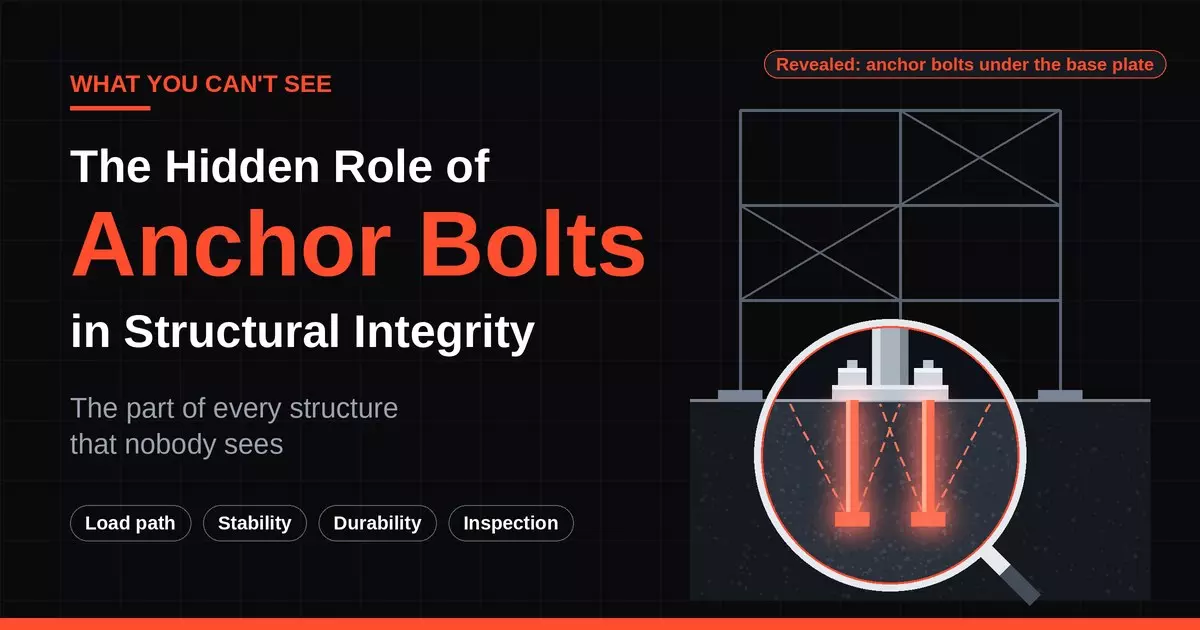
The Hidden Role of Anchor Bolts in Structural Integrity
Walk around any finished building, plant, or tower and you will rarely see the Anchor Bolts. They sit under base plates, inside pedestals, or beneath a layer of grout, and within days of construction they vanish from view.
Yet structural integrity, meaning a structure’s ability to carry its loads and stay stable over time, depends on them more than their size suggests. This article looks at the jobs they do quietly, why those jobs matter, and what can go wrong when nobody is watching.
Integrity is more than strength
A structure has integrity when it stays stable, keeps its shape within acceptable limits, and carries loads along a continuous path from the roof to the ground.
Strength is part of that, but so are stiffness, durability, and what engineers call robustness: the ability to tolerate damage or unexpected loads without disproportionate failure.
Every one of those qualities passes through the foundation connection. If the load path is broken at the base, the quality of everything above it stops mattering.
The first job: keeping the structure in place
Under gravity alone, a column mostly presses down on its base plate, and the concrete does the work. The picture changes as soon as the loads turn sideways or upward.
Wind pushes on a building face, earthquakes shake it, and cranes and machines apply horizontal forces. The structure tries to slide and to tip over.
Anchor Bolts resist both. In shear, they stop the base from sliding along the foundation. In tension, they hold down the side that wants to lift when the structure tries to overturn.
Tall, light, and slender structures, such as sign supports, tanks, towers, and light-clad warehouses, depend on this far more than heavy masonry buildings do.
The second job: stability during construction
Integrity matters before a building is finished. A steel frame is at its most vulnerable while it’s partly erected, when braces, floors, and walls aren’t in place yet. Anchor rods give each column the base fixity and hold-down it needs while the frame is being assembled.
Safety rules reflect that: in the United States, OSHA’s steel erection standard requires at least four anchor rods for each column in most cases, which gives a stable base during erection. Loose or missing nuts at this stage can turn a routine lift into a hazard.
The third job: tying the structure together
Robust design asks that the parts of a structure stay connected even when something unexpected happens, like an impact, an explosion, or the loss of a support.
Ties and continuous load paths limit the spread of damage. The base connection is part of that system. A connection that lets a column kick out or lift off its foundation removes a key restraint, and neighboring members then take loads they weren’t designed for.
This is one reason codes aim for ductile behavior at the base. Steel that stretches before it fails gives warning and lets forces redistribute. Concrete that breaks out in a cone fails suddenly.
Design rules therefore encourage a failure sequence in which the steel yields first, as covered in ACI 318 for anchoring to concrete and in AISC guidance on base plates and anchor rods.
The fourth job: handling repeated loads
Structures also need integrity over time, not only in a single extreme event. Machines, traffic, and wind gusts apply loads thousands or millions of times. Repeated loading can loosen nuts and start fatigue cracks, usually at stress concentrations such as thread roots.
Pretension helps. When a bolt is properly tightened, the joint stays clamped, and the bolt sees only a small part of each load swing.
Where vibration is expected, designers may specify locking devices, double nuts, or follow-up checks after initial operation. A connection that was tight on commissioning day but loosened a year later has lost some of its integrity, even if nothing looks wrong.
The fifth job: keeping things aligned
Integrity includes serviceability. A pump that shifts a few millimeters can strain its piping, and a column base that settles unevenly can distort the frame above it.
Anchor Bolts, working with a well-grouted base plate, keep equipment and columns where they were meant to be. That sounds modest, but misalignment often shows up as cracked grout, worn couplings, and leaking joints long before anyone suspects the anchors.
Why “hidden” is the real risk
The same concealment that makes anchors easy to forget makes their problems hard to detect. Several issues develop out of sight:
Corrosion at the interface, where the bolt leaves the concrete and water, oxygen, and salts collect. This is especially relevant in coastal and Gulf conditions.
Loosening nuts, common near vibrating machinery.
Cracked or missing grout, which lets water in and leaves the plate unevenly supported.
Installation errors, such as insufficient embedment, bolts forced into misaligned holes, or dust left in holes for adhesive anchors.
Overload from design changes, when new equipment is placed on an old foundation without rechecking the anchors.
None of these announces itself. By the time a base plate visibly moves or rust bleeds from under the grout, the damage has often been developing for years.
Reliable products start with documented ones
Because anchors are hidden, quality has to be established before installation, not discovered afterward. Ask for mill test certificates, grade markings, thread and coating details, and compare them with the specification when the material arrives.
ASTM F1554 is a widely used specification for anchor rods, and traceable certificates let an engineer rely on the assumed properties. Suppliers differ in what they make and document, so evaluate them on certification, testing, and size range as well as price.
UAE-based manufacturers such as Petrofast Middle East FZC, which lists stud anchors among its products, are one example of the sources available to Gulf projects. Whoever you choose, reject any material that doesn’t match its paperwork.
Protecting what you can’t see
Good practice is mostly about making hidden things visible at the right time:
- Check before the pour. Survey bolt positions, projection, and embedment while changes are still easy.
- Check after the pour. Confirm nothing shifted during concrete placement.
- Record tightening. Keep the method and results on file so future owners know what was done.
- Grout properly. Even bearing under the plate protects the bolts from bending and keeps water out.
- Inspect over time. Look for corrosion, loose nuts, cracked grout, and plate movement, with frequency set by environment and consequences.
- Recheck after changes. New equipment, added loads, or damage should trigger a review of the anchors.
Hot-dip galvanizing, stainless steel, and good drainage details extend life, but they don’t replace inspection.
What this means for owners and engineers
For engineers, the lesson is to treat the base connection as a primary structural element, not a detail left to the end. For contractors, it is to protect tolerances and records, because that’s where shortcuts hide.
For owners, it is to include anchors in maintenance plans, since the cost of checking them is tiny compared with the cost of what they support.
The takeaway
Anchor Bolts rarely get credit, because when they do their job, nothing happens. That quiet is exactly what structural integrity looks like. They keep structures in place, stabilize them while they’re built, tie the load path together, resist repeated loads, and hold everything aligned.
Choosing them carefully, installing them properly, and checking them over time are what keep that hidden role dependable. Always follow the project engineer’s specifications and the applicable code.