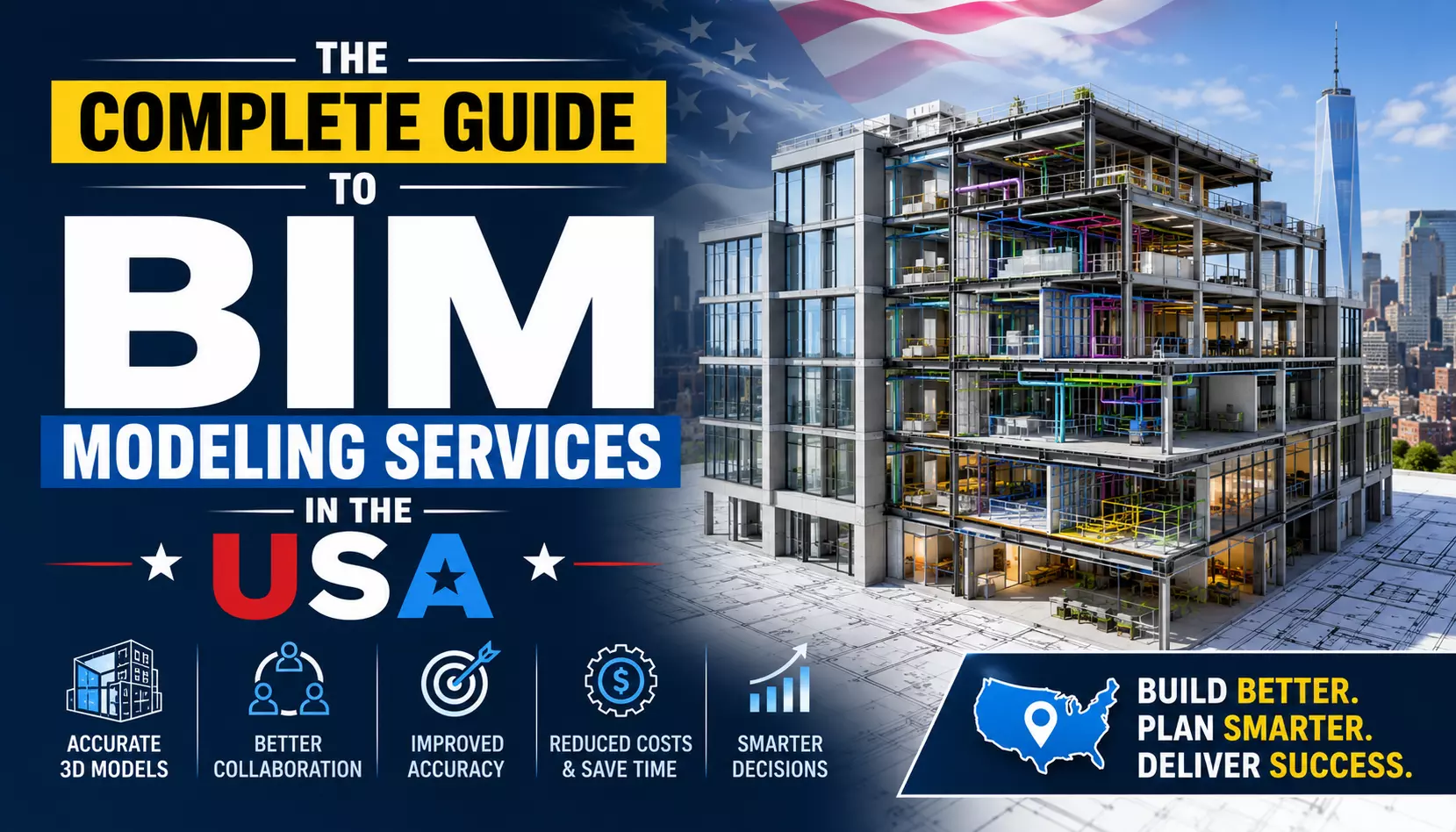
The Complete Guide to BIM Modeling Services in the USA
Building Information Modeling (BIM) is a digital process that creates intelligent 3D models to improve collaboration, reduce costs, and streamline construction projects. BIM Modeling Services USA providers like Chudasama Outsourcing help AEC firms across architecture, structure, and MEP disciplines deliver projects faster and smarter.
Construction projects fail for predictable reasons—miscommunication, design conflicts, budget blowouts, and poor coordination between trades. BIM modeling directly addresses all of these. As the AEC (Architecture, Engineering, and Construction) industry in the USA grows more competitive, firms that embrace BIM aren't just working smarter; they're winning more projects.
This guide covers everything you need to know: what BIM is, the types of services available, the benefits that matter most, and how to choose the right provider for your next project.
What Is BIM and Why Does It Matter in the AEC Industry?
Building Information Modeling (BIM) is a digital workflow that creates rich, data-driven 3D models of buildings and infrastructure. Unlike traditional CAD drawings, BIM models carry embedded data—materials, costs, schedules, energy performance—that every stakeholder can access and act on.
The significance of BIM in the AEC industry can't be overstated. According to the National BIM Report, projects using BIM consistently report fewer on-site errors, lower rework costs, and faster delivery timelines compared to those using conventional design processes.
In the USA, BIM adoption has accelerated sharply across both public and private sectors. Federal agencies, state transportation departments, and major general contractors increasingly mandate BIM on large-scale projects. For firms that haven't yet integrated BIM, the competitive gap is widening.
Key Benefits of BIM Modeling Services
How does BIM improve collaboration on construction projects?
BIM creates a single shared model that architects, engineers, contractors, and owners all work from simultaneously. Changes made by one team are instantly visible to others, eliminating the version-control chaos that plagues traditional document-based workflows. The result is faster decisions, fewer misunderstandings, and tighter coordination across every discipline.
What role does BIM play in clash detection and project visualization?
One of BIM's most tangible advantages is automated clash detection. Before a single shovel hits the ground, BIM software identifies where structural elements, MEP systems, and architectural features physically conflict. Resolving these clashes in the model—rather than on the job site—saves significant time and money.
Visualization is equally powerful. Photorealistic renders and 4D construction sequences allow clients and contractors to walk through a project before it's built, catching problems and building confidence early.
Can BIM modeling actually reduce project costs and timelines?
Yes—measurably so. Studies from McKinsey & Company highlight that large construction projects using BIM workflows can reduce costs by up to 20% and cut delivery times by 15–50% compared to non-BIM projects. These savings come from reduced rework, more accurate quantity take-offs, and better-coordinated scheduling.
How does BIM support better risk mitigation and decision-making?
BIM models serve as decision-support tools throughout a project's lifecycle. Stakeholders can simulate different design scenarios, assess structural performance, and evaluate cost implications before committing to a direction. This data-driven approach shifts decision-making from reactive to proactive, reducing risk at every stage.
Types of BIM Modeling Services Available in the USA
BIM Modeling Services USA providers typically offer the following core disciplines:
Architectural BIM Modeling covers the spatial and aesthetic design of a building—floor plans, facades, interior layouts, and material specifications—all built into a coordinated 3D model.
Structural BIM Modeling focuses on the building's skeleton: foundations, beams, columns, and load-bearing systems. Structural BIM ensures the design is safe, code-compliant, and constructible.
MEP BIM Modeling handles the mechanical, electrical, and plumbing systems that make a building functional. MEP is often the most complex coordination challenge on any project, making it the discipline where BIM delivers the most dramatic clash-detection value.
4D, 5D, and 6D BIM extend the model into additional dimensions:
- 4D BIM adds construction scheduling to the 3D model, visualizing how a project builds over time.
- 5D BIM integrates cost data for real-time budget tracking and quantity take-offs.
- 6D BIM incorporates sustainability and energy performance data, supporting green building certifications and lifecycle analysis.
How to Choose the Right BIM Service Provider in the USA
What factors should you consider when evaluating a BIM modeling company?
Experience and portfolio are the starting point. Look for providers with demonstrated experience in projects similar to yours in scale and complexity. A residential BIM specialist may not be the right fit for a commercial high-rise.
Technology stack matters too. Providers should be proficient in industry-standard platforms—Autodesk Revit, Navisworks, BIM 360, and Civil 3D are benchmarks. Ask whether they work to LOD (Level of Development) standards, which define the precision and reliability of model content at each project phase.
Communication and responsiveness are often underestimated. A provider like Chudasama Outsourcing, which specializes in BIM outsourcing for the US market, offers the advantage of dedicated project teams, clear deliverable timelines, and streamlined communication—factors that matter just as much as technical capability.
Questions to ask potential BIM providers before signing a contract
- What BIM standards and LOD levels do you work to?
- Can you provide references from similar project types?
- How do you handle revisions and change management?
- What file formats do you deliver, and are they compatible with our workflows?
- Do you carry professional liability insurance?
Read: Expert Scan to Revit Services USA for As-Built Models
The Future of BIM in the USA
What emerging technologies are shaping the future of BIM modeling?
BIM is evolving rapidly. AI-assisted design tools are beginning to automate routine modeling tasks, allowing engineers to focus on higher-value problem-solving. Digital twins—live BIM models connected to real-time building sensors—are transforming how owners manage and maintain assets after construction.
Cloud-based BIM platforms are also removing geographic barriers, enabling seamless collaboration between US-based project teams and offshore modeling specialists.
How is BIM influencing sustainable construction in the USA?
6D BIM is a growing priority as green building standards become more stringent. By embedding energy performance data into the model, project teams can simulate HVAC loads, daylighting, and carbon output early in design—before expensive changes become necessary. This directly supports LEED certification and compliance with increasingly strict state-level energy codes.
What is the current regulatory landscape for BIM adoption in the USA?
Unlike the UK—which mandated BIM Level 2 on all publicly funded projects in 2016—the USA has taken a more fragmented approach. Federal agencies like the GSA (General Services Administration) have encouraged BIM adoption on major projects, and many state DOTs now require it for transportation infrastructure. Broader federal mandates are likely as adoption rates continue to climb.
BIM Is a Competitive Advantage—Use It
BIM modeling is no longer a differentiator reserved for mega-projects. Firms of every size are using it to win bids, reduce errors, and deliver better outcomes. The question isn't whether BIM is worth adopting—the data is unambiguous—it's whether you have the right partner to implement it effectively.
Chudasama Outsourcing provides specialized BIM Modeling Services USA firms rely on to deliver high-quality architectural, structural, and MEP models on time and on budget. If you're evaluating BIM providers for your next project, reach out to discuss your specific requirements.
Frequently Asked Questions About BIM Modeling Services
What is the difference between BIM and CAD?
CAD produces 2D or 3D drawings, but those files contain no embedded data. BIM creates intelligent models where every element carries information—materials, costs, dimensions, and performance data—that updates automatically when the design changes.
How much do BIM modeling services cost in the USA?
Costs vary widely based on project complexity, LOD requirements, and service scope. Simple architectural models may start at a few thousand dollars, while full MEP coordination on a large commercial project can run significantly higher. Outsourcing BIM to specialists like Chudasama Outsourcing often reduces costs compared to in-house modeling.
What industries use BIM modeling in the USA?
BIM is used across commercial and residential construction, healthcare, education, transportation, infrastructure, and industrial facilities.
What is LOD in BIM, and why does it matter?
LOD (Level of Development) defines how detailed and reliable a model element is at each phase of a project, from schematic design (LOD 100) through fabrication and as-built documentation (LOD 500). Specifying the correct LOD ensures you receive the right level of detail for your project phase—no more, no less.
Is BIM suitable for small construction firms?
Yes. Cloud-based BIM platforms and outsourced modeling services have significantly lowered the entry barrier. Small firms can access the same BIM capabilities as large contractors without the overhead of building an in-house team.