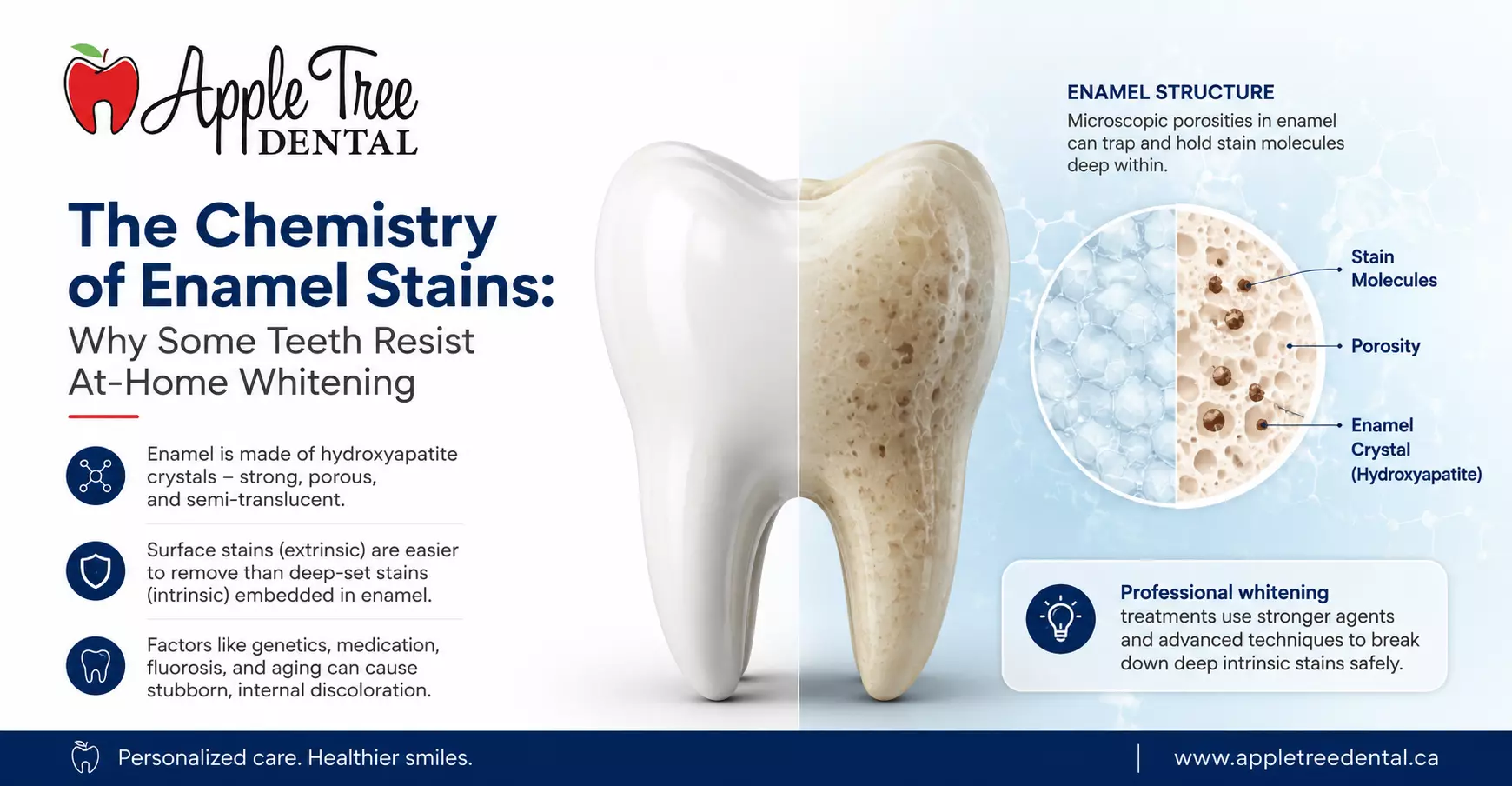
The Chemistry of Enamel Stains: Why Some Teeth Resist At-Home Whitening
If you walk down the oral care aisle of any pharmacy today, you are met with a dizzying wall of promises. Charcoal pastes, LED mouthpieces, overnight serums, and hydrogen peroxide strips all guarantee a Hollywood-level smile in a matter of days.
Yet, as dental professionals, we see patients every single week who have spent hundreds of dollars on these products, only to end up with extreme tooth sensitivity, chemically burned gums, and teeth that are the exact same shade they were a month ago.
The disconnect between marketing claims and real-world results usually comes down to one thing: a fundamental misunderstanding of dental anatomy and the chemistry of stains.
Whitening your teeth is not like scrubbing a dirty floor.
It is a precise chemical reaction. If you do not understand what kind of stain you are trying to break down, applying bleaching agents is essentially guesswork. Let’s look at the science behind tooth discoloration, how oxidation actually works, and why professional oversight is often the missing ingredient in achieving a safely brightened smile.
Intrinsic vs. Extrinsic Stains: Knowing Your Target
To understand why a whitening treatment fails, you first need to look at the structure of the tooth. The outer layer, the enamel, is composed of densely packed microscopic mineral crystals. Directly beneath the enamel lies the dentin, a softer, naturally yellowish tissue.
Stains fall into two distinct categories, and they require completely different chemical approaches.
Extrinsic Stains (Surface Level)
These are the most common stains, occurring on the surface of the enamel. They are caused by chromogens—highly pigmented molecules found in coffee, red wine, black tea, dark berries, and tobacco. Because enamel is porous, these chromogens settle into the microscopic ridges of your teeth over time.
Over-the-counter (OTC) whitening toothpastes and mild strips can sometimes manage light extrinsic stains. However, abrasive "whitening" pastes often just scrub the surface enamel away. Over time, thinning enamel reveals the yellow dentin underneath, ironically making your teeth look darker.
Intrinsic Stains (Deep Tissue)
Intrinsic stains occur inside the tooth, within the dentin. These cannot be reached by a surface-level abrasive or a low-concentration drugstore strip. Intrinsic discoloration can be caused by:
- Dental trauma: A hit to the mouth can cause a tooth to bleed internally, leading to a gray or black appearance as the blood breaks down.
- Medications: Certain antibiotics, like tetracycline, taken during childhood tooth development can cause deep gray or brown banding.
- Excessive fluoride: Ingesting too much fluoride during early childhood (fluorosis) can result in bright white or brown spots on the teeth.
- Aging: As we age, our enamel naturally thins, and the dentin becomes denser and darker.
If you have an intrinsic stain or a traumatized "dead" tooth, standard drugstore strips will never work. This is precisely when you need to seek out teeth whitening London residents can trust, as a clinical assessment is required to determine if internal bleaching or a cosmetic alternative like veneers is necessary.
The Oxidation Process: How Peroxide Breaks Down Stains
Whether you use an at-home kit or visit a clinic, the active ingredient doing the heavy lifting is almost always a peroxide derivative—usually hydrogen peroxide or carbamide peroxide.
When peroxide is applied to the tooth, it penetrates the porous enamel rods and reaches the discolored molecules (the chromogens) trapped inside.
The peroxide undergoes an oxidation reaction, breaking the double carbon bonds of the chromogen molecules. Once those molecular bonds are broken, the chromogens no longer reflect light in the same way, causing the tooth to appear white and clear rather than yellow or brown.
The Concentration Factor
The primary difference between an OTC product and what you receive in a dental chair is the concentration of the bleaching agent and the delivery method.
Health regulations restrict the concentration of hydrogen peroxide in non-prescription kits to ensure consumer safety (typically capping around 3% to 10%). While safe for casual use, these lower concentrations often lack the chemical power to break down older, stubborn intrinsic stains.
In a clinical setting, dentists can safely administer and monitor highly concentrated gels (up to 35% or 40% hydrogen peroxide). Because these agents are powerful enough to damage soft tissue, dental professionals use specialized barriers to paint over and protect your gums before the gel is applied.
This customized care is why many patients ultimately transition from trial-and-error kits to professional whitening treatments to achieve a noticeable difference without the painful side effects.
The Hidden Risks of Unsupervised Whitening
The pursuit of a perfect smile without professional guidance carries distinct risks that rarely make it onto the back of a product box.
1. The "Dehydration" Illusion
Many OTC whitening strips use acidic formulations to open the pores of the enamel quickly. This can temporarily draw moisture out of the tooth. A dehydrated tooth looks incredibly chalky and white. You might peel off a strip, look in the mirror, and think you’ve achieved a miracle.
However, within 24 to 48 hours, as the tooth naturally rehydrates from your saliva, that chalky whiteness fades, revealing that the actual stain was barely affected.
2. Gum Irritation and Chemical Burns
One-size-fits-all plastic strips or boil-and-bite trays do not conform perfectly to the unique gumline of your mouth. When peroxide gel leaks out of an ill-fitting tray and sits on your gums for 30 minutes, it causes tissue blanching (chemical burns). Repeated exposure can lead to permanent gum recession, exposing the sensitive roots of your teeth.
3. Masking Underlying Dental Issues
Whitening over active tooth decay is a recipe for severe pain. If you have an undiagnosed micro-cavity or a leaky filling, applying peroxide will drive the bleaching agent straight into the nerve center of the tooth.
What should be a painless cosmetic enhancement becomes an agonizing experience. A professional assessment ensures your teeth are structurally sound before any chemicals are applied.
Read: Family Dentistry in London, Ontario: A Practical Guide
The Clinical Advantage: Precision and Predictability
When you opt for a clinical approach, the treatment is tailored to the exact anatomy of your mouth and the specific nature of your stains.
For example, if you prefer the convenience of whitening at home but need clinical-grade results, dentists can take physical or digital impressions of your teeth to fabricate custom-molded whitening trays. These trays fit snugly against every contour of your teeth, holding a prescription-strength gel exactly where it needs to be while sealing it away from your gums.
If you are preparing for a major life event like a wedding and need immediate results, in-chair light-activated whitening provides a rapid oxidation process under strict supervision. By partnering with local London teeth whitening services, you ensure that the treatment duration and chemical concentration are calibrated perfectly for your specific enamel thickness and sensitivity levels.
Protecting Your Investment: Post-Whitening Care
The 48 hours immediately following a professional whitening session are critical. The pores of your enamel remain open, making your teeth highly susceptible to new stains.
During this window, we recommend adhering strictly to the "White Diet." As a general rule, if a food or beverage would permanently stain a white cotton shirt, it will stain your newly whitened teeth.
What to avoid for 48 hours:
- Coffee and dark teas
- Red wine and dark sodas
- Tomato-based sauces
- Soy sauce and balsamic vinegar
- Dark berries (blueberries, blackberries)
What to embrace:
- Water or milk
- Chicken, white fish, and tofu
- White rice and pasta with white sauces
- Cauliflower and potatoes
Additionally, using a remineralizing toothpaste—specifically one containing nano-hydroxyapatite or standard fluoride—will help seal the enamel pores more quickly, locking in your new shade and preventing post-treatment thermal sensitivity to hot and cold foods.
The Final Verdict
Achieving a bright, natural-looking smile shouldn't require a compromise in your overall oral health. While drugstores offer the allure of cheap, instant fixes, the science of enamel and dentin dictates that real, lasting stain removal requires customized chemical precision.
If you are struggling with stubborn discoloration, sensitivity, or uneven results, stepping away from the OTC aisle and consulting a professional is the safest, most effective path forward.
About the Author: Apple Tree Dental is a premier family and cosmetic dental practice based in London, Ontario. With two convenient locations (Beaverbrook and Wonderland), their team of highly credentialed dental professionals brings decades of combined clinical experience to the community.
Dedicated to patient-centered, evidence-based care, Apple Tree Dental specializes in everything from routine preventative hygiene to advanced restorative procedures and safe, tailored cosmetic enhancements. For those looking to safely brighten their smile under expert care, discover how their teeth whitening London clinic can deliver lasting, sensitive-free results.