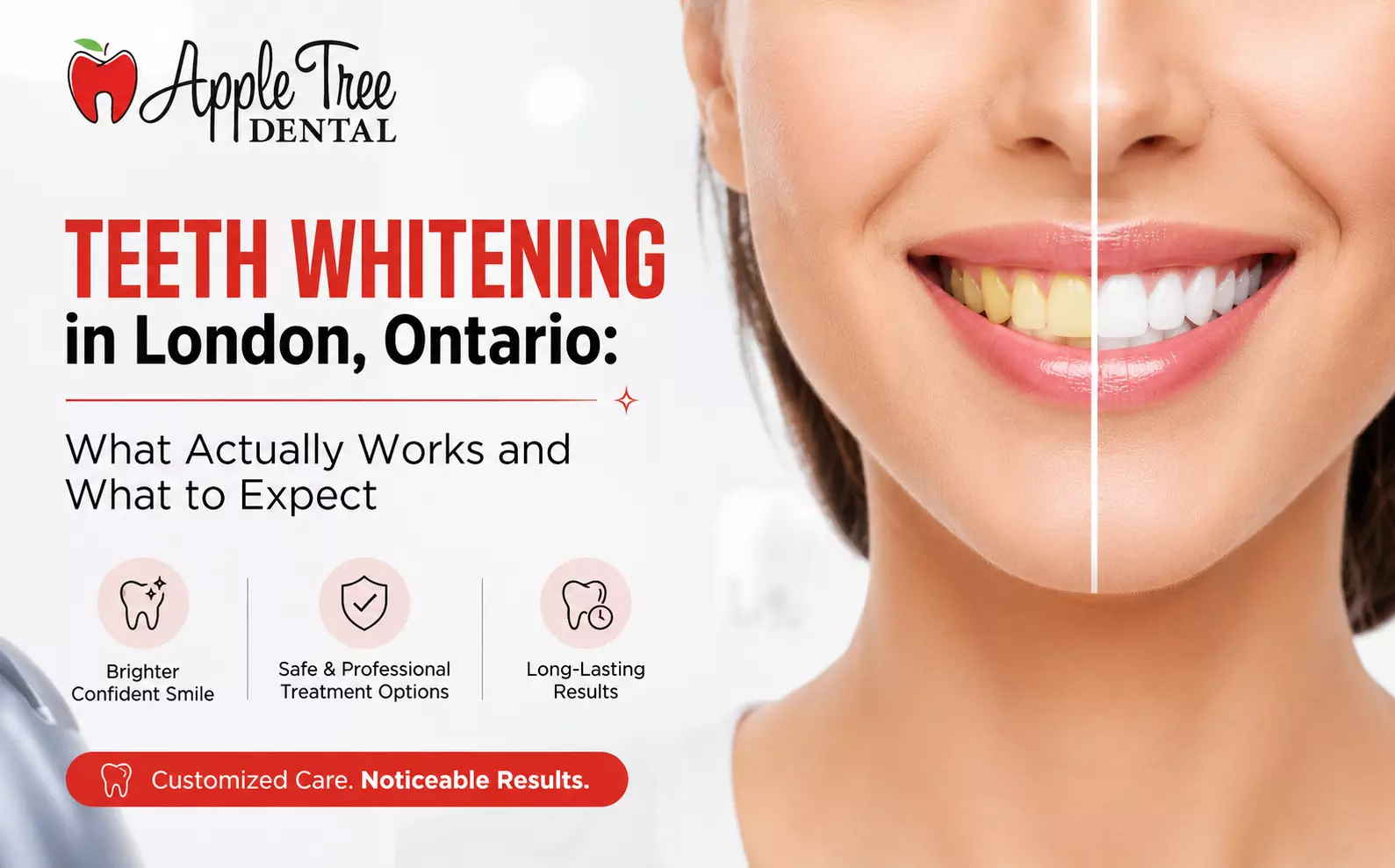
Teeth Whitening in London, Ontario: What Actually Works and What to Expect
Professional teeth whitening in London, Ontario typically lifts shade by 3–8 shades in a single in-office visit, while take-home trays achieve similar results over 1–2 weeks. Over-the-counter strips generally produce the most modest, slowest change of the three options.
Why "Whitening" Isn't One Single Thing
Patients often ask for "whitening" without realizing there are two distinct issues at play: extrinsic staining (surface stains from coffee, tea, red wine, or tobacco) and intrinsic discoloration (deeper staining from aging, certain medications, or fluorosis during tooth development).
Extrinsic stains respond well to almost any whitening method. Intrinsic discoloration is harder to shift and often needs a stronger, professionally supervised approach — or in some cases, a different solution entirely, like veneers.
This distinction matters because it explains why a $20 drugstore strip works well for one person and does almost nothing for another. It's not a product quality issue — it's a mismatch between stain type and treatment strength.
Common Causes of Discoloration
- Coffee, tea, and red wine (chromogenic staining)
- Tobacco use
- Aging (enamel thins and yellowish dentin shows through more)
- Certain antibiotics taken during childhood tooth development
- Excess fluoride exposure during enamel formation (fluorosis)
Read: Family Dentistry in London, Ontario: A Practical Guide
Comparing the Three Main Whitening Approaches
In-Office Professional Whitening
A higher-concentration peroxide gel is applied under controlled conditions, often activated with light or heat. This is the fastest route to visible change — usually one appointment, roughly 60–90 minutes.
Best for: Patients wanting fast, dramatic results before an event, or those with stubborn extrinsic staining.
Take-Home Professional Trays
Custom-fitted trays with a lower-concentration gel, worn for a set period daily over one to two weeks. Slower than in-office treatment, but the gradual approach tends to produce more even results and lower sensitivity for some patients.
Best for: Patients who prefer a gentler ramp-up or want to maintain results periodically after an initial in-office treatment.
Over-the-Counter Strips and Kits
Lowest concentration, least supervision, and the most variable results. Fine for very mild surface staining, but generally not effective on intrinsic discoloration.
Best for: Light touch-ups between professional treatments, not as a primary solution for noticeable discoloration.
Method
Typical Timeline
Shade Change
Sensitivity Risk
In-office
1 visit (60–90 min)
3–8 shades
Moderate, short-term
Take-home trays
1–2 weeks
3–6 shades
Low–moderate
OTC strips
2–4 weeks
1–3 shades
Low
The Sensitivity Question Nobody Explains Well
Sensitivity during whitening happens because peroxide gel temporarily opens microscopic channels in enamel to reach stain molecules — and those same channels can let temperature and pressure reach the nerve more easily for a few days.
It's temporary for the vast majority of patients, but it's also the number one reason people quit a whitening routine halfway through.
A few things that actually reduce sensitivity risk:
- Using a sensitivity-formulated toothpaste for a week before starting
- Reducing wear time per session rather than skipping days entirely
- Avoiding extremely hot or cold food/drink for 24–48 hours post-treatment
- Flagging existing enamel wear or exposed root surfaces to your dentist before starting, since these areas whiten unevenly and are more prone to sensitivity
Why a Consultation Matters More Than People Think
The biggest whitening disappointments usually trace back to skipping the diagnostic step.
Existing fillings, crowns, and veneers don't whiten — they stay their original shade while natural teeth around them lighten, which can create a visible mismatch if it isn't planned for in advance.
A dentist reviewing your mouth beforehand can flag this and sequence treatment (or restoration replacement) accordingly.
For patients comparing their options locally, this overview of teeth whitening in London breaks down which method tends to suit which stain type and starting shade — useful context to bring into a consultation rather than guessing based on marketing claims alone.
Maintaining Results Long-Term
Whitening isn't permanent — most patients see some shade regression within 6–24 months depending on diet and habits. A few maintenance habits stretch results considerably:
- Rinsing with water after coffee, tea, or wine rather than letting it sit on enamel
- Using a straw for staining beverages when practical
- Touch-up trays every few months rather than a full re-treatment
- Routine cleanings, which remove surface buildup that dulls shade over time
Frequently Asked Questions
Is professional whitening safe for enamel?
Yes, when done under professional supervision at appropriate concentrations — it doesn't remove or thin enamel, contrary to a common misconception.
Will whitening work on crowns or veneers?
No. Restorative materials don't respond to peroxide gel the way natural enamel does, which is why shade-matching is discussed before any major restorative work.
How long does one in-office treatment typically last?
Results vary by lifestyle, but many patients maintain visible results for 12–18 months with basic touch-up maintenance.
Patients who've already had a shade consultation and are ready to book a teeth whitening London appointment should ask specifically about any existing restorations that might need shade-matching consideration — it's a five-minute conversation that prevents a much bigger headache later.