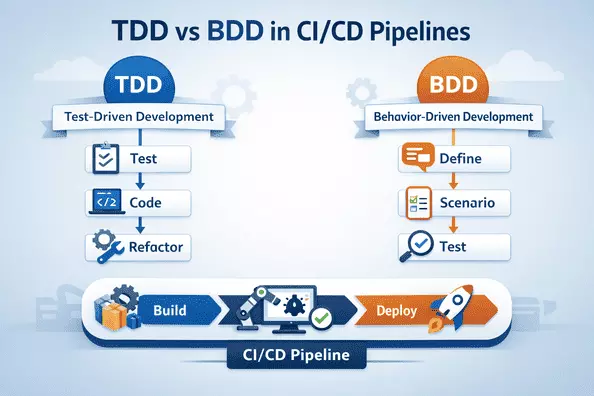
TDD vs BDD in CI/CD Pipelines: Where Each Approach Adds Value
CI/CD pipelines are built to move fast, but speed without confidence quickly turns into risk. As teams push code multiple times a day, testing practices must align tightly with automated pipelines. This is where the discussion around tdd vs bdd becomes practical, not philosophical.
Instead of asking which approach is better in theory, modern teams benefit more by understanding where each approach adds value inside a CI/CD pipeline. Both TDD and BDD serve different purposes, and when used intentionally, they strengthen different stages of delivery.
Why CI/CD Changes the TDD vs BDD Conversation?
Traditional testing discussions often assume long development cycles. CI/CD removes that luxury.
In fast pipelines:
- Feedback must be immediate
- Failures must be easy to diagnose
- Tests must support automation, not slow it down
- Signals must be trustworthy
This environment exposes the strengths and weaknesses of both TDD and BDD more clearly than slower release models.
Where TDD Fits Best in CI/CD Pipelines?
Test-driven development thrives close to the code.
In CI/CD pipelines, TDD adds the most value at the earliest stages, where fast feedback prevents defects from moving downstream.
TDD as a Gatekeeper for Code Quality
TDD-driven tests run quickly and fail fast. They are ideal for:
- Pull request validation
- Pre-merge checks
- Continuous integration triggers
These tests stop broken logic from ever entering the shared codebase.
Supporting Developer Velocity
Because TDD tests are written at the code level, they:
- Execute in seconds
- Pinpoint failures accurately
- Encourage smaller, safer commits
This tight feedback loop aligns perfectly with CI pipelines that run on every commit.
Reducing Downstream Noise
When logic-level issues are caught early through TDD:
- Fewer failures appear in later pipeline stages
- Integration and acceptance tests become more meaningful
- Release decisions rely on cleaner signals
In the tdd vs bdd comparison, this early containment of risk is a clear strength of TDD.
Limitations of TDD in CI/CD Contexts
While powerful, TDD has blind spots that CI/CD pipelines quickly expose.
TDD tests:
- Do not validate user workflows
- Miss integration mismatches
- Cannot confirm business intent
A pipeline that relies only on TDD often looks “green” until real-world usage proves otherwise.
Where BDD Adds Value in CI/CD Pipelines?
Behavior-driven development operates at a different layer.
BDD shines in CI/CD pipelines when teams need confidence that the system behaves correctly from a business and user perspective.
Validating End-to-End Behavior
BDD scenarios validate:
- User journeys
- Business rules
- Cross-service workflows
- Acceptance criteria
These tests typically run later in the pipeline, after successful builds and integrations.
Aligning Releases With Expectations
One of the strongest benefits of BDD in CI/CD is clarity.
BDD scenarios act as living documentation that:
- Confirms what the system should do
- Reduces misinterpretation of requirements
- Aligns engineering output with product intent
In tdd vs bdd discussions, this alignment is where BDD consistently adds unique value.
Supporting Release Confidence
When BDD tests pass in staging or pre-production:
- Release managers gain confidence
- Stakeholders trust the pipeline signals
- Rollbacks become less frequent
BDD doesn’t just test code. It validates readiness.
Challenges of BDD in Fast Pipelines
BDD tests are powerful, but they come with trade-offs.
Common challenges include:
- Slower execution times
- Higher maintenance cost
- Fragility when environments are unstable
In CI/CD pipelines, running too many BDD tests too early can slow feedback and frustrate teams.
Using TDD and BDD Together in CI/CD
The most effective teams stop treating tdd vs bdd as an either-or choice.
Instead, they place each approach where it delivers the strongest signal.
A Practical Pipeline View
A balanced CI/CD pipeline often looks like this:
- Early stages: TDD-driven tests for fast validation
- Mid stages: Integration and contract checks
- Later stages: BDD scenarios validating business behavior
Each layer answers a different question, without overlapping responsibility.
Clear Ownership and Intent
When teams are intentional:
- TDD tests protect internal correctness
- BDD tests protect external behavior
- Failures are easier to interpret
- Pipelines stay fast and reliable
This separation of concerns reduces confusion and increases trust in automation.
Read: DevOps Pipeline – Automate, Deploy, And Scale Efficiently
Anti-Patterns Teams Should Avoid
CI/CD pipelines expose poor testing discipline quickly.
Common mistakes include:
- Using BDD for low-level logic
- Treating TDD tests as acceptance validation
- Running all tests at every pipeline stage
- Measuring success by test count instead of signal quality
These patterns create noise, not confidence.
Choosing Based on Pipeline Goals
The real question in tdd vs bdd is not which approach is superior, but what the pipeline needs at each stage.
If the goal is:
- Fast feedback → TDD adds more value
- Business confidence → BDD adds more value
- Release stability → both are required
CI/CD pipelines reward clarity and intent more than strict adherence to methodology.
Final Thoughts
CI/CD pipelines turn testing philosophy into operational reality.
TDD adds value by protecting code quality early and keeping feedback fast. BDD adds value by validating behavior, expectations, and readiness closer to release. Teams that understand where each fits stop debating and start delivering with confidence.
In modern delivery pipelines, the real win in the tdd vs bdd conversation comes from using both intentionally, not choosing sides.