Building More Efficient Workflows for Growing Businesses
Growth is the ambition of virtually every business, but it brings with it a category of operational challenges that are easy to underestimate until they are encountered at scale.
As a business grows from a small, tightly coordinated team to a larger organisation with multiple departments, locations, or client portfolios, the informal coordination methods that worked well at a smaller scale begin to fail in ways that are initially subtle and then suddenly significant.
Work management tools are the infrastructure that allows growing businesses to scale their operational capacity without a proportional increase in coordination overhead, maintaining the efficiency and responsiveness that made them successful at a smaller scale as they become larger and inherently more complex.
Why Growth Creates Workflow Problems
Small teams operate with a degree of natural coordination that comes from proximity, frequent informal communication, and a shared understanding of priorities that does not need to be made explicit because everyone is close enough to the work to maintain awareness without a formal system.
When a team grows beyond a certain size — typically somewhere between ten and twenty people depending on the nature of the work — this natural coordination breaks down.
People are no longer close enough to all of the work to maintain informal awareness, communication becomes less spontaneous, and priorities that seemed self-evident in a smaller context need to be articulated and managed explicitly.
Work management tools address this transition by providing the structural scaffolding that allows coordination to scale without requiring a proportional increase in management effort, communication overhead, or the risk of important work falling through the gaps as the complexity of the operation increases.
What Efficient Workflows Actually Look Like
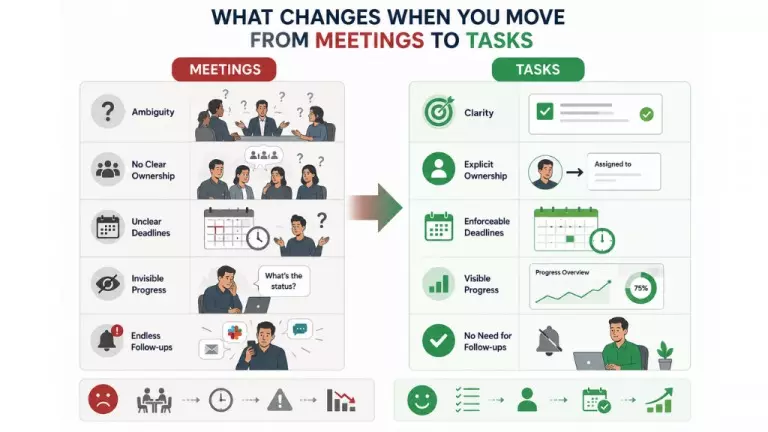
An efficient workflow is one in which work moves from initiation to completion through a clear, well-understood sequence of steps with minimal friction, delay, or ambiguity at each transition point.
The task is created with clear parameters — who is responsible, what is required, when it is due, and what other work it depends upon or enables. It is progressed through defined stages with status updates that are visible to relevant stakeholders without requiring active communication to maintain awareness.
It is completed and reviewed according to a consistent quality standard, and the outcome is recorded in a way that can be referenced and built upon in future work of a similar nature.
Work management tools support this ideal workflow by providing the structure within which each of these stages can be managed consistently, regardless of the complexity of the project, the size of the team, or the number of concurrent workstreams the business is managing at any given time.
The Role of Standardisation in Workflow Efficiency
One of the most significant efficiency gains available to growing businesses through the adoption of work management tools is the ability to standardise recurring workflows.
Most businesses contain a significant number of processes that are repeated regularly — client onboarding sequences, project kickoff procedures, weekly reporting cycles, approval workflows, and content production pipelines are all examples of work that follows a broadly consistent pattern each time it is executed.
Without a formal system, these recurring processes are recreated from memory each time, with variations in how different team members approach the same task and inconsistencies in the steps followed and the quality of the output produced.
A task tracking app platform that supports the creation of reusable workflow templates allows these recurring processes to be standardized, ensuring consistent execution and freeing team members from the cognitive overhead of recreating the process from scratch on each occasion.
Read: I Reviewed 15 Delivery Management Software Tools
How Work Management Tools Support Decision-Making
Beyond their direct impact on task execution and workflow efficiency, work management tools provide leaders and managers with the visibility needed to make better operational decisions.
When work is captured and tracked within a structured system, patterns in workload distribution, bottlenecks in specific workflow stages, and trends in task completion rates and deadline adherence become visible in ways that informal management approaches simply cannot reveal.
This visibility supports more accurate resource planning, more realistic capacity assessment, and earlier identification of workflow problems before they develop into the kind of significant operational failures that damage client relationships, team morale, and business performance.
Decisions made with access to accurate, real-time operational data are consistently better than those made on the basis of intuition or periodic manual reporting, which is always retrospective and inherently less accurate than a live view of work in progress.
Integrating Work Management Into the Business Culture
Implementing work management tools is not simply a technology decision — it is a change management initiative that requires deliberate attention to how people are introduced to the new system, how working practices are adapted to reflect its use, and how the benefits of structured work management are communicated in ways that motivate consistent adoption rather than grudging compliance.
The businesses that achieve the most sustained efficiency gains from work management tools are those where leaders model the use of the system, where expectations around task capture and status updates are clear and consistently reinforced, and where the tool evolves in response to how the team actually works rather than requiring the team to contort its working practices to fit the constraints of the software.
Scaling Without Losing Operational Control
The ultimate test of a work management system for a growing business is whether it allows the organisation to scale its operational capacity without a corresponding loss of visibility, coordination quality, or execution consistency.
A system that works well for a team of fifteen but becomes unwieldy and difficult to manage for a team of fifty has not solved the scaling problem — it has merely deferred it.
Work management tools that are designed with scalability in mind provide role-based access controls, hierarchical project structures, cross-team dependency management, and reporting capabilities that remain useful and informative as the volume and complexity of work managed within the system grows over time.
Choosing Tools That Grow With Your Business
The decision about which work management tools to adopt is one that growing businesses should approach with their future state in mind as well as their current requirements.
A tool that meets today's needs but will require replacement at the next stage of growth creates disruption, data migration challenges, and re-adoption costs that are better avoided by selecting a solution with sufficient flexibility and depth to accommodate growth from the outset.
TaskOPad Solutions Private Limited builds work management solutions with the scalability requirements of growing businesses at the centre of the product design, ensuring that the efficiency gains achieved through initial adoption continue to compound as the business grows rather than becoming the constraints that hold the next stage of growth back.