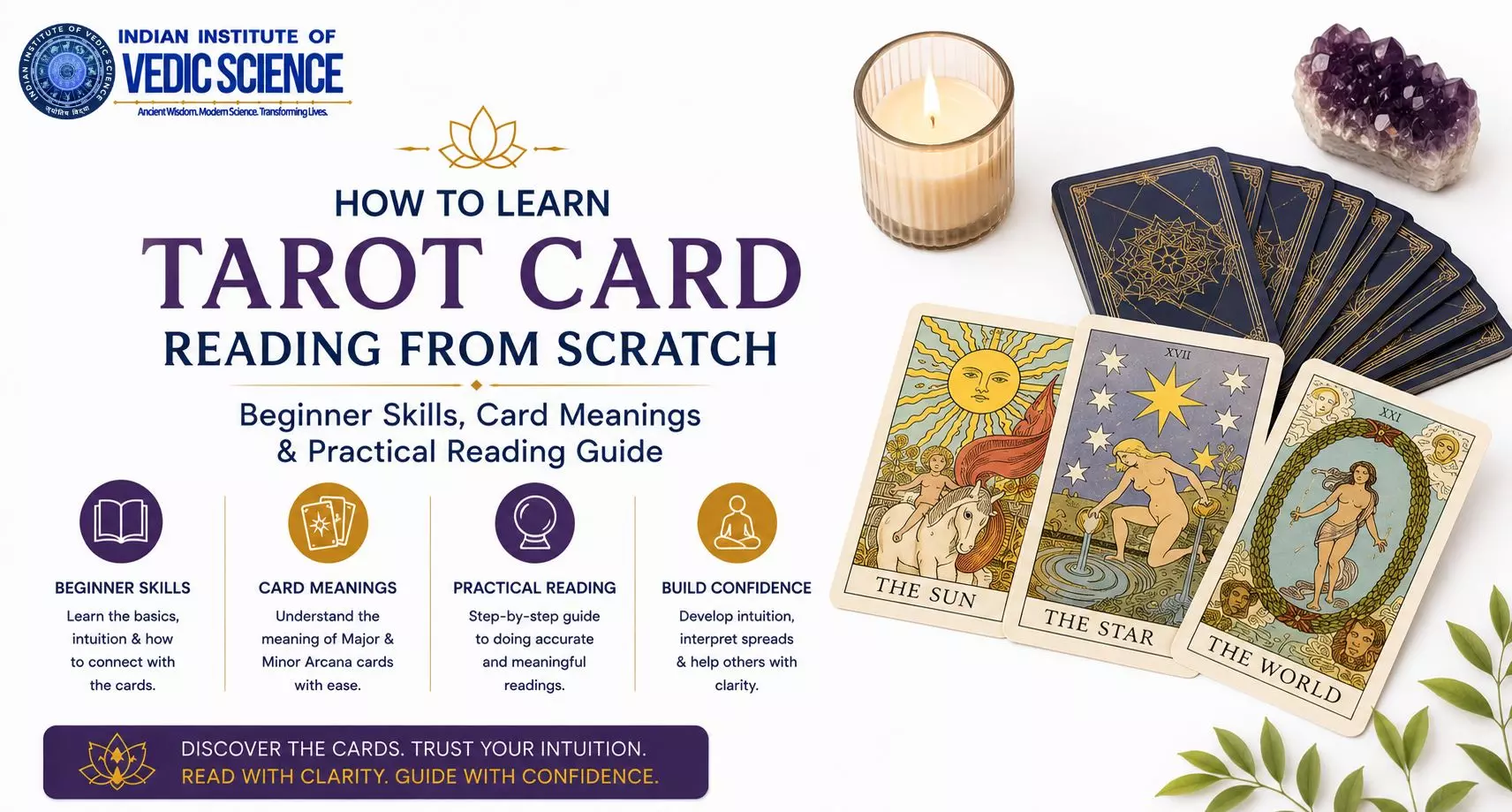
Tarot Card Reading Course: Learn Tarot with Expert Guidance
A tarot card reading course provides a structured way to understand tarot cards, their symbolism, traditional meanings, spreads, and practical interpretation.
Tarot reading is commonly used as a reflective and symbolic practice, where cards are interpreted in relation to a question, situation, or personal perspective.
For beginners, learning tarot through random videos or individual card meanings can become confusing. A structured course provides a logical learning sequence, practical examples, and guidance that helps students move from understanding individual cards to conducting complete readings.
Online learning also allows students to study Tarot from home with greater flexibility.
A structured Tarot course generally combines card knowledge with practical reading techniques.
- Understand the structure of a tarot deck.
- Learn Major and Minor Arcana.
- Study traditional card meanings and symbolism.
- Learn commonly used Tarot spreads.
- Understand card combinations and context.
- Practice complete Tarot readings.
- Develop intuitive and analytical interpretation skills.
- Learn responsible communication during readings.
What Is Tarot Card Reading?
Tarot card reading is a symbolic interpretation practice that uses a deck of cards to explore questions, situations, emotions, and possible perspectives.
Cards are arranged in specific layouts called spreads, and their meanings are interpreted according to the question and surrounding cards.
A standard Tarot deck contains 78 cards:
- Major Arcana: 22 cards traditionally associated with major themes, experiences, and archetypal ideas.
- Minor Arcana: 56 cards divided into four suits and generally connected with everyday situations and experiences.
A card does not always have one fixed meaning. Its interpretation can change depending on the question, spread, surrounding cards, and the reader's approach.
What Do You Learn in a Tarot Card Reading Course?
The curriculum differs between institutes, but a comprehensive tarot card reading course may include both theory and practical training.
- Tarot fundamentals: Learn the history, structure, terminology, and basic principles of Tarot.
- Major Arcana: Study the symbolism and traditional meanings of the 22 Major Arcana cards.
- Minor Arcana: Understand the four suits and their traditional associations.
- Court cards: Learn the traditional interpretations of Pages, Knights, Queens, and Kings.
- Card combinations: Understand how multiple cards can influence an interpretation.
- Tarot spreads: Explore one-card, three-card, relationship, career, and other common layouts.
- Reversed cards: Learn different approaches to interpreting reversed cards.
- Practical readings: Practice interpreting sample questions and complete spreads.
- Intuitive reading: Develop personal observation and intuitive interpretation alongside traditional meanings.
Why Is IIVS a Good Choice for Students?
The Indian Institute of Vedic Science (IIVS) provides students with an opportunity to study Tarot within a structured spiritual and traditional learning environment. For beginners, this type of guidance can make the subject easier to understand and practice.
Structured Curriculum
A planned curriculum helps students progress from basic card meanings to spreads, combinations, and complete readings without having to decide what to study next.
Practical Learning
Tarot is a skill that improves with practice. Working with actual cards and sample questions can help students understand how interpretations change according to context.
Expert Guidance
Instructor support gives students an opportunity to ask questions, clarify card meanings, and understand different approaches to Tarot interpretation.
Flexible Learning
Online learning can be useful for students and working professionals who want to study Tarot from home without being limited by location.
Broader Spiritual Education
Students interested in related subjects can also explore an occult science course and other traditional or spiritual learning areas according to their interests.
How Can Beginners Learn Tarot Card Reading?
To learn tarot card reading, beginners should avoid trying to memorize all 78 cards immediately. Starting with the structure of the deck and gradually moving toward practical readings makes the subject easier to understand.
A practical learning path can include:
- Begin with the Major Arcana.
- Learn the four Minor Arcana suits.
- Understand numbers and court cards.
- Study traditional card symbolism.
- Practice one-card readings.
- Move to three-card spreads.
- Learn common larger spreads.
- Study card combinations.
- Practice readings with different questions.
- Keep notes to track interpretations and observations.
Regular practice helps students develop their own reading style while maintaining a foundation in traditional Tarot meanings.
Can You Learn Tarot Through Tarot Reading Online?
Yes, tarot reading online programs can provide a convenient way to study Tarot from home. Depending on the institute, online learning may include live classes, recorded lessons, demonstrations, study materials, practical assignments, and instructor interaction.
When choosing an online program, check whether students receive opportunities to practice readings and ask questions. A course that combines theory with guided practice can be more useful than one that only provides recorded information.
What Should You Check Before Choosing a Tarot Course?
Choosing a Tarot program should involve more than comparing prices or course titles. Look at the actual learning experience.
Consider:
- Curriculum: Check whether Major and Minor Arcana are covered properly.
- Faculty: Look at instructor experience and teaching style.
- Practical training: Check whether students practice actual readings.
- Spreads: Ensure the program covers multiple reading techniques.
- Study material: Understand what resources are provided.
- Format: Compare live, recorded, and blended classes.
- Duration: Check the total learning period.
- Student support: Find out how questions are handled.
- Certification: Understand whether a certificate is offered and what it represents.
- Reviews: Consider genuine learner experiences where available.
How Much Does a Tarot Card Reading Course Cost?
The cost of a Tarot course varies depending on the institute, instructor, curriculum, course duration, learning format, study material, practical training, and certification.
Before enrolling, check whether the fee includes:
- Live or recorded classes.
- Study material.
- Practical sessions.
- Assignments or assessments.
- Instructor support.
- Certification.
- Additional learning levels.
Comparing the complete course structure is more useful than selecting a program solely because it has a lower fee.
How Long Does It Take to Learn Tarot?
The time required depends on the course depth and the student's practice schedule. Basic card meanings can be learned relatively quickly, but becoming comfortable with complete Tarot readings requires continued practice.
A comprehensive learning path may include:
- Tarot fundamentals.
- Major Arcana.
- Minor Arcana.
- Court cards.
- Card combinations.
- Tarot spreads.
- Reversed cards.
- Practical readings.
- Intuitive interpretation.
The goal should be to understand how cards work together rather than simply memorizing their meanings.
Can Tarot Reading Become a Career?
Some people study Tarot as a personal interest, while others develop it as a professional or complementary skill. Potential areas include Tarot consultations, workshops, educational content, social media, and spiritual guidance.
Professional outcomes depend on knowledge, communication skills, experience, audience building, reputation, business development, and the services offered. Completing a Tarot course does not guarantee a specific salary or career outcome.
Why Is Practical Training Important in Tarot?
Reading Tarot requires more than knowing individual card definitions. The same card can communicate a different idea depending on the question, spread, surrounding cards, and overall context.
Practical training helps students:
- Become comfortable handling the cards.
- Understand different spreads.
- Practice interpreting combinations.
- Learn how to frame questions.
- Improve communication during readings.
- Develop a consistent reading approach.
- Build confidence through repeated practice.
This is why students should look for courses that include guided examples and opportunities to perform readings.
Start Your Journey
A tarot card reading course can give beginners a structured way to understand tarot symbolism, the major and minor arcana, card combinations, spreads, and practical interpretation. Consistent practice is important for developing confidence and learning how cards work together in different contexts.
IIVS can be considered by students who want to explore Tarot within a structured spiritual and traditional learning environment.
If you want to learn tarot card reading, review the curriculum, instructor experience, practical training, duration, fees, student support, and certification details before choosing a course that fits your goals.
Begin your learning journey with IIVS to gain expert guidance, practical experience, flexible online learning, and recognized certification that supports your personal and professional development.
Frequently Asked Questions
1. Can beginners join a tarot card reading course?
Yes. Beginner-friendly Tarot courses generally start with deck structure, Major and Minor Arcana, basic symbolism, and simple spreads before introducing advanced interpretation and complete readings.
2. Can I learn tarot through tarot reading online?
Yes. Tarot reading online programs can include live classes, recorded lessons, demonstrations, study materials, and practical exercises. Students should check whether instructor interaction and guided practice are included.
3. How long does it take to learn Tarot?
Basic Tarot concepts can be learned relatively quickly, but developing confidence with complete readings takes regular practice. Learning all cards, spreads, combinations, and contextual interpretation requires additional time.
4. How many cards are in a Tarot deck?
A standard Tarot deck contains 78 cards, including 22 Major Arcana cards and 56 Minor Arcana cards. The Minor Arcana is traditionally divided into four suits with numbered and court cards.
5. Is Tarot scientifically proven?
Tarot is generally considered a symbolic or spiritual practice rather than a scientifically validated method for predicting future events. Readers may use it for reflection and interpretation rather than treating readings as scientific certainty.
6. Can tarot reading become a career?
Some learners develop tarot as a professional or complementary skill through consultations, workshops, education, or content creation. Career outcomes depend on experience, communication skills, audience, reputation, and individual business development.
7. Is certification available after learning tarot?
Some institutes offer certification after students complete their course requirements. Students should check whether assessments, practical work, attendance, or other conditions are required before enrolling in a certification program.