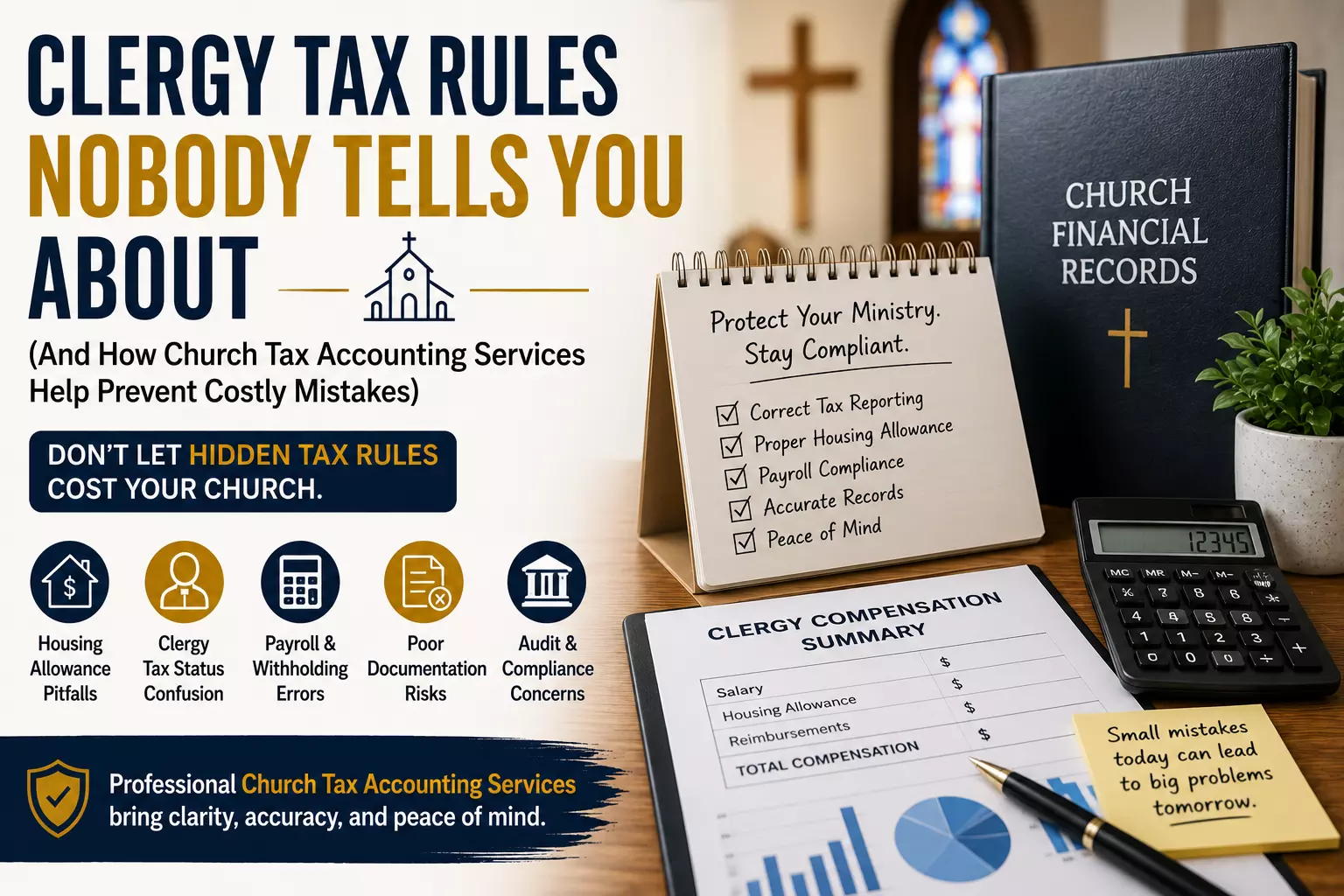
Struggling With Church Payroll? Here's What Most Ministries Get Wrong
Why church payroll is more complicated than most ministries expect
For many churches, payroll starts out simple.
A pastor receives compensation. Staff members are paid. Taxes are handled. Everything appears straightforward.
Then questions begin to surface.
Should housing allowance be included in taxable income? How should clergy be classified? Are payroll taxes being handled correctly? What records need to be maintained?
Suddenly, payroll becomes one of the most confusing administrative responsibilities a ministry faces.
The reality is that church payroll follows rules that are different from those used by most businesses. Unfortunately, many churches do not discover those differences until mistakes have already been made.
The biggest misconception: treating church payroll like business payroll
One of the most common mistakes ministries make is assuming church payroll works exactly like payroll in a traditional company.
It does not.
Pastors and ministers often have unique tax treatment that affects:
- Federal income taxes
- Social Security obligations
- Housing allowances
- Reimbursement plans
- Payroll reporting
A payroll process designed for a standard business may not address these requirements properly.
That is why many churches eventually seek specialized church payroll services rather than relying solely on general payroll systems.
Mistake #1: Misunderstanding clergy tax status
- This is perhaps the most frequent payroll error churches make.
- For income tax purposes, ministers are generally considered employees.
- However, for Social Security and Medicare purposes, ministers are often treated as self-employed.
- This unusual arrangement creates confusion for church administrators and volunteer treasurers alike.
- When payroll is set up incorrectly, ministers may face tax issues that are not discovered until months later.
Mistake #2: Improper housing allowance setup
Housing allowance is one of the most valuable tax benefits available to clergy.
Yet it is also one of the most commonly mishandled.
Many churches:
- Fail to designate housing allowance properly
- Approve it after the fact
- Keep insufficient documentation
- Report it incorrectly
A properly documented housing allowance can provide significant tax advantages. An improperly handled one can create unnecessary complications.
Strong church bookkeeping services often help ensure these designations are recorded correctly and supported by accurate documentation.
Mistake #3: Relying on spreadsheets for payroll management
Spreadsheets work well until they don't.
A small church with one employee may manage payroll manually for a while. But as ministries grow, manual
systems often become unreliable.
Common issues include:
- Calculation errors
- Missing payroll records
- Incorrect tax reporting
- Inconsistent payroll schedules
Even small mistakes can become larger compliance problems over time.
Mistake #4: Waiting until year end to review payroll records
Many churches operate under the assumption that payroll can be reviewed once tax season arrives.
That approach creates risk.
Payroll should be reviewed throughout the year.
Regular reviews help identify:
- Reporting inconsistencies
- Compensation errors
- Missing documentation
- Tax withholding issues
The sooner problems are identified, the easier they are to correct.
Why payroll mistakes often begin with bookkeeping
Payroll and bookkeeping are closely connected.
When financial records are inaccurate, payroll problems become much more likely.
Good church bookkeeping provides the foundation for:
- Accurate payroll processing
- Reliable financial reporting
- Budget planning
- Tax compliance
Without organized financial records, even the best payroll software can produce inaccurate results.
A practical example
Consider a growing church in Florida.
The ministry had three staff members and one pastor. Payroll was managed internally by a volunteer who handled bookkeeping part time.
Everything seemed fine until the end of the year.
During a financial review, leadership discovered:
- Housing allowance documentation was incomplete
- Payroll reports did not match accounting records
- Certain compensation items had been categorized incorrectly
None of the issues were intentional.
The church simply lacked a structured payroll process.
After implementing stronger payroll procedures and improving financial oversight, the ministry was able to correct reporting issues and simplify future payroll management.
The hidden cost of payroll mistakes
Most churches focus on the direct costs of payroll.
However, payroll mistakes often create hidden costs as well.
These may include:
- Administrative time spent fixing errors
- Penalties and interest charges
- Additional accounting expenses
- Increased stress for leadership teams
In some cases, leaders spend more time resolving payroll problems than they would have spent implementing proper systems in the first place.
Read: Top 10 Must-Have SaaS Tools for Finance Teams Today
Signs your church payroll process may need improvement
Many ministries do not realize they have payroll issues until a specific problem appears.
Common warning signs include:
Frequent payroll questions
If staff regularly ask questions about compensation, withholding, or tax documents, there may be underlying process issues.
Inconsistent reporting
Payroll reports should align with accounting records. If numbers frequently differ, further review is needed.
Limited documentation
Missing payroll records create risk during audits and financial reviews.
Leadership involvement in payroll corrections
Pastors and church leaders should not spend significant time fixing payroll errors.
When they do, it often indicates the system needs improvement.
How specialized payroll support helps
Church payroll requires knowledge that goes beyond standard payroll processing.
Specialized providers understand:
- Clergy compensation rules
- Housing allowance requirements
- Nonprofit payroll regulations
- Church specific reporting standards
Many churches also benefit when payroll support is integrated with church bookkeeping services, creating better consistency between payroll and financial reporting.
Organizations such as Prospera provide accounting and financial support designed specifically for
churches and nonprofit organizations, helping ministries establish more reliable systems for payroll and compliance.
What ministries should focus on instead
Church leaders are called to focus on ministry, community impact, and stewardship.
Payroll should support those goals, not distract from them.
That means building systems that are:
- Accurate
- Consistent
- Well documented
- Compliant with current regulations
The strongest payroll processes often operate quietly in the background, allowing ministry leaders to focus on
serving their congregation.
Final thoughts
Church payroll is one of the most overlooked administrative challenges many ministries face.
What appears simple on the surface often involves unique tax rules, documentation requirements, and reporting obligations that differ significantly from traditional payroll systems.
The good news is that most payroll problems are preventable.
By improving church bookkeeping, maintaining accurate records, and using appropriate church payroll services, ministries can reduce errors, improve compliance, and spend less time worrying about payroll details.
When payroll is handled correctly, churches gain something valuable: confidence that their financial operations are supporting their mission rather than creating obstacles.