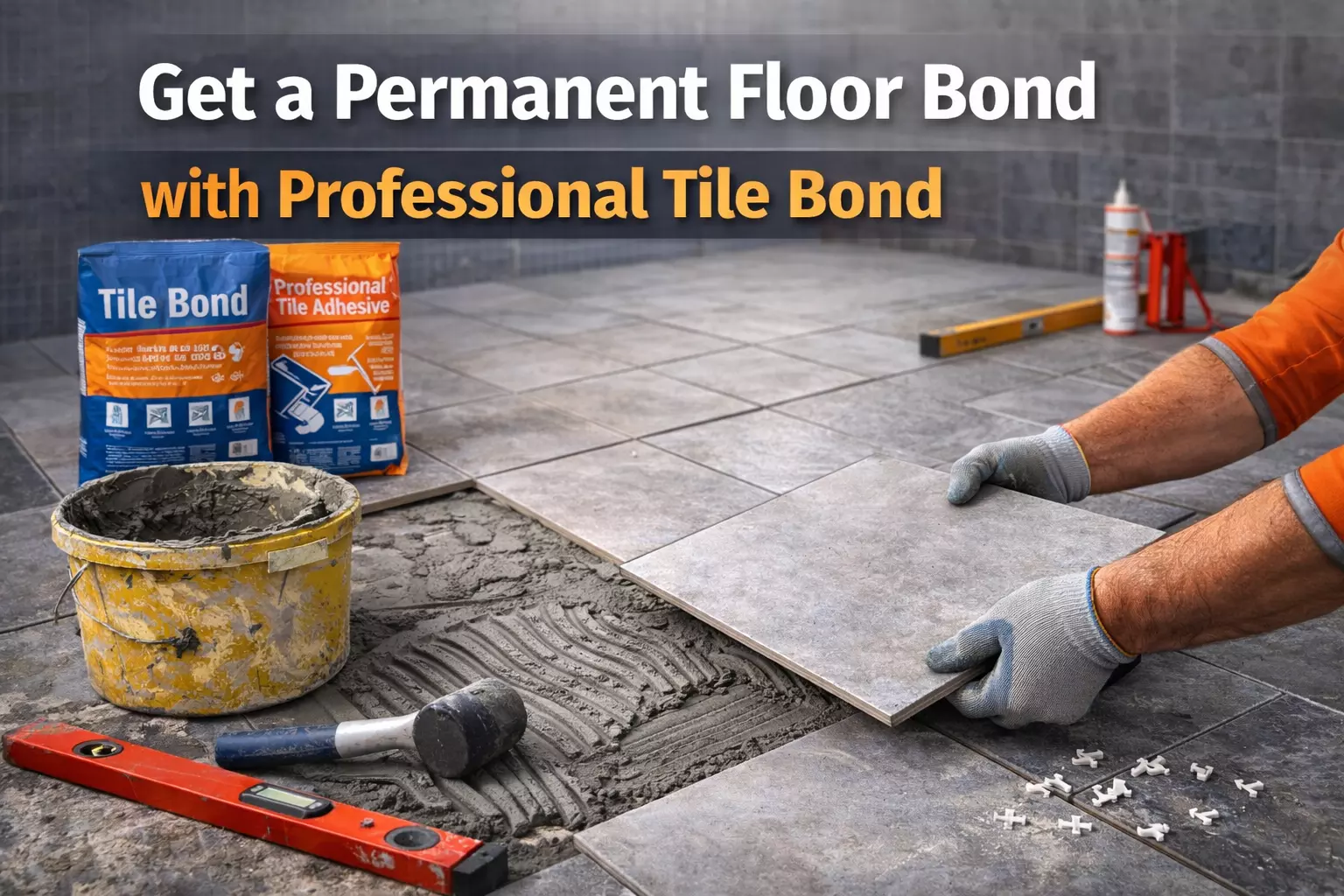
Stop Loose Tiles Forever: Switch to Industrial Tile Bond
I’ve walked across countless floors, from Lahore’s residential lounges to Karachi’s industrial estates, and one sound always makes me wince: that hollow "click-clack" underfoot. If you’ve heard it, you know the floor is failing. Most people blame the tile or a lazy mason, but after thirty years in this game, I’ve seen the real culprit relying on a basic sand-cement mix for a job it wasn't built for.
In our local climate, floors are living things that expand and contract with the heat. To keep a surface silent and level for decades, you have to stop thinking about "glue" and start thinking about Tile Bond. I’m talking about an industrial-grade bond that actually fuses with the concrete substrate.
Let's look at why the old ways are costing you a fortune and how the right polymer chemistry can save your project.
The Expensive Myth of the "Cheap" Cement Mix
We’ve all been tempted to save a bit of budget by sticking to the traditional sand-cement mortar. It worked for our grandfathers, right? Well, the tiles our grandfathers used were usually porous clay.
Today, we’re using dense, beautiful vitrified tiles and porcelain slabs. These materials are nearly non-porous. They don’t "soak up" cement water to create a bond. Instead, the cement just sits on the back like a dry biscuit.
From my experience, here is why that "cheap" method is a ticking time bomb:
- Thermal Expansion Struggles: When temperatures hit 40°C, tiles expand. Brittle cement has zero flexibility; it simply snaps, leading to tile popping and debonding.
- The Hollow Sound Trap: As cement dries, it shrinks. This creates air pockets. One heavy step or a dropped pot, and that hollow spot becomes a crack.
- Moisture Rot: In wet areas like bathrooms, water eventually seeps through grout. Traditional mortar turns into a soggy mess, while a professional Tile Bond acts as a secondary waterproof barrier.
Why Industrial Grade is the "Nuclear Option" for Floors
When I talk about Famsa’s Epoxy SE Tile Bond, I’m not just talking about another bag of powder. We’re talking about a polymer-modified powerhouse. This is what I call the "nuclear option" because it solves the problems that standard adhesives can’t touch.
Because Famsa has been manufacturing these chemicals since 1988, the formula is dialed in for the specific stresses of industrial environments.
What actually happens inside that bond?
Mechanical Grip: The polymers inside the bond reach into the microscopic pores of the tile and the floor, creating a tensile adhesion that is often stronger than the tile itself.
Zero-Shrinkage Setting: This is huge. Because it’s a shrinkage-free setting formula, the bond stays exactly the same volume from the moment it’s applied until it’s fully cured. No pulling away from the edges.
C2TE Improved Adhesive: In the world of international standards, this classification means the bond has high strength (C2), is slip-resistant (T), and has an extended open time adjustment (E).
Matching Your Bond to the Mission
One thing I’ve noticed is that people try to use a "one size fits all" approach. That’s a mistake. You need to match the chemistry to the material and the environment. Here is how I usually break it down for my clients:
- For Large Format Porcelain Slabs: You need high deformability. Large tiles move more, and a rigid bond will crack them. You need a bond that "breathes" with the building.
- For Swimming Pools To Fountains: You cannot even think of compromise here. You need a 100% waterproof bond that resists chlorine and constant hydrostatic pressure.
- For Commercial Kitchens: Here, you’re fighting grease, heat, and harsh cleaning chemicals. An Epoxy SE Tile Bond is the only thing that won’t degrade under those conditions.
- For "Tile-on-Tile" Renovations: If you don't want to rip up your old floor, you need an adhesive with extreme mechanical grip to bond to the smooth surface of the existing tile.
The Professional’s Checklist for a "Forever Bond"
You can buy the best Industrial Tile Bond in the world, but if the installation is sloppy, you’re still going to have issues. I always tell my team that the bond is only as good as the prep work. If you're overseeing a project, keep an eye on these four things:
Substrate Prep: If there is dust, oil, or old paint on the concrete substrate, the bond will stick to the dust, not the floor. Clean it until you could eat off it.
The "Back-Buttering" Secret: For large tiles, don't just put bond on the floor. Spread a thin layer on the back of the tile too. This ensures 100% coverage and zero air gaps.
Watch the Open Time: If the mason spreads too much bond at once, the surface "skins over" before the tile hits it. This is why a bond with an extended open time adjustment is a lifesaver in hot weather.
Anti-Sagging Verification: Especially on walls, ensure the bond has enough "grab." You don’t want your expensive tiles sliding down the wall while the adhesive is still wet.
Making the Smart Investment
Honestly, the difference in cost between a mediocre floor and an indestructible one is usually less than 2% of the total project budget. When you consider the cost of labor, the price of the tiles, and the sheer headache of a repair, skipping the high-quality Tile Bond just doesn't make sense. In many high-stress environments, we even integrate specialized epoxy resin technology into our formulas to ensure the bond is chemically resistant and physically unbreakable.
At Famsa Polymers Industry, we’ve spent 35 years making sure that when a builder puts a tile down, it stays down. We don't just sell chemicals; we sell the peace of mind that comes with knowing you’ll never have to hear that "click-clack" sound again. Whether you are fixing a single loose tile or flooring a massive industrial complex, do it once, and do it right.
So, what’s your next move? If you’re tired of "patching" things up and want to switch to a professional-grade solution, request a quote from us today. Let’s build something that actually lasts.
Read: Technical Engineering Help for Assignments
Frequently Asked Questions
1. Can I use Tile Bond over an existing painted floor?
I get asked this a lot. Honestly, it’s risky. The bond will only be as strong as the paint’s grip on the concrete. My advice? Scrape or sand the paint off to expose the concrete substrate for a true mechanical grip.
2. Why is Tile Bond better than just adding more cement?
Cement is rigid and shrinks. Tile Bond is polymer-modified, meaning it has a tiny bit of "give" to handle vibrations and temperature shifts without snapping the tensile adhesion.
3. How do I know if my mason is using enough bond?
Lift a tile occasionally right after he lays it. If you don't see 100% coverage on both the floor and the tile back (no "comb" lines showing), they aren't using enough.
4. Does industrial bond work for marble and natural stone?
Yes, but be careful! Natural stone is porous and can "bleed" if you use the wrong adhesive. For expensive marble, I always recommend an Epoxy SE Tile Bond to prevent staining and ensure a shrinkage-free setting.
5. How long should I wait before walking on a newly bonded floor?
Technically, most bonds set in 24 hours. But if you want to be safe especially in humid conditions give it 48 hours before you start moving heavy furniture back in. Patience now saves a cracked tile later.