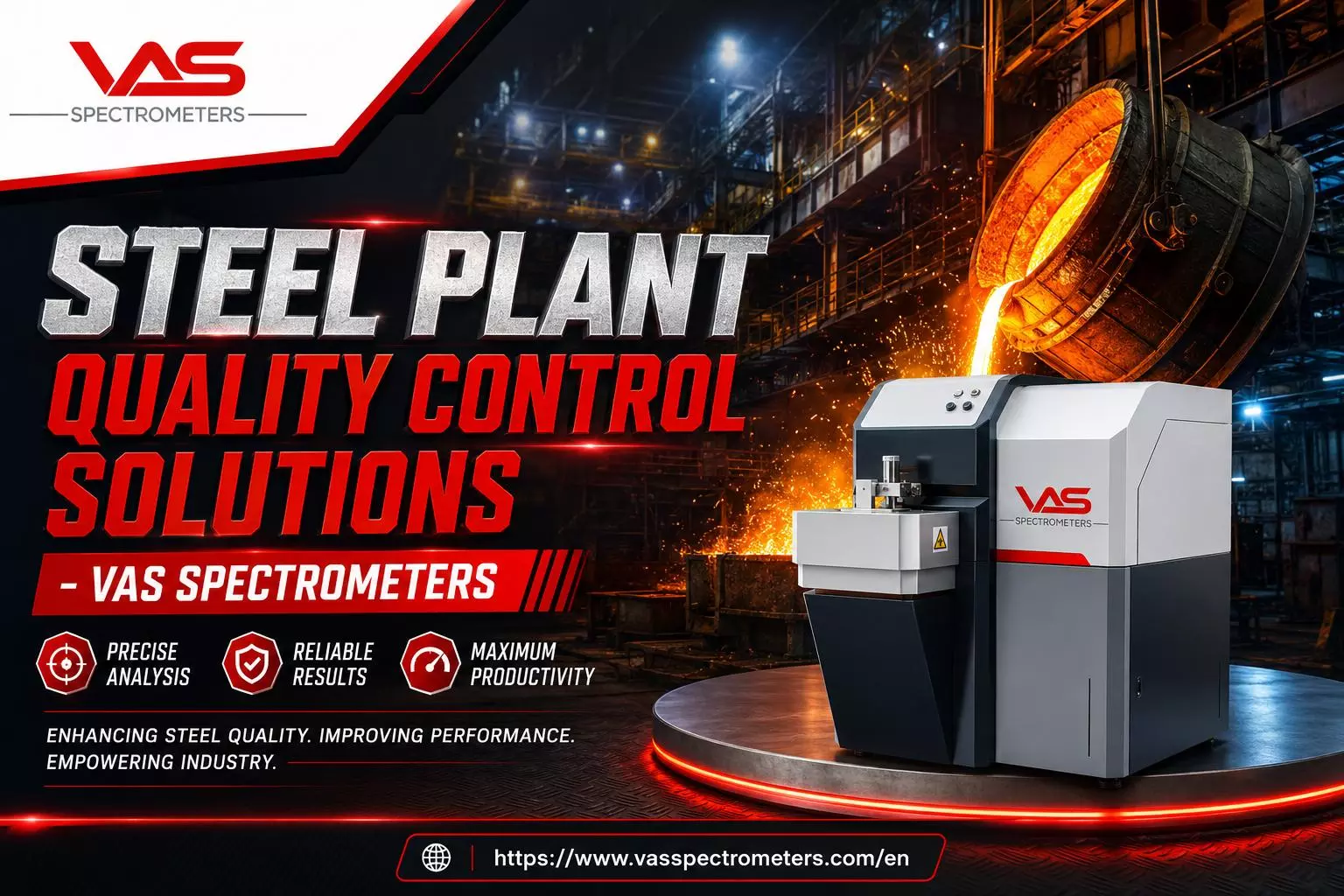
Steel Plant Quality Control Solutions: Why the Gold Plus XL Spectrometer Is Changing the Game
Walk onto the floor of any modern steel plant and you'll notice something immediately: nothing moves forward until the metal is verified.
A single batch of steel with the wrong carbon content, a missed trace of phosphorus, or an out-of-spec nitrogen level can mean rejected shipments, costly recalls, or worse, a structural failure down the line. This is why Steel plant quality control isn't a back-office formality. It's the backbone of every reliable steel operation.
For decades, plant managers have relied on optical emission spectrometers to answer one deceptively simple question: what exactly is in this metal?
Today, one instrument is earning a reputation as the benchmark for accuracy, speed, and reliability in this space — the Gold Plus XL spectrometer. In this article, we'll break down why quality control matters so much in steel manufacturing, how a modern Spectrometer for metal analysis actually works, and what makes the Gold Plus XL worth a serious look if you're upgrading your lab.
Why Quality Control Is Non-Negotiable in Steel Manufacturing
Steel is rarely just "steel." Every grade — from mild construction rebar to high-strength automotive sheet to specialty alloy tubing — is defined by a precise chemical recipe.
Carbon, manganese, silicon, phosphorus, sulfur, chromium, nickel, and dozens of other elements each play a role in determining hardness, ductility, weldability, and corrosion resistance. Get the ratios wrong, even by a fraction of a percent, and the final product can fail to meet the standard it was sold under.
That's what makes steel plant quality control such high-stakes work. A few realities make it especially demanding:
- Speed of production: Molten metal doesn't wait. Ladle and furnace decisions often need to happen in minutes, so lab results have to keep pace with the melt shop, not slow it down.
- Tightening industry standards: Automotive, aerospace, and infrastructure specifications are getting stricter every year, particularly around trace elements like nitrogen, boron, and residuals.
- Cost of getting it wrong: Reworking or scrapping an out-of-spec heat is expensive. A shipped batch that fails downstream testing is even costlier, both financially and reputationally.
- Traceability requirements: Many customers and regulators now expect full documentation of chemical composition for every batch, not just spot checks.
This is exactly the gap that optical emission spectrometry was built to close, and it's why investment in reliable testing equipment consistently pays for itself.
How a Spectrometer for Metal Analysis Actually Works
If you're newer to metallurgical testing, the concept behind a spectrometer for metal analysis is more intuitive than it sounds.
Every chemical element, when excited with enough energy, emits light at specific, unique wavelengths — think of it as an elemental fingerprint. Optical emission spectrometers use this principle to identify and measure exactly which elements are present in a metal sample, and in what concentration.
Here's the general workflow inside a modern metal analyzer:
- Sample preparation: A disc or pin sample is cut from the melt and its surface is ground flat and clean.
- Spark excitation: An electrical spark (or arc) is generated between an electrode and the sample surface, vaporizing a tiny amount of metal and exciting its atoms.
- Light capture: The excited atoms emit light as they return to a stable state. This light travels through the instrument's optical system.
- Wavelength separation: Using a diffraction grating or prism, the light is split into its component wavelengths, each corresponding to a specific element.
- Detection and calculation: High-resolution detectors (CCD or CMOS sensors) measure the intensity of each wavelength, and onboard software converts that data into precise elemental percentages.
The entire process, from spark to results on screen, typically takes just seconds — which is exactly why spectrometers have become the standard tool for real-time quality control in steel plants, foundries, and metal fabrication facilities worldwide.
Introducing the Gold Plus XL Spectrometer
Among the many optical emission spectrometers on the market, the Gold Plus XL spectrometer from VAS Spectrometers stands out for a simple reason: it was engineered specifically to meet the demanding testing requirements of modern steel and metal industries, without the premium price tag typically attached to high-end analytical instruments.
Here's what sets it apart on the plant floor:
Industry-Leading Nitrogen Analysis
One of the toughest challenges in ferrous metallurgy is accurately measuring nitrogen at trace levels, since it directly affects steel's mechanical properties and aging behavior.
The Gold Plus XL is built for nitrogen (N2) analysis down to 10 PPM, which helps plants meet increasingly strict steel industry standards for quality and compliance without needing separate specialized equipment.
High-Resolution Optics for Cleaner Data
The instrument uses advanced multi-high-resolution CMOS/CCD optics with 3 pm pixel resolution. In practical terms, this means it can distinguish between closely spaced spectral lines that a lower-resolution system might blur together — translating into more reliable differentiation between similar elements and fewer false readings.
Fast Startup, Less Downtime
Traditional spectrometers can require lengthy warm-up and stabilization periods before they're ready to deliver trustworthy results.
The Gold Plus XL's Quick Startup Technology gets the instrument ready for reliable analysis in roughly 10 minutes, which matters a great deal in a melt shop where every idle minute has a cost attached to it.
Stable, Precise Spark Source
A 100 kHz real-time regulated spark system keeps the excitation discharge highly stable from spark to spark.
Consistent excitation is one of the biggest factors behind repeatable results, and it's part of why operators report tighter, more trustworthy readings across multiple samples of the same heat.
Rugged 5-Axis Monoblock Optics
The optical bench itself is built on a 5-axis Monoblock design, engineered for mechanical and thermal stability. This matters more than people realize: even small vibrations or temperature shifts inside an instrument can quietly drift calibration over time.
A stable optical platform means the instrument holds its accuracy longer between recalibrations, which reduces both maintenance headaches and unplanned downtime.
Broad Elemental Coverage
The Gold Plus XL can analyze more than 56 elements across ferrous and non-ferrous bases, with low PPM detection limits.
That range means a single instrument can typically handle carbon steel, alloy steel, and stainless-steel testing needs, along with select non-ferrous applications, rather than requiring multiple dedicated units.
Read: Ointment Plant: Raw Materials and Production Process
What This Means for Your Quality Control Process
Put those features together and the practical benefits become clear for anyone running a lab or melt shop:
- Faster decision-making: Rapid startup and quick spark-to-result cycles mean furnace operators get composition data while there's still time to adjust the heat, rather than after the fact.
- Fewer disputes with customers: High-resolution, repeatable data reduces the chance of composition disagreements during quality audits or customer certification checks.
- Lower cost of ownership: Stable optics and a maintenance-light design mean less time spent on recalibration and servicing, and more time running production.
- Compliance-ready reporting: With trace-level nitrogen and broad multi-element capability, plants are better positioned to meet the stricter specifications now common in automotive, construction, and structural steel contracts.
For plant managers evaluating new equipment, it's worth thinking of a spectrometer not as a lab accessory but as a production tool. The right instrument shortens the feedback loop between "what's in the ladle" and "what correction do we need to make," and that loop is where quality — and profitability — is actually won or lost.
Choosing the Right Spectrometer for Your Steel Plant
Not every facility needs the same setup, so it's worth thinking through a few questions before you commit to a specific analyzer:
- What elements and PPM ranges matter most to your product mix? If your customers require certified low-nitrogen or low-residual steel, prioritize instruments with proven trace-element performance.
- How much downtime can your melt shop tolerate? If your furnace cycle is fast, a slow-starting or high-maintenance spectrometer will become a bottleneck no matter how accurate it is.
- Do you need coverage beyond ferrous metals? If your plant occasionally tests aluminum, copper, or other non-ferrous alloys, look for an instrument with a genuinely broad base library rather than one that's ferrous-only.
- What's your total cost of ownership, not just the sticker price? Argon consumption, consumable costs, and recalibration frequency add up over years of operation, so factor those in alongside the upfront investment.
Instruments like the Gold Plus XL spectrometer are designed around exactly this kind of real-world usage pattern, which is part of why they've found a home in steel plants that need dependable, high-volume testing without the overhead of enterprise-grade lab equipment.
Final Thoughts
Quality control in steel manufacturing has never been a "nice to have." It's the mechanism that protects your product, your customers, and your reputation, heat after heat, shipment after shipment.
As specifications tighten and margins get thinner, the instruments doing that verification work need to keep up — delivering fast, accurate, repeatable results without adding friction to production.
That's the space where a well-designed spectrometer for metal analysis earns its keep, and it's exactly the problem the Gold Plus XL spectrometer was built to solve.
Whether you're setting up quality control in a new facility or replacing an aging analyzer, it's worth evaluating your options against the standard that instruments like this one are setting: fast startup, trace-level precision, and the kind of mechanical stability that keeps results trustworthy shift after shift.
Strong steel plant quality control isn't about adding more steps to your process. It's about giving your team the right data, at the right moment, to make the right call — and that starts with the spectrometer on your lab bench.