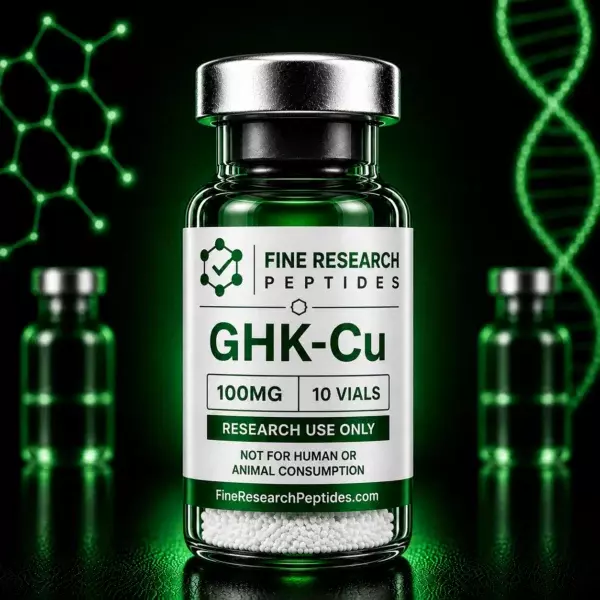
Sourcing GHK-Cu Research Peptide for Skin and Tissue Assays
In regenerative dermatology, connective tissue biochemistry, and wound healing research, the tripeptide-copper complex GHK-Cu ($Glycyl\text{-}L\text{-histidyl}\text{-}L\text{-lysine}\text{-copper}$) represents one of the most thoroughly documented signaling molecules.
Discovered in human plasma in 1973, GHK is a naturally occurring peptide fragment with a remarkably high binding affinity for divalent copper ions ($Cu^{2+}$).
The primary biological role of the GHK sequence is to bind $Cu^{2+}$ ions safely and transport them directly to cellular receptors. This delivery system modulates gene expression, drives extracellular matrix (ECM) remodeling, and suppresses chronic tissue inflammation.
For research laboratories evaluating dermal fibroblast proliferation, collagen synthesis, and tissue regeneration models, sourcing high-purity ghk-cu research peptide reagents provides a reliable model to study gene-level connective tissue repair.
1. Molecular Mechanisms: ECM Synthesis and Genomic Modulation
Unlike simple surface-acting cosmetics or non-specific growth factors, GHK-Cu functions at the genomic level.
Broad gene profiling studies show that GHK-Cu alters the expression of over 4,000 human genes—upregulating tissue repair pathways while downregulating pro-inflammatory and pro-apoptotic genes.
The primary mechanisms activated by GHK-Cu include:
- Extracellular Matrix Biosynthesis: GHK-Cu directly stimulates dermal fibroblasts, increasing the mRNA expression and protein synthesis of collagen types I and III, elastin, and glycosaminoglycans (GAGs) such as decorin and hyaluronic acid.
- MMP and TIMP Regulation: Healthy tissue remodeling requires controlled degradation of damaged matrix proteins alongside new synthesis. GHK-Cu modulates the balance between matrix metalloproteinases ($MMP\text{-}1, MMP\text{-}2$) and their tissue inhibitors ($TIMP\text{-}1, TIMP\text{-}2$), accelerating organized matrix turnover without causing tissue breakdown.
- Antioxidant and Anti-Inflammatory Gene Profiles: GHK-Cu suppresses pro-inflammatory cytokine expression ($NF\text{-}\kappa B, TNF\text{-}\alpha, IL\text{-}6$) while upregulating antioxidant enzymes (superoxide dismutase, catalase). This protective shift reduces oxidative stress in damaged tissue microenvironments.
- Angiogenesis and Microvascular Repair: By upregulating basic fibroblast growth factor ($bFGF$) and vascular endothelial growth factor ($VEGF$), GHK-Cu accelerates microvascular capillary formation, improving oxygenation and nutrient delivery to regenerating tissue beds.
To achieve reliable results across cell culture and tissue explant models, securing analytical-grade material is essential. Choosing a certified domestic supplier ensures access to verified ghk-cu peptide for sale lots that maintain consistent copper-chelation ratios.
2. Preclinical Efficacy Across Wound Healing and Tissue Regeneration
In preclinical wound models, burn recovery studies, and hair follicle culture assays, GHK-Cu demonstrates broad tissue-repair capabilities.
Key experimental outcomes documented across dermatological literature include:
- Accelerated Wound Closure: In full-thickness dermal wound assays, topical or local administration of GHK-Cu increases collagen density, enhances re-epithelialization, and speeds up overall wound closure compared to untreated controls.
- Scar Reduction and Matrix Organization: By balancing $MMP$ activity with $TIMP$ expression, GHK-Cu prevents excessive collagen deposition, promoting organized dermal architecture rather than hypertrophic scar formation.
- Hair Follicle Remodeling: In follicular dermal papilla models, GHK-Cu stimulates papilla cell proliferation and enlarges hair follicle size, encouraging the transition from the inactive telogen phase to the active anagen growth phase.
3. Analytical Benchmarks for High-Purity Copper Tripeptide Sourcing
GHK-Cu synthesis involves both solid-phase peptide assembly and precise copper chelation ($1:1$ molar stoichiometry).
Substandard synthesis can leave unchelated peptide sequences or excess free $Cu^{2+}$ ions, both of which introduce cellular toxicity and alter experimental data.
Analytical Parameter
Low-Tier Global Imports
Certified USA Research Standard
Preclinical Impact
RP-HPLC Purity Profile
Variable (80–90%)
Guaranteed $\ge$98% per batch
Prevents truncated peptide fragments from altering fibroblast assays
Copper Chelation Ratio
Imbalanced ($<1:1$)
Precise $1:1$ molar complex
Prevents free $Cu^{2+}$ Fenton reaction toxicity in cell culture
Endotoxin Level (LAL)
High risk ($>0.5\text{ EU/mg}$)
Strict $\le0.25\text{ EU/mg}$ benchmark
Prevents $TLR4$-mediated inflammatory background noise
Counter-Ion Profile
High residual $TFA$ salts
Acetate/salt-exchanged options
Preserves neutral cell culture pH and eliminates local cell toxicity
When evaluating suppliers to find the best place to buy ghk cu peptide options, research institutions should prioritize domestic vendors that provide lot-specific Reverse-Phase High-Performance Liquid Chromatography (RP-HPLC) and Atomic Absorption Spectroscopy (AAS) verification.
Read: BC9 vs Peptide Pros: Which Peptide Supplier Stands Out
4. Reconstitution Protocols and Solution Preservation
Maintaining the stability of reconstituted copper peptide solutions is critical for extended tissue culture protocols. While the GHK-Cu complex is relatively stable in aqueous media, improper storage or microbial contamination can lead to peptide bond cleavage and copper dissociation.
When reconstituting multi-dose vials for extended cell culture assays, using unpreserved sterile water creates a risk of airborne bacterial contamination upon repeated vial entries. Introduced bacteria secrete peptidases that rapidly degrade the tripeptide chain, releasing free copper into the medium.
To safeguard reagent stability:
- Preserved Reconstitution Vectors: Dissolve lyophilized GHK-Cu powder using high-grade bacteriostatic water for peptides containing 0.9% USP-grade benzyl alcohol. Reconstitution media supplied in bacteriostatic water 10ml or 10ml bacteriostatic water formats inhibit bacterial growth and preserve compound stability for up to 28 days under refrigeration ($2^\circ\text{C}$ to $8^\circ\text{C}$).
- Gentle Dissolution Technique: Direct the stream of bacteriostatic water for reconstituting peptides slowly down the inner glass wall of the vial. Gently swirl until fully dissolved; avoid vigorous shaking or vortexing, which can introduce mechanical shear stress.
5. Endotoxin Control and Preclinical Precision
Bacterial endotoxins (lipopolysaccharides, or LPS) present a major confounding variable in dermal remodeling
In primary dermal fibroblast assays, keratinocyte cultures, and tissue explants, trace endotoxin levels bind to Toll-like receptor 4 ($TLR4$).
This binding triggers an NF-$\kappa$B pro-inflammatory response ($TNF\text{-}\alpha$, $IL\text{-}6$), inducing artificial inflammatory stress and upregulating destructive $MMP$ enzymes. This background noise masks the anti-inflammatory and regenerative signals of GHK-Cu.
Selecting reagents verified via Limulus Amebocyte Lysate (LAL) testing guarantees endotoxin levels remain strictly below $0.25\text{ EU/mg}$. Combined with expedited domestic cold-chain shipping, this preserves compound bioactivity and ensures clean, publishable experimental data.
Advancing Connective Tissue Biochemistry
The study of GHK-Cu signaling represents a foundational model in regenerative dermatology and tissue biochemistry.
By modulating thousands of repair-related genes, accelerating collagen and elastin synthesis, balancing $MMP/TIMP$ ratios, and delivering essential copper ions without oxidative toxicity, GHK-Cu serves as a versatile tool for tissue engineering and wound recovery research.
For laboratories establishing protocols to buy peptides online for research use, adhering to strict analytical standards—including $\ge98\%$ HPLC purity, verified $1:1$ copper chelation,
LAL endotoxin screening, and proper preserved reconstitution techniques—is essential. Sourcing analytical-grade materials empowers research teams to generate reliable, reproducible, and publication-ready scientific datasets.