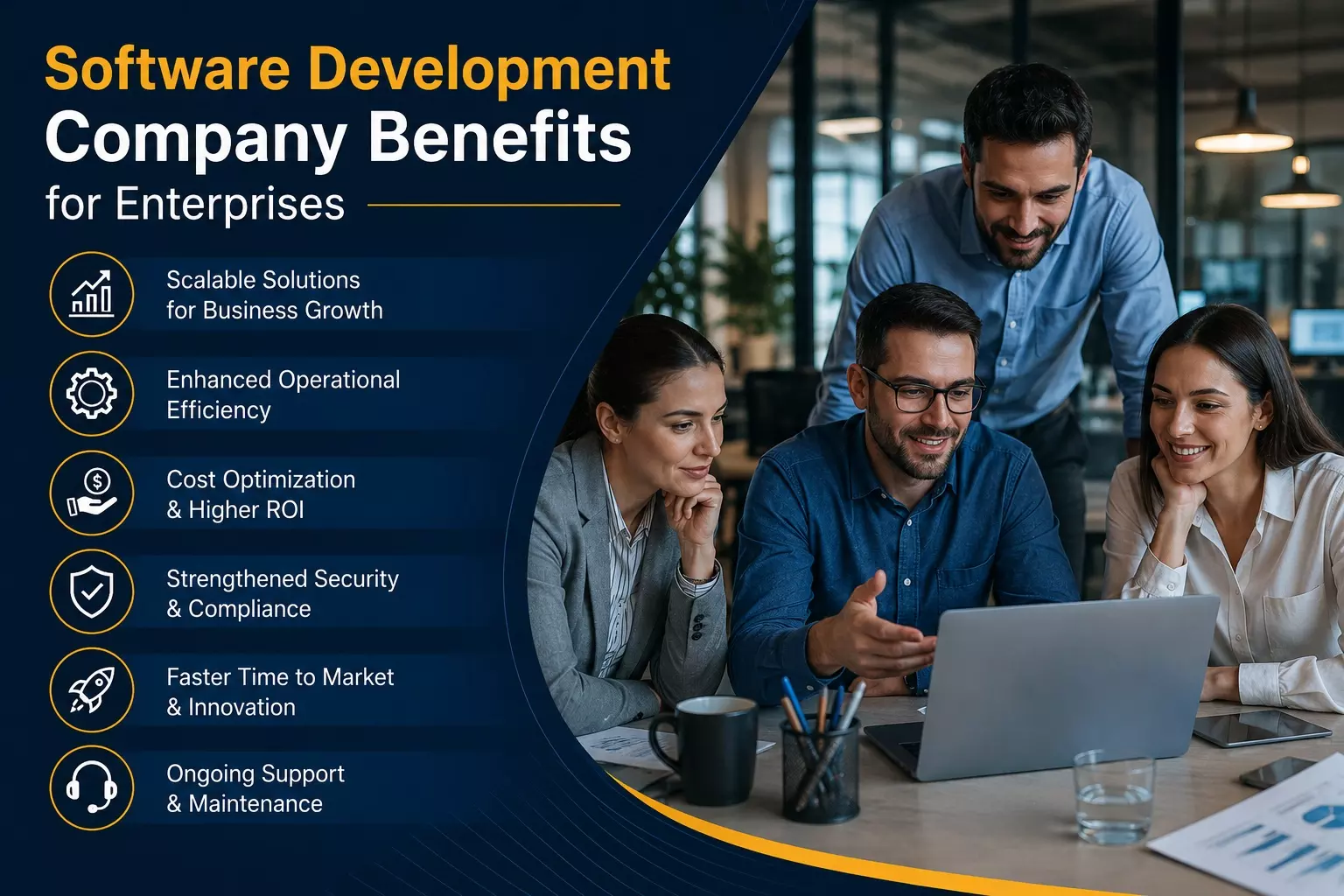
Software Development Company Benefits for Enterprises
Enterprise businesses operate differently from startups and small companies. Their systems are larger, workflows are more complex, and the impact of technical failure is significantly higher.
A slow internal platform, disconnected departments, or outdated software can affect revenue, operations, compliance, and customer trust at the same time.
This is why enterprises increasingly rely on software development companies instead of depending only on internal teams or off-the-shelf tools. The right development partner does more than write code.
It helps enterprises modernize systems, improve efficiency, scale infrastructure, and reduce long-term operational risk.
This article explains the real benefits enterprises gain from working with a software development company and why custom-built systems have become critical for long-term business growth.
Enterprise Challenges Cannot Be Solved with Generic Software
Most enterprise organizations eventually outgrow standard platforms.
At first, prebuilt software may seem practical because implementation is faster and initial costs appear lower.
Over time, limitations become visible:
- Systems stop fitting internal workflows
- Integrations become difficult
- Performance decreases under scale
- Security concerns increase
- Teams begin relying on manual processes
Large organizations cannot operate efficiently when departments are disconnected or dependent on outdated systems.
This creates a need for tailored solutions designed around enterprise operations rather than forcing operations to adapt to software limitations.
Why Enterprises Work with Software Development Companies
Building software internally is not always practical for enterprises. Internal teams often focus on maintaining existing infrastructure, handling security operations, or supporting day-to-day technical issues.
A dedicated software development company brings:
- Specialized engineering expertise
- Experience across industries
- Structured delivery processes
- Scalability-focused architecture
More importantly, external development teams provide perspective. They identify inefficiencies that internal departments may overlook because of familiarity with existing systems.
For enterprises, this outside expertise becomes valuable during digital transformation initiatives.
Custom Systems Improve Operational Efficiency
Enterprise operations involve multiple departments, approval chains, reporting systems, and data sources.
When systems are disconnected, employees waste time switching between tools, duplicating data, and handling avoidable administrative tasks.
Custom software solves this by centralizing workflows.
For example:
A logistics company managing inventory, shipping, customer communication, and supplier tracking across separate platforms may experience delays and inconsistent reporting.
A custom-built enterprise platform can unify these processes into one system, reducing operational friction and improving visibility across departments.
This improves:
- Productivity
- Reporting accuracy
- Communication speed
- Decision-making efficiency
The impact becomes measurable at scale.
Better Scalability for Growing Enterprises
Growth exposes technical weaknesses quickly.
A platform that supports 5,000 users may fail at 500,000 users if scalability was never considered during development.
Enterprises require systems capable of handling:
- High transaction volumes
- Large databases
- Multi-region operations
- Concurrent user activity
Scalable software architecture ensures performance remains stable as demand increases.
This is one of the major reasons enterprises invest in custom platforms instead of relying entirely on generic SaaS products.
Strong software architecture supports future expansion without requiring complete system rebuilds.
Enterprise Security Requires Specialized Development
Security is one of the biggest concerns for enterprise businesses.
Large organizations manage:
- Customer records
- Financial data
- Internal business intelligence
- Employee information
- Operational infrastructure
A single security vulnerability can result in:
- Financial loss
- Regulatory penalties
- Reputation damage
- Operational downtime
Software development companies with enterprise experience understand how to build systems with layered security measures.
This includes:
- Role-based access control
- Encrypted data handling
- Secure API communication
- Threat monitoring systems
- Audit logging
Security cannot be treated as an add-on feature. It must be integrated into the architecture itself.
Enterprise Software Must Support Complex Integrations
Modern enterprises use multiple platforms simultaneously.
Examples include:
- ERP systems
- CRM platforms
- Payment gateways
- HR software
- Analytics tools
Disconnected systems create inefficiencies and inconsistent data.
Software development companies help enterprises create unified ecosystems where systems communicate effectively through APIs and centralized data structures.
This reduces:
- Manual work
- Reporting inconsistencies
- Operational delays
Integration capability becomes increasingly important as enterprises adopt more digital tools.
Long-Term Flexibility Is a Competitive Advantage
Technology changes constantly.
Businesses that cannot adapt quickly lose operational efficiency and market relevance.
Off-the-shelf platforms limit flexibility because businesses depend on external vendors for updates, features, and customization.
Custom enterprise software gives organizations greater control over:
- Features
- Infrastructure
- Security standards
- Workflow changes
This flexibility allows enterprises to evolve systems based on business goals instead of vendor limitations.
That level of control becomes critical during expansion, restructuring, or industry shifts.
Reduced Dependency on Multiple Vendors
Many enterprises rely on numerous software providers simultaneously.
This creates problems such as:
- Licensing costs
- Data fragmentation
- Vendor lock-in
- Compatibility issues
Custom systems reduce this dependency by consolidating functions into a centralized platform tailored to the organization’s operations.
Instead of paying for several disconnected subscriptions, enterprises gain a unified solution built around their needs.
Over time, this reduces operational complexity significantly.
Enterprise Software Development Improves Decision-Making
Enterprises generate large amounts of data every day.
Without centralized systems, valuable insights remain fragmented across departments.
Custom software platforms improve visibility by connecting data sources into a unified reporting environment.
Executives gain access to:
- Real-time operational metrics
- Financial reporting
- Performance analytics
- Customer behavior insights
This improves strategic planning and allows faster decision-making based on accurate information.
Businesses that rely on disconnected spreadsheets and manual reporting often struggle to react quickly in competitive markets.
Modern Enterprises Need Automation
Manual processes create bottlenecks.
Enterprises often lose thousands of work hours because employees handle repetitive administrative tasks manually.
Software automation improves efficiency by handling:
- Data synchronization
- Approval workflows
- Notifications
- Reporting processes
- Inventory tracking
Automation reduces human error while increasing operational speed.
A software development company can design automation workflows specifically aligned with enterprise operations instead of forcing businesses into generic automation templates.
The Importance of User Experience in Enterprise Software
Many enterprise systems fail because employees avoid using them.
Complex interfaces reduce productivity and increase training requirements.
Modern enterprise software must prioritize usability.
Well-designed systems improve:
- Employee adoption
- Workflow speed
- Training efficiency
- Data accuracy
Software development companies that understand enterprise UX design create systems that employees can navigate efficiently without unnecessary complexity.
This directly impacts operational performance.
Compliance and Regulatory Readiness
Enterprises operating in sectors such as healthcare, finance, and logistics face strict compliance requirements.
Examples include:
- GDPR
- HIPAA
- PCI DSS
Failure to meet compliance standards can result in severe penalties.
Experienced development companies build systems designed around regulatory requirements from the beginning.
This includes:
- Audit trails
- Secure data handling
- Access control systems
- Compliance reporting features
Trying to retrofit compliance later is significantly more expensive and risky.
Read: Best Software Development Services Company In Vaishali
Understanding the Real Software Development Cost
Many enterprises focus too heavily on upfront pricing.
This creates short-term thinking.
The real Software Development Cost is not limited to initial development. It also includes:
- Maintenance
- Security updates
- Downtime risks
- Performance optimization
- Rebuild expenses
Cheap development often leads to higher long-term operational costs because systems require frequent fixes and restructuring.
Enterprises benefit more from stable, scalable systems designed correctly from the beginning.
The goal is not simply reducing development expense. The goal is reducing operational inefficiency and long-term technical debt.
Enterprise Software Development Services Create Long-Term Value
Businesses often underestimate the strategic value of technology.
Enterprise systems influence:
- Customer experience
- Operational speed
- Internal collaboration
- Revenue generation
This is why enterprise software development services are no longer viewed as technical support functions alone. They are directly connected to business performance.
The right software infrastructure improves efficiency across the organization while supporting future scalability and innovation.
Real-World Example: Manufacturing Enterprise Transformation
A manufacturing company relied on separate systems for inventory, procurement, production scheduling, and reporting.
Problems included:
- Delayed reporting
- Inventory mismatches
- Communication gaps between departments
A software development company built a centralized enterprise platform connecting all operational departments.
Results included:
- Faster production planning
- Improved inventory accuracy
- Reduced administrative overhead
- Better reporting visibility
The transformation was not about adding more software. It was about creating a system aligned with operational reality.
Why Internal Teams Alone Are Not Always Enough
Internal development teams understand company processes deeply, but they may lack specialized experience in large-scale transformation projects.
External software development companies contribute:
- Cross-industry expertise
- Architecture specialization
- Dedicated project delivery frameworks
This combination allows enterprises to move faster while maintaining stability.
The strongest enterprise outcomes often come from collaboration between internal stakeholders and external engineering experts.
Enterprise Modernization Is No Longer Optional
Many enterprises still operate on outdated legacy systems.
These systems create:
- Security vulnerabilities
- Maintenance challenges
- Integration limitations
- Performance issues
Modernization is no longer optional because digital infrastructure now directly impacts competitiveness.
Enterprises that delay modernization often face larger transition costs later.
Working with experienced software development companies helps organizations modernize gradually without disrupting critical operations.
Final Thoughts
Enterprise businesses require more than basic software solutions. They need systems designed for complexity, scale, security, and long-term adaptability.
A software development company helps enterprises build technology infrastructure aligned with business goals instead of relying on disconnected tools and temporary fixes.
The benefits extend beyond software itself.
Enterprises gain:
- Operational efficiency
- Better scalability
- Stronger security
- Improved decision-making
- Greater flexibility
Technology is no longer separate from business strategy. In modern enterprises, technology defines operational capability.