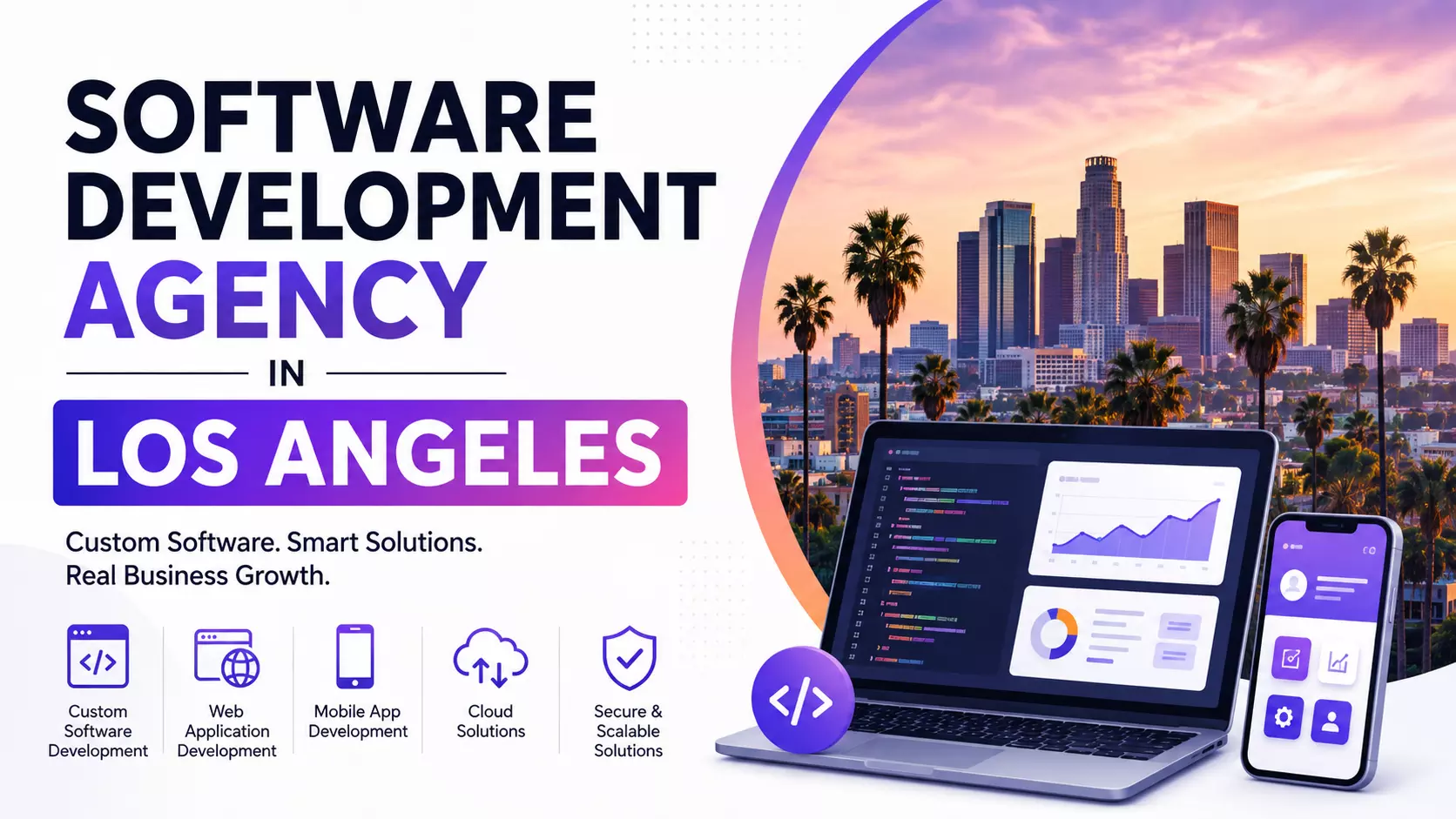
How to Choose a Software Development Agency in Los Angeles
Los Angeles has become an important technology hub alongside its established strengths in entertainment, media, aerospace, ecommerce, and consumer brands.
The region also has a growing software ecosystem covering areas such as artificial intelligence, robotics, fintech, hospitality technology, real estate, and business software.
For businesses operating in this environment, software is no longer simply an internal tool. A well-built application can improve customer experiences, automate repetitive work, connect disconnected systems, or become the foundation of an entirely new business.
That is why choosing the right software development agency in Los Angeles requires more than comparing portfolios or development rates. Businesses need a development partner that understands their objectives, technical requirements, users, budget, and plans for future growth.
What Does a Software Development Agency Do?
A software development agency helps businesses plan, design, build, test, launch, and maintain digital products.
Depending on the agency, services can include web applications, mobile applications, custom business software, APIs, cloud solutions, integrations, automation, and software modernization.
The important difference between custom development and an off-the-shelf product is flexibility. Instead of changing business processes to fit an existing application, custom software can be designed around the way an organization actually operates.
A typical development engagement starts with understanding the business problem. The team then defines requirements, plans the architecture, designs the user experience, develops the software, tests its functionality, and prepares it for launch.
Good development does not end when the application goes live. Maintenance, security updates, performance improvements, integrations, and new features may all become part of the product's longer-term lifecycle.
Why Los Angeles Businesses Invest in Custom Software
Los Angeles has a particularly diverse technology environment. Local businesses and startups operate across entertainment, ecommerce, media, healthcare, aerospace, real estate, hospitality, finance, and other sectors.
Current industry directories also show a broad software ecosystem covering AI, robotics, recruiting, logistics, hospitality, and real estate.
This diversity creates very different software requirements.
A growing ecommerce company may need a custom order management system. A media business might require a content platform with specialized workflows.
A service company could benefit from automated scheduling and customer management. A startup may need an MVP that can later evolve into a larger product.
Off-the-shelf software can work well for standardized requirements. However, businesses often consider custom development when existing tools create unnecessary manual work, lack important functionality, or cannot communicate effectively with other systems.
Services You Can Expect From a Software Development Agency
The exact service portfolio varies between agencies, but a full development partner may support several stages of the software lifecycle.
Custom Software Development
Custom software is developed around specific business requirements rather than a generic use case. It can include internal business applications, customer portals, dashboards, workflow systems, marketplaces, and other specialized platforms.
The goal is not simply to create more software. It is to solve a particular operational or customer problem with a system that can evolve as requirements change.
Web and Mobile Application Development
Web applications can provide customers or employees with browser-based access to products and services. Mobile applications can extend those experiences to iOS and Android devices.
Successful application development involves more than writing code. User experience, performance, security, accessibility, backend architecture, and future maintenance all need to be considered during development.
API Development and System Integration
Many businesses already use several applications to manage different parts of their operations. Problems arise when these systems do not share information effectively.
API development and integration can connect applications such as CRM, ecommerce, payment, inventory, accounting, or logistics platforms. This can reduce duplicate data entry and help information move between systems more consistently.
Legacy Software Modernization
Older software can become expensive to maintain while remaining essential to daily operations.
Modernization can involve updating the technology stack, improving the interface, replacing individual components, connecting the system with newer applications, or gradually rebuilding important functionality.
A phased approach can sometimes reduce disruption compared with replacing an entire system at once.
Automation and Business Applications
Custom software can also automate repetitive business processes. Examples include approval workflows, reporting, document processing, employee portals, notifications, customer onboarding, and administrative tasks.
Automation should begin with identifying where time is being lost. Building technology without understanding the underlying process can simply move an inefficient workflow into a new system.
How the Development Process Usually Works
A reliable development process should give the business a clear understanding of what is being built and why.
Discovery and Requirement Planning
The first stage is understanding the business objective, users, existing systems, technical requirements, and expected outcomes.
This is where unclear ideas are converted into defined requirements. Strong discovery can reduce misunderstandings later in development.
UX and Technical Architecture
Once requirements are understood, the team can plan the user experience and technical foundation.
Wireframes, prototypes, database structures, integrations, technology choices, and system architecture may all be considered before significant development begins.
Development and Testing
Developers then build the product in planned stages. Depending on the project, development may follow an Agile or iterative process where features are reviewed throughout the project rather than only at the end.
Testing should happen throughout development. Functional testing, security checks, performance testing, compatibility testing, and user acceptance testing can identify problems before launch.
Launch and Ongoing Improvement
Launching software is not necessarily the final stage. Real users may reveal issues or opportunities that were not obvious during planning.
A development partner can continue improving the product through maintenance, bug fixes, performance optimization, security updates, integrations, and new functionality.
Read: Website Development Company in Jaipur | Top Web Agency
What to Look for in a Los Angeles Software Development Agency
There are many development providers serving the Los Angeles market, with different team sizes, service offerings, pricing models, and areas of specialization. Current industry directories list numerous agencies serving businesses in the region.
Instead of choosing based only on company size or price, businesses should examine whether an agency fits the specific project.
Relevant Technical Experience
Look for experience with technologies and systems relevant to your project. A team building a complex enterprise platform may require different expertise from a company developing a consumer mobile application.
Understanding of Your Business Requirements
Technical skills are important, but developers also need to understand the business problem.
During early discussions, pay attention to whether the agency asks meaningful questions about users, workflows, integrations, security, scalability, and business goals.
Transparent Communication
Software projects involve decisions and changes. Clear communication about progress, scope, risks, timelines, and technical limitations can make the development process easier to manage.
Scalable Development Practices
The first version of a product should not necessarily contain every possible feature. A practical architecture can allow businesses to launch a focused product and expand it as users and requirements grow.
Post-Launch Support
Ask what happens after launch. Maintenance and support can be particularly important for software that handles customer information, transactions, integrations, or business-critical processes.
How Much Does Custom Software Development Cost?
There is no single price for custom software development because project complexity varies significantly.
A relatively focused business application may require substantially less development than a large platform involving multiple user roles, third-party integrations, advanced security requirements, mobile applications, or complex data processing.
Cost can be affected by the number of features, design requirements, technology choices, integrations, testing requirements, team structure, and ongoing support.
A better starting point than asking for a generic development price is to define the project's requirements and separate essential features from future improvements. This gives development teams a clearer basis for estimating effort.
Why Local Knowledge Can Matter
Working with a Los Angeles-focused agency does not automatically guarantee better software, and physical location is only one factor when evaluating a development partner.
However, familiarity with the local business environment can be useful when a company wants Pacific Time collaboration, local meetings, or experience with industries that are particularly active in the region.
Los Angeles is also home to the technology community commonly associated with Silicon Beach, particularly around Santa Monica, Venice, and nearby areas.
For businesses that value local collaboration, timezone alignment can make communication and project coordination more convenient.
Build Software Around the Problem, Not the Trend
The most useful software is not necessarily the software with the longest feature list.
Before starting development, businesses should identify the problem they want to solve, who will use the product, which processes need improvement, and what success should look like.
From there, a development team can determine whether custom software is appropriate and what should be included in the first release.
For some businesses, the answer may be a custom application. For others, improving an existing platform or integrating several tools may provide a more practical solution.
The right approach depends on the business rather than the technology trend.
Final Thoughts
Choosing a software development agency in Los Angeles is ultimately about finding a team that can translate a business requirement into reliable technology.
A strong development process combines business understanding, thoughtful architecture, user-focused design, disciplined development, testing, and ongoing support.
Businesses should also evaluate relevant experience, communication practices, project ownership, scalability, and long-term support before making a decision.
With a clearly defined problem and realistic requirements, companies can approach software development as a long-term business investment rather than simply another technology project.