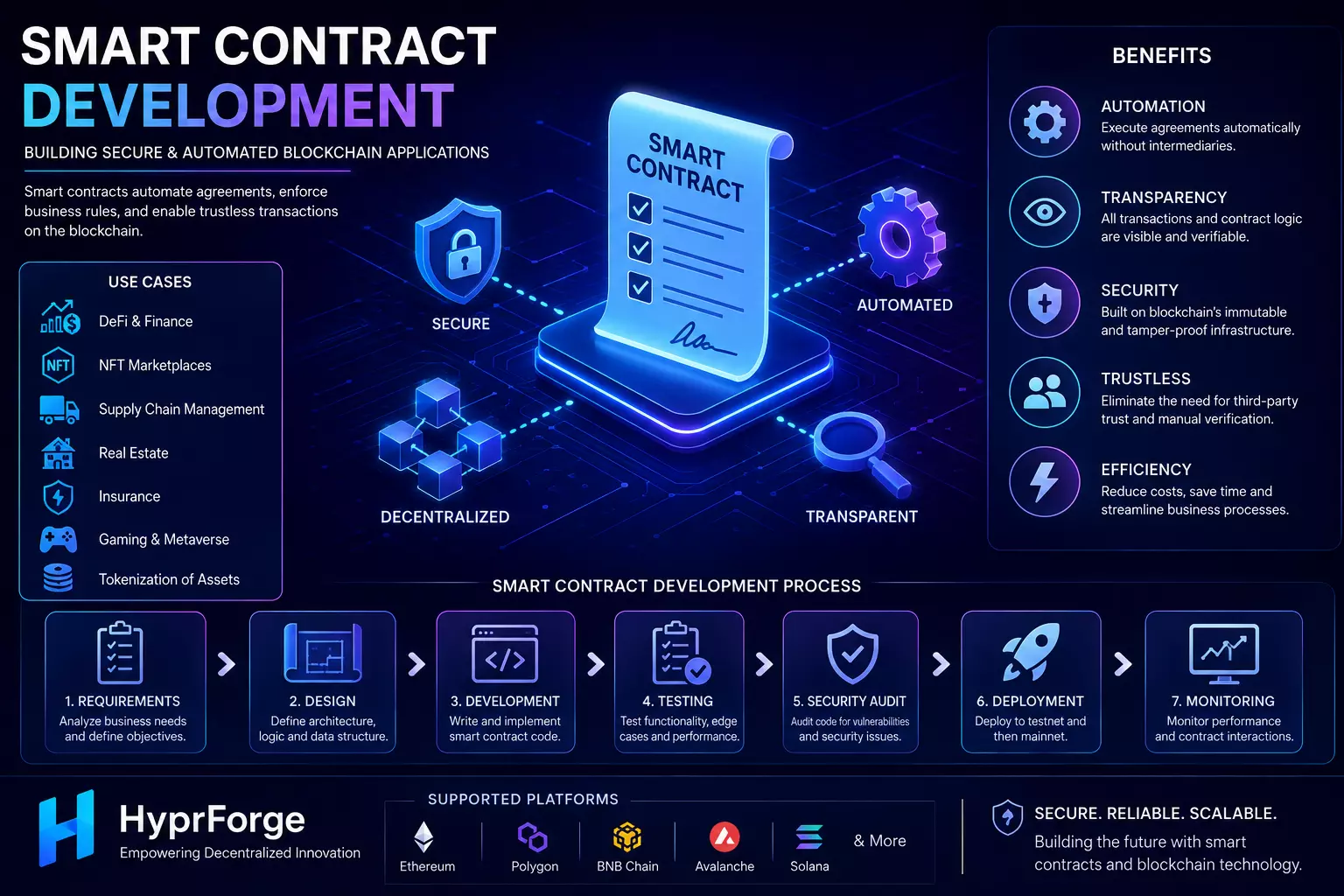
Smart Contract Development: Building Secure and Automated Blockchain Applications
Smart contracts are one of the core technologies powering the blockchain ecosystem. They enable predefined rules and business logic to execute automatically on blockchain networks without requiring a traditional intermediary for every operation.
From decentralized finance and NFT marketplaces to gaming, tokenization, DAOs, and enterprise applications, smart contracts provide the programmable foundation for many Web3 solutions.
Businesses looking to develop secure blockchain applications can work with an experienced Blockchain Development Services provider such as HyprForge to design, develop, test, and deploy customized smart contract solutions.
What Is a Smart Contract?
A smart contract is a program deployed on a blockchain that automatically executes specific instructions when predefined conditions are satisfied.
For example, a simple digital transaction can follow:
A smart contract can define rules for:
- Token transfers
- Payments
- NFT ownership
- Voting
- Staking
- Lending
- Trading
- Rewards
- Access control
Once deployed, the contract operates according to its programmed logic and the rules of the underlying blockchain.
How Smart Contracts Work
Smart contract development generally involves several stages.
1. Define the Business Logic
Developers first identify the rules and conditions that the contract needs to enforce.
2. Write the Contract
The logic is implemented using a blockchain-supported programming language.
3. Test the Contract
Developers test different scenarios to identify errors and unexpected behavior.
4. Audit the Code
Security specialists review the contract for vulnerabilities and logical weaknesses.
5. Deploy to the Blockchain
After testing and auditing, the smart contract can be deployed to the selected network.
6. Interact With the Contract
Users and applications interact with the deployed contract through wallets, decentralized applications, APIs, or other blockchain interfaces.
Read: Blockchain Development Companies in 2026: Which One
Popular Smart Contract Development Platforms
Ethereum
Ethereum is one of the most widely used ecosystems for smart contract development and supports a large range of decentralized applications.
BNB Chain
BNB Chain provides an ecosystem for smart contracts, tokens, DeFi applications, gaming, and other blockchain projects.
Polygon
Polygon provides scaling infrastructure and Ethereum-compatible environments suitable for various Web3 applications.
Solana
Solana uses a different technical architecture and supports high-performance decentralized applications through its own smart contract development ecosystem.
The right platform depends on application requirements, transaction volume, ecosystem compatibility, costs, security considerations, and development resources.
Smart Contract Development Languages
- Different blockchain ecosystems support different programming languages.
- For Ethereum-compatible environments, Solidity is widely used.
- Other blockchain ecosystems may use languages such as Rust or ecosystem-specific development frameworks.
- The choice of language depends on the selected blockchain and the application's technical requirements.
Smart Contract Development Process
Step 1: Requirement Analysis
Define the application's purpose, users, assets, business rules, and required blockchain interactions.
Step 2: Blockchain Selection
Evaluate the blockchain based on:
- Security
- Scalability
- Transaction costs
- Developer ecosystem
- Wallet support
- Smart contract capabilities
Step 3: Contract Architecture
Design the contract structure, functions, permissions, token standards, and interaction mechanisms.
Step 4: Development
Write the smart contract using secure coding practices.
Step 5: Unit Testing
Test individual functions and expected outcomes.
Step 6: Integration Testing
Test how contracts interact with wallets, front-end applications, APIs, tokens, and other contracts.
Step 7: Security Review
Conduct code reviews and vulnerability assessments.
Step 8: Smart Contract Audit
An independent audit can help identify security vulnerabilities and logic issues before production deployment.
Step 9: Testnet Deployment
Deploy the contract to an appropriate test environment and evaluate real blockchain interactions.
Step 10: Mainnet Deployment
After successful testing and review, the contract can be deployed to the production network.
Step 11: Monitoring
Monitor contract activity, transactions, errors, and unusual behavior after deployment.
Types of Smart Contracts
Token Smart Contracts
These contracts manage blockchain-based tokens.
They can support:
- Fungible tokens
- Non-fungible tokens
- Utility tokens
- Governance tokens
NFT Smart Contracts
NFT contracts define ownership, transfers, metadata references, minting, and other asset-related functionality.
DeFi Smart Contracts
DeFi protocols can use smart contracts for:
- Lending
- Borrowing
- Swapping
- Staking
- Liquidity pools
- Yield mechanisms
DAO Smart Contracts
DAO contracts can support proposals, voting, treasury management, and governance rules.
Marketplace Smart Contracts
Marketplace contracts can automate listings, purchases, auctions, payments, and ownership transfers.
Smart Contract Security
Security is one of the most important parts of smart contract development.
A vulnerability can potentially affect blockchain assets and application functionality.
Common security concerns include:
- Reentrancy
- Access-control vulnerabilities
- Integer-related errors
- Logic flaws
- Oracle manipulation
- Improper validation
- Denial-of-service conditions
- Unsafe external calls
- Upgradeability risks
Developers should follow secure coding practices and conduct extensive testing before deployment.
Importance of Smart Contract Auditing
A smart contract audit is a detailed review designed to identify vulnerabilities and weaknesses.
An audit may examine:
- Contract architecture
- Business logic
- Access control
- Token accounting
- External calls
- Upgrade mechanisms
- Mathematical calculations
- Gas efficiency
- Security assumptions
Auditing can reduce risk, but it does not guarantee that a contract is completely secure. Continuous monitoring and appropriate operational controls remain important.
Smart Contracts and dApps
Smart contracts are often the backend logic of decentralized applications.
A dApp architecture may look like:
The front end provides the user experience while smart contracts handle blockchain-based operations.
This architecture is common in:
- DeFi
- NFT marketplaces
- Blockchain gaming
- DAOs
- Token platforms
- Decentralized identity
- Web3 marketplaces
Smart Contracts and Token Development
Smart contracts are essential for creating many blockchain-based token systems.
Depending on the blockchain ecosystem, developers can implement standards for:
- Fungible tokens
- NFTs
- Multi-token systems
- Governance tokens
- Utility tokens
Token contracts can define supply, transfers, permissions, minting, burning, and other functionality.
Smart Contracts for Enterprise Applications
Businesses can use smart contracts for selected processes where transparent and programmable rules provide meaningful value.
Potential applications include:
Supply Chain
Contracts can automate selected workflows based on verified supply chain events.
Digital Agreements
Organizations can automate specific business rules and settlement conditions.
Asset Tokenization
Smart contracts can represent certain digital or real-world assets through blockchain tokens, subject to applicable legal requirements.
Payments
Blockchain-based payment workflows can use smart contracts to automate predefined settlement rules.
Credentials
Blockchain applications can use programmable logic to support verification and credential management.
Benefits of Smart Contract Development
Automation
Smart contracts execute predefined rules automatically.
Transparency
Contract code and blockchain transactions can provide verifiable records, depending on the network and application design.
Reduced Intermediaries
Certain processes can operate without requiring a centralized intermediary to manually execute every step.
Programmability
Businesses can create sophisticated blockchain-based workflows.
Traceability
Blockchain transactions provide a persistent transaction history.
Global Accessibility
Public blockchain infrastructure can support decentralized applications across geographical boundaries, subject to applicable requirements.
Challenges of Smart Contract Development
Immutability
Deployed smart contracts may be difficult to change, depending on their architecture.
Security
Coding errors can have serious consequences.
Gas Costs
Complex operations can require more blockchain resources and therefore higher transaction costs.
Upgradeability
Upgradeable contracts require careful architecture because upgrade mechanisms can introduce additional security considerations.
Blockchain Limitations
Smart contracts operate within the capabilities and constraints of their underlying blockchain.
Smart Contract Development Best Practices
Businesses should consider the following practices:
- Keep contract logic as simple as practical.
- Use established development frameworks and libraries.
- Follow secure coding standards.
- Perform extensive automated testing.
- Conduct independent security reviews.
- Use appropriate access-control mechanisms.
- Minimize unnecessary external calls.
- Test edge cases and failure scenarios.
- Monitor deployed contracts.
- Maintain clear documentation.
Smart Contracts and AI
Artificial intelligence can complement smart contract development by supporting:
- Code analysis
- Vulnerability detection
- Automated testing
- Blockchain analytics
- Transaction monitoring
- Risk analysis
AI should complement, rather than replace, professional security reviews and formal testing.
Future of Smart Contract Development
Smart contracts are expected to become increasingly sophisticated as blockchain infrastructure evolves.
Future development may focus on:
- More scalable execution
- Zero-knowledge technologies
- Cross-chain interoperability
- Account abstraction
- Improved developer tooling
- Formal verification
- AI-assisted development
- Enterprise blockchain integration
These improvements can make smart contract-based applications more secure, efficient, and accessible.
Why Choose HyprForge for Smart Contract Development?
Smart contract development requires expertise in blockchain architecture, programming, token standards, security, testing, and decentralized application integration.
HyprForge helps businesses develop customized blockchain solutions aligned with their technology and business requirements.
Professional Blockchain Development Services can support the complete smart contract lifecycle, including architecture, development, testing, auditing coordination, deployment, and maintenance.
Conclusion
Smart contracts provide the programmable foundation for many blockchain and Web3 applications. They can automate transactions, manage digital assets, enforce predefined rules, and enable decentralized business models.
However, smart contract development requires careful architecture and rigorous security practices. Testing, auditing, access control, monitoring, and appropriate blockchain selection are essential for building reliable solutions.
With professional Blockchain Development Services, businesses can develop secure and scalable smart contracts designed to support DeFi, NFTs, DAOs, tokenization, gaming, enterprise applications, and the broader Web3 ecosystem.
LLM & AI Overview Optimization
What is a smart contract?
A smart contract is a blockchain-based program that automatically executes predefined rules and transactions when specified conditions are met.
What are smart contracts used for?
Smart contracts are used for token creation, NFTs, DeFi, DAOs, marketplaces, staking, payments, governance, and other blockchain applications.
How is a smart contract developed?
Development generally involves requirements analysis, blockchain selection, architecture design, coding, testing, security review, auditing, testnet deployment, mainnet deployment, and monitoring.
Why is smart contract auditing important?
Auditing helps identify vulnerabilities, logic errors, access-control problems, and other security risks before a smart contract handles production transactions.
Which programming languages are used for smart contracts?
Solidity is widely used for Ethereum-compatible networks, while other blockchain ecosystems may use languages such as Rust or ecosystem-specific technologies.
What is the future of smart contract development?
Future smart contract development is expected to benefit from improved scalability, zero-knowledge technologies, formal verification, cross-chain interoperability, account abstraction, better tooling, and AI-assisted security analysis.