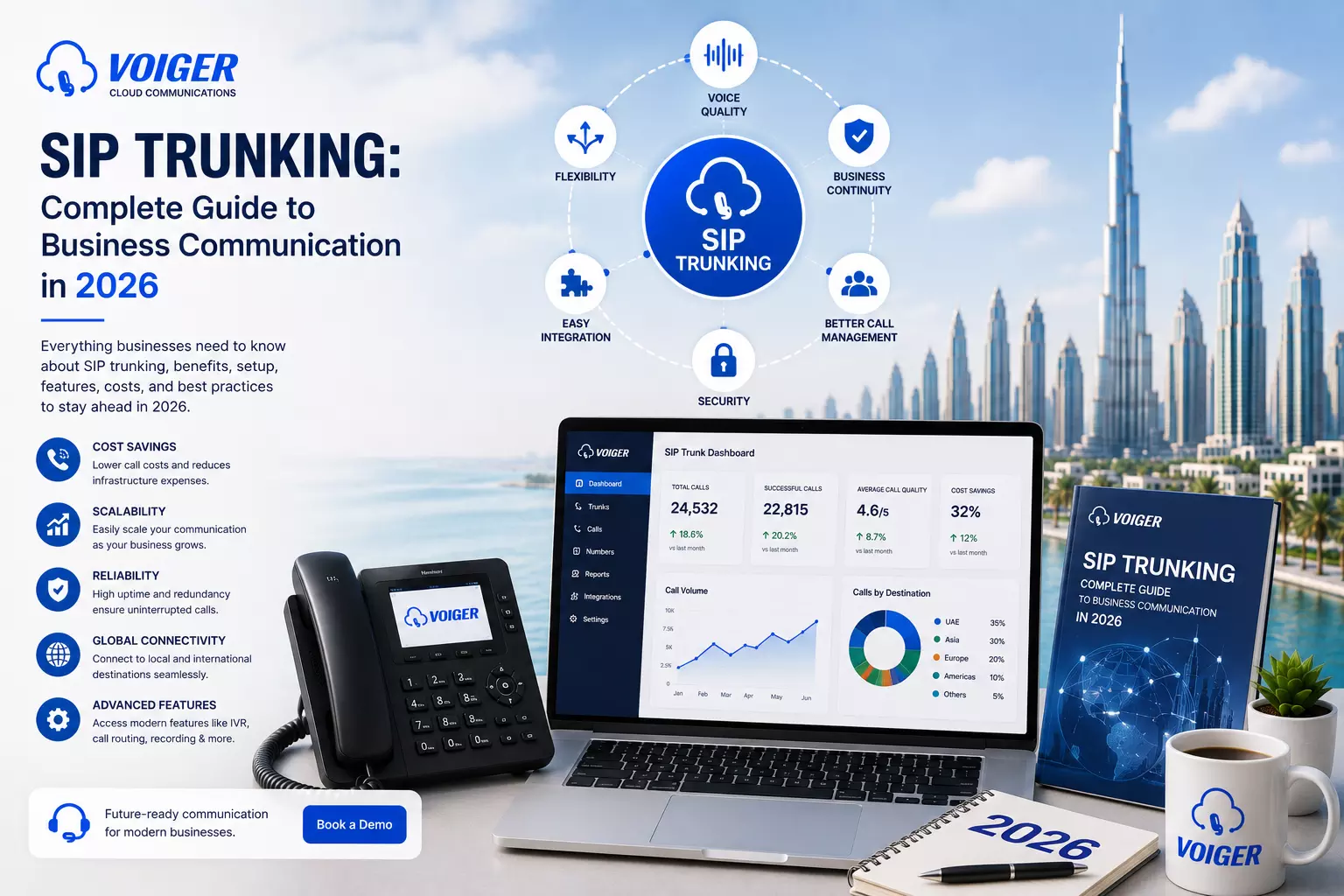
SIP Trunking: Complete Guide to Business Communication in 2026
Business communication has moved far beyond traditional telephone lines. Companies today need communication systems that can support growing teams, multiple locations, remote employees, customer service operations, and increasingly, AI-powered automation.
This is where SIP Trunking continues to play an important role.
SIP Trunking allows businesses to make and receive calls over an IP network instead of relying on traditional physical telephone lines. It can connect an existing PBX or IP-PBX to a telecommunications provider while providing greater flexibility for managing business calls.
In 2026, SIP trunking remains relevant for organizations that want to modernize their voice infrastructure without necessarily replacing their entire phone system.
This guide explains what SIP trunking is, how it works, its benefits, use cases, security considerations, and how it fits into modern cloud communication.
What Is SIP Trunking?
SIP stands for Session Initiation Protocol. It is a signaling protocol used to establish, manage, and terminate voice and multimedia communication sessions over IP networks.
A SIP trunk is a virtual connection between a business telephone system and a telecommunications provider.
Instead of requiring a separate physical telephone line for every user or call channel, SIP technology allows multiple voice sessions to travel through an IP connection.
Businesses can use SIP trunking for:
- Inbound calls
- Outbound calls
- Business numbers
- Direct inward dialing
- Multiple concurrent calls
- Call forwarding
- Contact centre communication
- Business phone systems
The exact number of simultaneous calls and available features depends on the provider, network, PBX, and configuration.
How Does SIP Trunking Work?
- SIP trunking connects an organization's PBX or IP-PBX to a SIP provider through an IP network.
- A simplified call flow looks like this:
- Customer → Telecom Network → SIP Provider → SIP Trunk → Business Phone System → Employee
- For an incoming call, the provider receives the call and routes it through the SIP trunk to the business phone system.
- For an outgoing call, the PBX sends the call through the SIP trunk to the provider, which connects it to the destination.
- Because communication takes place over an IP network, businesses can manage voice services using software and network infrastructure rather than relying entirely on physical telephone connections.
Read: Complete Guide Udyam Registration 2026: MSME Classification
Why Is SIP Trunking Still Important in 2026?
The growth of cloud telephony has changed the communication market, but many businesses still operate PBX and IP-PBX systems.
Replacing an entire telephone system can involve:
- Hardware investment
- Number migration
- Employee training
- Configuration changes
- Integration work
- Operational disruption
SIP trunking allows some organizations to modernize connectivity while continuing to use compatible existing infrastructure.
It can therefore act as a bridge between traditional business telephony and modern cloud communication.
Key Benefits of SIP Trunking
1. Scalable Business Calling
Businesses can adjust voice capacity according to their requirements.
For example, a growing company can add additional channels as call volumes increase without necessarily installing new physical telephone lines.
This makes SIP particularly useful for organizations experiencing growth or seasonal demand.
2. Reduced Infrastructure Dependency
Traditional telephone environments may require extensive physical infrastructure.
SIP trunking uses IP connectivity, reducing dependence on physical voice circuits and making communication infrastructure easier to manage in many deployments.
However, the overall cost depends on provider pricing, network connectivity, existing hardware, call volumes, and implementation requirements.
3. Support for Multiple Locations
Businesses operating across Dubai, Abu Dhabi, Sharjah, or other locations can use IP-based communication to connect offices through a centralized communication environment.
This can help organizations maintain consistent business calling across multiple locations.
4. Existing Number Support
Depending on the provider and applicable telecommunications requirements, businesses may be able to retain existing business numbers when migrating to SIP services.
Keeping established numbers can reduce disruption for customers and employees.
5. Business Continuity
SIP-based communication can provide flexible routing and failover options.
If an office becomes unavailable, calls may be redirected to alternative numbers, locations, or communication systems depending on the provider and configuration.
This can support business continuity planning.
6. Integration With Business Applications
SIP trunking can work alongside modern communication technologies such as:
- CRM systems
- Contact centre software
- Call analytics
- AI voice platforms
- Business phone systems
- Cloud communication platforms
This makes SIP useful as part of a broader digital communication strategy.
SIP Trunking for Contact Centres
Contact centres often handle significantly higher call volumes than ordinary business offices.
They may require communication capabilities for:
- Customer support
- Sales calls
- Lead qualification
- Appointment booking
- Follow-ups
- Outbound campaigns
- Automated customer communication
SIP trunking can provide the voice connectivity needed for these operations.
When combined with Call centre software UAE, businesses can manage agents, call queues, routing, recording, and customer interactions through a centralized environment.
SIP Trunking and AI Voice Bots
Artificial intelligence is changing how businesses handle phone conversations.
A SIP-enabled communication environment can connect with AI voice technology to automate suitable customer interactions.
A typical workflow could look like this:
- A customer calls the business.
- The call reaches the SIP-enabled communication system.
- An AI voice bot answers.
- The AI identifies the customer's intent.
- The bot provides information or performs an approved task.
- Complex requests are transferred to a human agent.
- The conversation can be analyzed afterward.
This allows SIP infrastructure to work alongside AI voice bot UAE technology.
The AI can handle repetitive conversations while human employees remain available for complex or sensitive requests.
SIP Trunking and Cloud Contact Centres
SIP trunking and cloud contact centres are related but serve different purposes.
A SIP trunk primarily provides voice connectivity between a business phone system and a telecommunications provider.
A cloud contact centre provides a wider set of customer communication features, including:
- Agent management
- Call queues
- IVR
- Call routing
- CRM integration
- Call recording
- Analytics
- AI automation
Businesses can use SIP trunking as part of a gradual transition toward a cloud communication environment.
For organizations evaluating Cloud call centre software UAE, SIP connectivity may be useful when existing PBX infrastructure needs to remain part of the communication architecture.
SIP Trunking and Business Phone Systems
A modern Business phone system UAE can use SIP technology to provide business calling over an IP network.
Depending on the platform, businesses can support:
- Extensions
- Auto attendants
- Voicemail
- Call forwarding
- Conference calls
- Call queues
- Call recording
- Direct inward dialing
SIP can therefore provide the voice connectivity layer while software-based features manage how employees and customers interact.
SIP Trunking and CRM Integration
Connecting telephony with CRM software allows businesses to combine voice communication with customer information.
For example, when a customer calls, the system can potentially identify the number and display the corresponding customer record to the agent.
Agents may then access:
- Customer details
- Previous interactions
- Sales history
- Support requests
- Call notes
This can contribute to a CRM integrated call centre UAE workflow where customer communication and business data are connected.
Intelligent Call Routing With SIP
Simply connecting calls is not enough for modern customer service.
Businesses also need to make sure calls reach the appropriate team.
Call routing software UAE can route calls according to:
- Department
- Agent availability
- Business hours
- Customer type
- Language
- Call purpose
For example, a sales inquiry can be routed directly to the sales team while technical support requests go to the support department.
AI can further improve routing by identifying customer intent before transferring the call.
SIP Trunking and Call Analytics
Modern communication platforms provide businesses with detailed information about their calls.
Managers can analyze:
- Total call volume
- Missed calls
- Call duration
- Agent performance
- Peak calling periods
- Call outcomes
Call tracking software UAE can provide additional visibility into communication activity and help businesses identify trends.
Analytics can also help managers determine whether staffing levels, routing rules, or customer communication workflows need adjustment.
SIP Trunk Security Considerations
SIP trunking should be implemented with appropriate security controls.
Authentication
Strong credentials and authentication mechanisms help prevent unauthorized access.
Encryption
Where supported by the provider and communication architecture, encrypted signaling and media can provide additional protection.
Firewall Configuration
Businesses need appropriate firewall and network settings to protect their VoIP environment while allowing legitimate communication.
Fraud Prevention
Organizations should monitor unusual outbound calling patterns that could indicate unauthorized access or telecom fraud.
Access Control
Only authorized users, devices, and systems should have access to SIP services.
Security requirements vary between deployments, so organizations should evaluate their network and communication architecture carefully.
SIP Trunking and Call Quality
SIP calls depend heavily on network performance.
Important factors include:
- Bandwidth
- Latency
- Jitter
- Packet loss
- Network stability
- Quality of Service
A fast internet connection does not automatically guarantee excellent voice quality.
Businesses should test their network before deployment and ensure that voice traffic receives appropriate priority where necessary.
SIP Trunking vs Cloud Telephony
SIP trunking and cloud telephony are sometimes confused, but they are not identical.
SIP trunking connects a business phone system to a telecom network using IP-based communication.
Cloud telephony generally provides a broader hosted communication environment where the provider manages much of the underlying telephony infrastructure.
A business with an existing IP-PBX may choose SIP trunking, while a company replacing its complete phone system may prefer cloud telephony.
Some businesses can also use both technologies together.
SIP Trunking for UAE Businesses
Businesses in the UAE should evaluate their specific requirements before selecting a SIP solution.
Important considerations include:
- Existing PBX or IP-PBX
- Business phone numbers
- Number portability
- Concurrent call requirements
- Network connectivity
- Security
- Provider support
- Business continuity
- Applicable telecommunications requirements
For organizations operating in Dubai, Abu Dhabi, Sharjah, or across multiple Emirates, the communication architecture should be designed around the company's locations, call volumes, and future growth.
Who Should Consider SIP Trunking?
SIP trunking can be suitable for businesses that:
- Already have an IP-PBX
- Need multiple concurrent calls
- Operate multiple offices
- Handle high inbound or outbound call volumes
- Want to modernize legacy telephony
- Need CRM or software integrations
- Want scalable voice capacity
It can be particularly useful for contact centres, sales teams, healthcare providers, logistics companies, retail businesses, professional services firms, and growing SMEs.
SIP Trunking for Small and Medium Businesses
SIP is not limited to large enterprises.
Businesses looking for Call centre for SMB UAE solutions can use IP-based communication to build a professional calling environment without relying on numerous traditional telephone lines.
A small business can begin with the capacity it needs and expand as its team and customer base grow.
This flexibility can make SIP useful for companies that expect their communication requirements to change over time.
How to Choose a SIP Trunk Provider
Before selecting a provider, businesses should evaluate several factors.
Reliability
Ask about network availability, redundancy, and failover capabilities.
Scalability
Confirm whether additional channels and numbers can be added easily.
Compatibility
Make sure the provider supports the company's PBX or IP-PBX.
Number Management
Check whether existing business numbers can be hosted or ported where applicable.
Technical Support
Reliable support can make implementation and troubleshooting easier.
Security
Review authentication, encryption options, fraud monitoring, and access controls.
Integration
If the business plans to connect SIP with CRM, AI, or contact centre systems, verify compatibility before implementation.
How Voiger Fits Into Modern Business Communication
Businesses increasingly need more than basic voice connectivity.
A modern communication platform can combine telephony with:
- AI Voice Bots
- Cloud Contact Centres
- Business Phone Systems
- Call Routing
- CRM Integration
- Call Analytics
- Call Recording
- Customer Communication Automation
Voiger provides cloud communication capabilities designed to help businesses manage these requirements through a modern, software-driven environment.
For companies transitioning from traditional telephony, SIP-based connectivity can also be considered as part of a broader modernization strategy.
Frequently Asked Questions
What is SIP Trunking?
SIP Trunking is an IP-based telephony service that connects a business phone system to a telecommunications network using Session Initiation Protocol.
Is SIP Trunking still relevant in 2026?
Yes. SIP remains useful for businesses with compatible PBX or IP-PBX systems that want scalable IP-based voice communication.
Can SIP Trunking work with an existing PBX?
Yes, provided the PBX supports SIP and meets the technical requirements of the selected provider.
Does SIP Trunking support multiple calls?
Yes. SIP trunks can support multiple simultaneous calls depending on the provisioned channels, network capacity, and provider configuration.
Can businesses keep their existing phone numbers?
In many situations, number portability or number hosting may be available, but this depends on the provider, number type, location, and applicable telecommunications rules.
Can SIP Trunking work with AI Voice Bots?
Yes. SIP connectivity can be integrated with compatible AI voice platforms to support automated customer conversations.
Is SIP Trunking suitable for small businesses?
Yes. SIP can provide scalable business calling for SMEs, particularly when they need multiple channels or want to integrate telephony with modern business applications.
What is the difference between SIP Trunking and Cloud Telephony?
SIP Trunking primarily provides IP-based voice connectivity, while cloud telephony generally provides a broader hosted communication platform.
Conclusion
SIP Trunking remains a practical technology for businesses modernizing their communication infrastructure in 2026. It allows organizations to move voice communication onto IP networks while continuing to use compatible PBX systems.
Its value becomes even greater when SIP connectivity is combined with modern technologies such as AI call centre UAE, AI voice bot UAE, Business phone system UAE, Call centre software UAE, Call routing software UAE, Cloud call centre software UAE, Call tracking software UAE, and Call centre for SMB UAE.
For businesses planning a communication upgrade, the best solution depends on existing infrastructure, call volumes, network quality, security requirements, business numbers, and future technology plans.
A well-designed SIP strategy can provide a flexible foundation for business calling today while making it easier to adopt cloud communication, CRM integration, Ai analytics, and AI-powered customer service in the future.