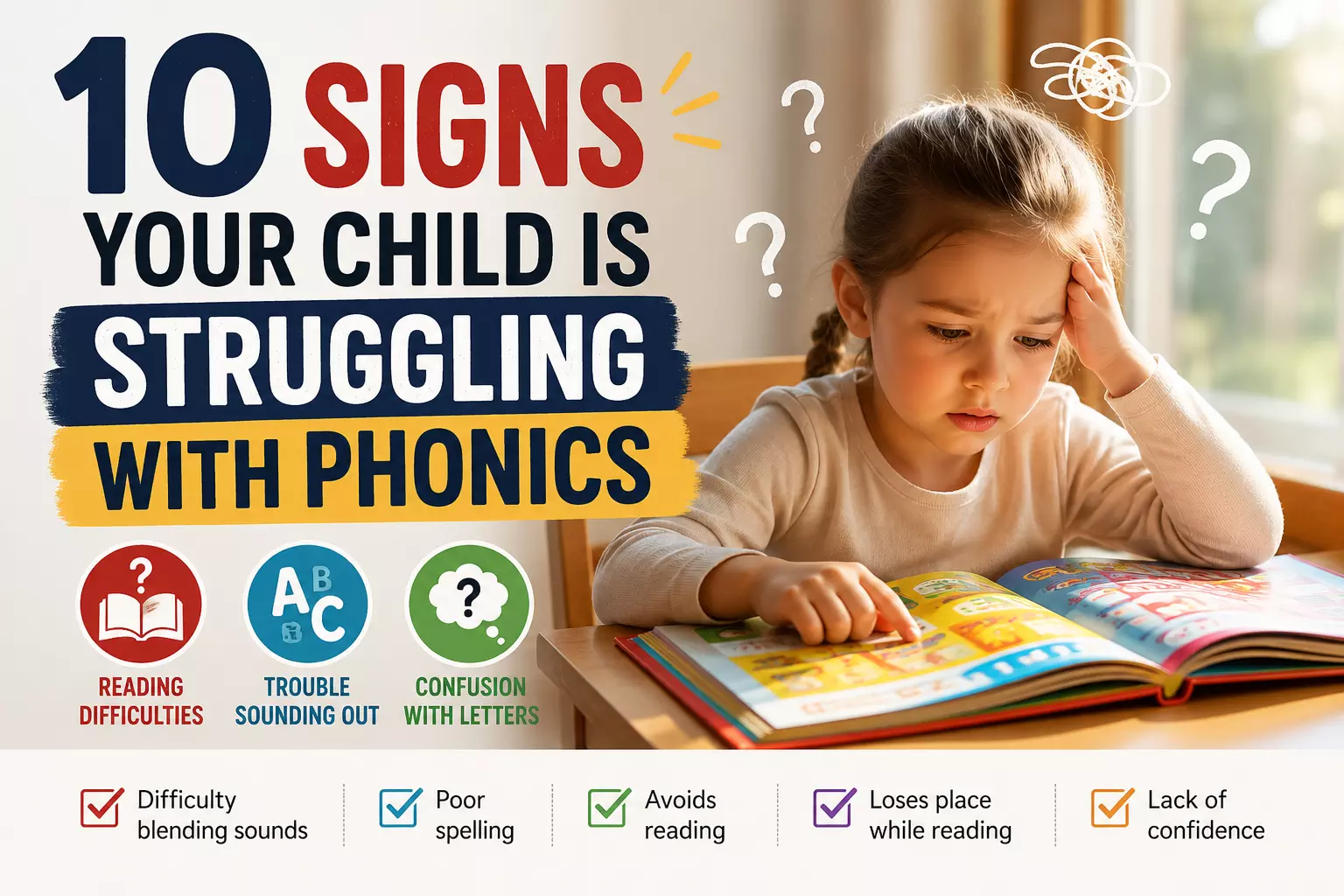
10 Signs Your Child Is Struggling with Phonics
Learning to read is rarely a straight line. Every child hits bumps along the way, and a little stumbling over new words is normal.
But sometimes the difficulty runs deeper than a rough patch, and it points to a genuine gap in phonics understanding. Here are ten signs worth paying attention to, and what they usually mean.
1. Sounding out simple words takes a long time
If your child can recognize letters but still struggles to blend them into a word, even a short one like “cat” or “dog,” that's often a sign the connection between letters and sounds hasn't fully clicked yet. Occasional hesitation is fine. Consistent, word-by-word struggle is the pattern to watch for.
2. They guess words instead of decoding them
Some children learn to “read” by memorizing the shape of a word or guessing from a picture, rather than actually sounding it out. This works for a while with familiar books, then falls apart the moment they meet an unfamiliar word with no picture to lean on.
3. Rhyming feels difficult
Rhyming depends on hearing the smaller sound units inside words, which is a core phonemic awareness skill. A child who can't tell that “cat,” “hat,” and “bat” rhyme may be missing this foundational piece, and it's worth addressing before moving further into reading instruction.
4. Letter-sound confusion persists past the early stages
Mixing up b and d, or forgetting that “s” makes a hissing sound, is completely normal at first.
But if that confusion is still happening well after other children the same age have moved past it, it's a sign the sound-letter mapping needs more targeted practice.
5. Reading feels exhausting, even for short passages
When decoding hasn't become automatic, every single word demands conscious effort.
That kind of mental load adds up fast, which is why some children seem tired, frustrated, or reluctant after only a page or two, even though the text itself isn't especially long or hard.
Read: Top Home Tutor in Delhi – Improve Your Child's Academic
6. Spelling is wildly inconsistent
A child who spells the same word three different ways in the same piece of writing usually isn't being careless. It's often a sign they haven't internalized reliable sound-to-letter patterns yet, so each attempt is closer to a guess than a rule being applied.
7. They avoid reading out loud
Avoidance is one of the clearest signals. Children who dislike reading aloud, ask to skip their turn, or go quiet when a book comes out are frequently protecting themselves from the visible struggle of decoding in front of others.
8. Comprehension drops during reading, even though listening comprehension is fine
If your child understands a story perfectly when it's read to them, but loses the thread the moment they have to read it themselves, the issue usually isn't understanding, it's that decoding is using up all their attention, leaving nothing left for meaning.
9. Progress has plateaued despite regular practice
Consistent effort with little to no improvement over weeks or months is one of the stronger signs that the current approach isn't addressing the actual gap. This is often the point where it helps to look closely at how phonics is being taught, not just how much.
10. Frustration shows up before the reading even starts
Tears, refusal, or a sudden stomachache at reading time are emotional responses to a skill that doesn't feel achievable yet.
This kind of frustration is common among children who need a different instructional approach, which is part of why Fonetic English explains how it supports readers, including those who find traditional phonics instruction difficult.
What parents can do
None of these signs mean a child can't learn to read well, they simply mean the current method isn't landing the way it should. Phonics instruction that accounts for cognitive load and builds sound-letter relationships more systematically tends to help children who've been stuck the longest.
For a closer look at what that looks like in practice, Fonetic English's guide for parents walks through how a more structured, science-based approach can close these gaps without adding pressure at home.