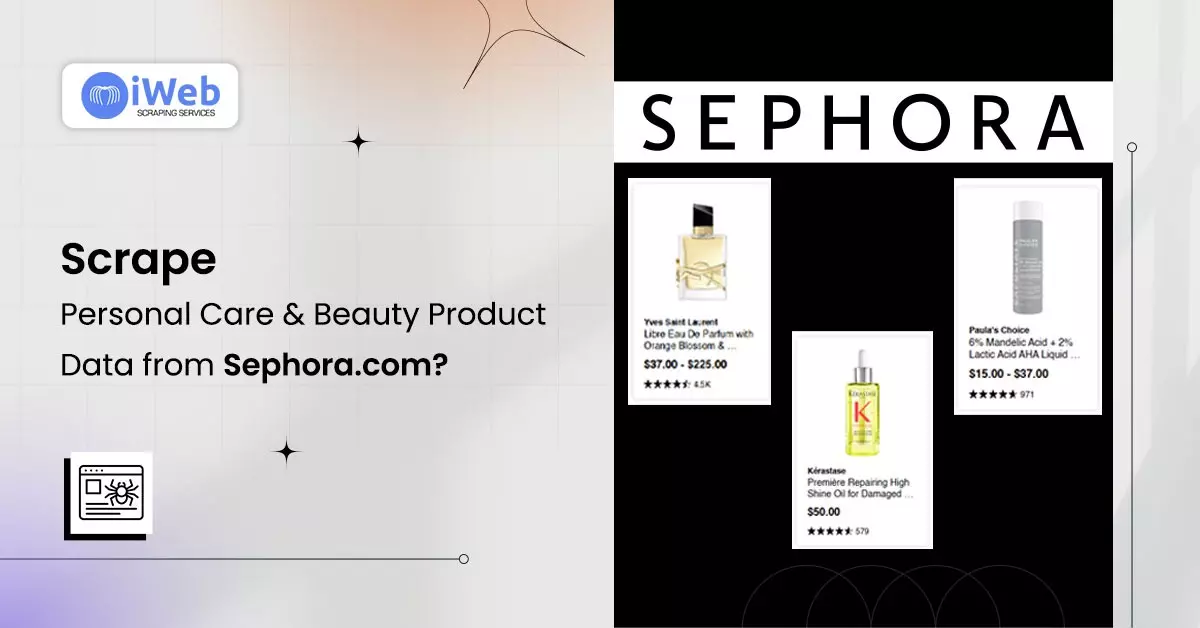
Scrape Personal Care & Beauty Product Data from Sephora.com?
The beauty and personal care industry has become one of the most data-driven retail sectors in the world. Pricing fluctuations, rapid product launches, influencer-driven demand, and shifting customer preferences require brands to react faster than ever. Static reports and delayed datasets are no longer enough to stay competitive.
This is where the ability to scrape personal care & beauty product data becomes a strategic advantage. Among all beauty retailers, Sephora stands out as a goldmine of market intelligence.
From premium skincare and cosmetics to wellness and fragrance, Sephora hosts a massive, continuously updated product catalog that reflects real consumer demand.
At the same time, search engines are evolving. Google’s AI-powered search experiences are prioritizing authoritative, structured, and data-backed content.
Understanding the AI overviews SEO impact is now critical for brands, agencies, and data providers that rely on organic visibility. When combined, Sephora product data and AI-driven SEO strategies create a powerful growth engine.
This guide explains how businesses can scrape personal care & beauty product data from Sephora.com, the challenges involved, and how this data fuels analytics, SEO, and competitive intelligence.
Why Sephora Product Data Matters for Businesses
Sephora is more than an online store—it is a real-time reflection of beauty market trends. Every product page, category listing, and review contributes to a larger picture of consumer behavior.
By choosing to scrape P Product Data from Sephora.com, businesses gain access to insights that are otherwise expensive or impossible to collect manually.
Sephora data reveals:
- Which brands dominate specific categories
- How pricing changes across seasons and campaigns
- What customers praise or criticize in reviews
- Which ingredients and formulations are trending
- How fast new products gain traction
This data is invaluable for beauty brands, ecommerce sellers, analytics teams, and SEO professionals alike.
Understanding AI Overviews SEO Impact in Retail Data Content
Google’s AI Overviews are reshaping how users discover information. Instead of scrolling through multiple links, users now receive summarized answers generated from authoritative sources.
For data-driven websites, this change presents both a challenge and an opportunity.
When your content is supported by fresh, structured, and original product data, it becomes more likely to be referenced in AI-generated summaries. This is where scraping plays a key role.
How scraped Sephora data supports AI Overviews:
- Adds factual accuracy to content
- Enables semantic relevance through structured attributes
- Improves topical authority in beauty and retail niches
- Supports comparison-based and intent-driven queries
Businesses that understand the AI overviews SEO impact and adapt their content accordingly are better positioned for long-term organic visibility.
What Personal Care & Beauty Product Data Can Be Scraped?
Not all data delivers the same value. Strategic scraping focuses on high-impact attributes that support analytics, SEO, and decision-making.
High-value Sephora data points include:
- Product titles and SKUs
- Brand names and product categories
- Prices, discounts, and promotional tags
- Customer ratings and review counts
- Review sentiment and keywords
- Ingredients and formulation details
- Product availability and variants
When combined, these data points create a complete view of the beauty market.
How to Scrape Personal Care & Beauty Product Data from Sephora.com
Scraping Sephora requires a thoughtful approach. The platform relies heavily on dynamic content and modern frontend frameworks, which means traditional scraping methods often fail.
A scalable scraping workflow typically includes intelligent crawling, structured extraction, and continuous validation.
Common approaches used to scrape Sephora data:
- Category-level crawling to map product listings
- Product-page extraction for detailed attributes
- Headless browsers to render JavaScript content
- Network request analysis to identify data endpoints
- AI-assisted parsers for flexible data extraction
The goal is not just to collect data once, but to build a sustainable pipeline that adapts to changes over time.
Technical Challenges in Sephora Data Scraping
Sephora actively protects its platform to ensure performance and security. As a result, unmanaged scraping attempts often face limitations.
Common challenges include:
- Dynamic page rendering
- Anti-bot detection systems
- IP rate limiting and blocking
- Frequent layout and DOM changes
- Inconsistent data structures across categories
Overcoming these challenges requires advanced scraping strategies, monitoring, and optimization rather than brute-force automation.
Ethical and Compliant Scraping Practices
Following ethical scraping practices is essential—not just for compliance, but also for credibility and EEAT alignment.
Responsible scraping focuses on collecting publicly available information without disrupting the platform or violating usage expectations.
Ethical scraping best practices:
- Respect crawl limits and request frequency
- Avoid aggressive scraping patterns
- Collect only publicly accessible data
- Use data strictly for analytics and insights
- Maintain transparency in data usage
Ethical scraping ensures long-term sustainability and trust, especially for enterprise clients.
Business Use Cases for Sephora Product Data
Once collected, Sephora product data can be transformed into powerful business intelligence across multiple functions.
Popular business applications include:
- Competitive pricing intelligence for beauty brands
- Assortment optimization and catalog analysis
- Product trend and demand forecasting
- Customer sentiment analysis using reviews
- Market entry and new product launch planning
These insights help businesses shift from reactive decisions to proactive strategies.
SEO Advantages of Scraping Sephora Product Data
From an SEO perspective, scraped product data enables highly relevant, intent-driven content that aligns perfectly with modern search algorithms.
Search engines increasingly favor content that demonstrates expertise, originality, and real-world relevance.
SEO benefits include:
- Continuous content freshness
- Expanded long-tail keyword coverage
- Strong topical authority signals
- Improved alignment with AI Overviews
- Better internal linking opportunities
When enriched with expert commentary and original analysis, scraped data significantly strengthens EEAT signals.
Using Sephora Data for Content & Remarketing Campaigns
For remarketing and content marketing teams, Sephora data provides endless opportunities to create high-intent assets.
Instead of generic blogs, brands can publish insight-driven content backed by real product data.
Content formats powered by Sephora data:
- Competitive pricing reports
- Trend analysis blogs
- Product comparison guides
- Ingredient-based market insights
- Data-backed thought leadership articles
This approach increases engagement, trust, and conversion rates.
Integrating Scraped Data into Analytics & BI Platforms
Raw data becomes truly valuable when integrated into analytics systems and dashboards.
Sephora product data is commonly used in:
- Retail pricing intelligence dashboards
- Trend monitoring and forecasting models
- SEO and content performance dashboards
- AI-driven recommendation engines
These integrations allow teams to track changes in near real-time and respond faster than competitors.
Why AI-Driven Scraping Is the Future of Retail Intelligence
Manual and rule-based scraping methods struggle to keep pace with dynamic websites like Sephora. AI-driven scraping introduces adaptability and intelligence into the process.
Advantages of AI-powered scraping:
- Automatic detection of layout changes
- Higher data accuracy and consistency
- Faster adaptation to platform updates
- Reduced maintenance effort
This approach aligns perfectly with evolving SEO requirements and enterprise analytics needs.
Read: Performance Tuning for Beauty App Development: Strategy, Cost
Conclusion
The ability to scrape personal care & beauty product data from Sephora.com has evolved from a technical capability into a strategic necessity. In an era shaped by AI-driven search, real-time analytics, and rapidly changing consumer behavior, businesses need access to fresh, reliable product intelligence.
Understanding the AI overviews SEO impact makes this data even more valuable. When Sephora product data is ethically scraped, intelligently processed, and paired with expert analysis, it fuels stronger SEO performance, smarter business decisions, and more effective remarketing campaigns.
For brands and data-driven organizations, investing in scalable, compliant Sephora data scraping is no longer optional—it is a competitive advantage that drives visibility, insight, and growth.