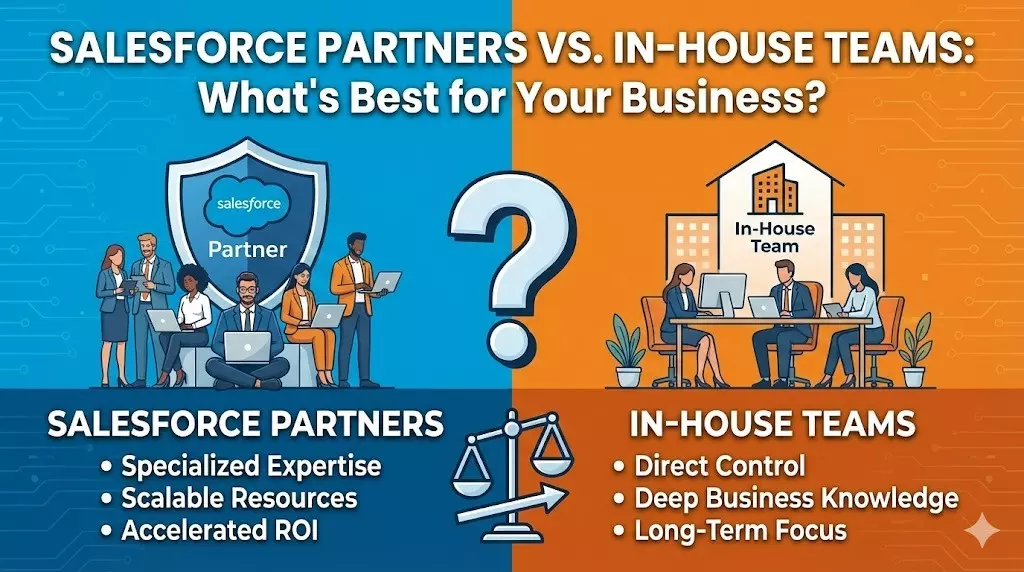
Salesforce Partners vs. In-House Teams: What’s Best for Your Business?
Is your business ready for Salesforce, but unsure who should build and manage it? Choosing between Salesforce partners and an in-house team is pivotal. The choice significantly impacts your organization’s Salesforce experience.
The decision creates challenges for many organizations. They must weigh a certified partner’s expertise and efficiency against an internal team’s cultural fit and control.
Salesforce partner companies excel with their specialized knowledge and tested methods. Internal teams understand your company’s processes and business requirements better. Your business needs, timeline, budget, and long-term CRM strategy determine the better choice.
This blog talks about both options, so that you can learn which path suits your organization.
Understanding the Two Models
Businesses need a clear picture of what in-house teams and Salesforce partners bring to the table before making a choice. Each approach comes with its own set of benefits and limitations that companies should assess based on what they need.
I. What Does an In-House Salesforce Team Do
An in-house Salesforce team works directly on your payroll and manages your entire CRM system. These professionals take care of daily admin tasks, customization, integration, and maintenance.
A typical team has Salesforce administrators who handle routine tasks, developers who build custom features, and business analysts who turn requirements into solutions.
Internal teams shine when quick responses matter. A department head might ask for a new report in the morning and get it by lunch.
These teams also understand how your company’s various departments work. For example, they know precisely how the finance team needs their data formatted.
The best administrators do more than keep the lights on. They make the Salesforce CRM an inseparable part of the company’s operations.
II. What Services Do Salesforce Partner Companies Offer
Salesforce partners bring expert guidance and implementation services through their certified professionals. They help with strategic planning, custom development, complex integrations, and support.
Research tells us that around 70% of Salesforce implementations benefit from the expertise of consulting partners.
These partners help set up systems, customize features, train teams, and provide support after launch. Many also offer managed services that include system maintenance, updates, user support, and performance tweaks to boost the value of your Salesforce solution over time.
Partner companies have a deep understanding of the entire Salesforce ecosystem. Years of work with different clients help them develop methods to spot potential issues and resolve them quickly.
III. How Certified Salesforce Partners Differ From Internal Teams
The main difference lies in specialization and breadth of experience. Salesforce certified partners have professionals who work solely with the platform.
They hold multiple certifications and learn new features instantly. Their experience across industries gives them insights that your internal teams might miss.
Partners are generally faster. They use established frameworks from previous projects to deliver results faster and with fewer errors. Partner-led implementations often offer higher returns in the beginning compared to in-house projects.
Partner companies also bring an objective perspective. While internal teams might stick to familiar methods, external partners examine your workflows without bias.
They spot automation opportunities others might not see and match them against industry best practices.
Key Benefits of Working with a Salesforce Partner
Salesforce technology partners offer advantages that help projects succeed and boost returns. Companies that work with certified partners achieve smoother deployments and improved long-term results.
1. Access to Certified Salesforce Experts
Salesforce’s top partners have professionals who have passed rigorous certification exams. These experts have verified technical skills and platform knowledge that regular IT staff may lack.
Salesforce rates its partners on three vital factors: deep knowledge of industries and products, implementation experience, and customer success.
Salesforce Summit partners keep large teams of certified professionals who regularly train on new features and best practices.
2. Faster Implementation and Fewer Errors
Salesforce partners guide implementation phases smoothly and help businesses avoid common mistakes. Their properly designed methods result from years of experience and ensure minimal hassle during setup.
The outcome? Companies get faster results with fewer expensive errors.
Partners use flexible delivery frameworks to reduce downtime. They know potential challenges extremely well, which streamlines projects and leads to reliable deployments.
3. Support for Complex Customizations and Integrations
Salesforce certified partners excel at building customized solutions and integrations that align with your business goals. Their main work includes:
- Connecting Salesforce with marketing platforms and ERPs
- Setting up middleware to sync data smoothly
- Creating custom automation for business processes
These capabilities make Salesforce work as part of a unified digital world rather than a standalone platform.
4. Post-Launch Support
A relationship with a Salesforce partner continues after implementation. Partners stick around to provide system maintenance, updates, performance optimization, and user training.
This support helps businesses adjust their system as new requirements come up. It also allows them to get the most value from their platform.
Partners offer structured training programs for sales, marketing, service, and management teams. This fuels user adoption and ensures data accuracy.
Many companies add extra applications to their Salesforce systems. Partners facilitate this growth by helping install these applications safely.
In-House Teams: Strengths and Drawbacks
Managing Salesforce with your own team comes with clear benefits and challenges. Companies need to carefully weigh these factors before choosing between their own staff and Salesforce technology partners.
I. Full Control Over CRM Operations
Companies with their own Salesforce teams track every aspect of their CRM environment. The setup gives them complete control over their operations, data security, and system administration.
These specialists can fix critical issues immediately without waiting for outside help. They also make sure the CRM follows the company’s exact standards.
II. Alignment with Internal Workflows
Internal Salesforce administrators understand the nuances of a business. Outside partners rarely match this depth of knowledge.
These experts know exactly how the finance department needs reports or how the sales team tracks goals. A better understanding of needs leads to faster communication and highly customized solutions that fit a company’s workflows.
III. Challenges with Hiring and Training
Finding skilled people to build your team is a formidable challenge. The market for certified professionals is competitive, due to which the cost for salaries and training is high.
Even if you find great talent, they might leave for better pay. Core staff members take vital knowledge with them when they quit. This turnover creates huge gaps in operations.
IV. Risks of Misconfiguration and Delays
Internal teams may not have the broad experience that partners get from working on many different projects. Without exposure to varied use cases, they could miss security risks and best practices. For example, wrong configuration settings could easily leak sensitive data in customer portals. These issues usually arise due to knowledge gaps that external reviews would catch.
How to Make the Right Choice for Your Business
The right approach to Salesforce implementation depends on your business needs, available resources, and goals. It’s advisable to understand the benefits and constraints of each option before picking one.
1. When to Choose a Salesforce Partner Company
Salesforce technology partners excel at complex or specialized solutions. Companies with little internal knowledge of the platform should work with certified partners, especially for their first implementations or major upgrades.
Partners bring efficiency to projects involving multi-cloud setups with Sales, Service, or Marketing Cloud integrations.
Companies that need industry-specific solutions obtain better results from partners who know their sector thoroughly. Likewise, businesses with changing project requirements usually find partners more economical than keeping full-time staff.
Certified Salesforce partners are also valuable when you have strict compliance needs or data security concerns.
2. When an In-House Team Makes More Sense
In-house teams work well when Salesforce is central to your business model. Companies that want full control over every process usually prefer internal teams. Similarly, those with stable long-term plans can benefit from building knowledge within their organization.
Internal teams suit companies with sufficient budget to hire, train, and keep specialized talent. With this approach, they can work with people who fit perfectly with their culture.
They can also use the expertise of administrators who can tweak the system regularly as their business needs change.
3. How a Hybrid Model Balances These Approaches
The hybrid model puts together the oversight of internal teams with external expertise. The approach keeps business knowledge inside the company while bringing in help for complex setups.
Many hybrid setups require internal teams to manage administration, user training, and strategic decisions. Salesforce’s top partners take care of complex customizations, data migration, or company-wide upgrades.
This balance helps you build internal skills with expert guidance while keeping projects moving forward.
Read: Top 8 Salesforce Managed Services Providers in 2026
4. Questions to Shape Your Decision
Organizations should assess these factors before they select a path:
- Complexity: How customized is your Salesforce implementation? Do you need knowledge of multiple clouds or integrations?
- Internal Skills: Does your team have certified Salesforce expertise? Can they learn what’s needed within a short time?
- Strategic Importance: Does Salesforce give you a competitive edge, or is it mainly for operations?
- Budget: What’s the total cost for each approach, including hidden expenses?
- Timeline Requirements: How soon do you need to finish implementation? Can you allow time for internal learning?
- Growth Projections: Will your Salesforce needs grow over the next several years? How will growth affect your chosen approach?
- Risk Tolerance: What happens if key team members leave? How would delays affect your business?
Conclusion
The success of your CRM system relies on whether you choose Salesforce partner companies or in-house teams. Partner collaboration works great for businesses that need complex implementations or specialized expertise.
Building internal teams makes more sense when Salesforce is central to your business strategy.
A hybrid model has become a middle ground for many companies. It combines your internal vision with external technical skills. This approach lets you keep business knowledge in-house while getting help for complicated tasks.
Companies should examine their internal capabilities, goals, budget, and growth plans before making their final choice. This evaluation will help them select the path that matches both their current needs and long-term aspirations.