The Role of Electronic Health Records Software in Workplace Health and Safety Compliance
Workplace health and safety depends on more than preventing accidents. Organizations also need accurate employee health records, timely medical information, compliance documentation, and effective processes for identifying health-related risks.
As workplaces become more data-driven, Electronic Health Records Software is becoming an important technology for managing employee health information while supporting broader workplace safety objectives.
By replacing fragmented paperwork and disconnected health records with centralized digital information, organizations can improve visibility, streamline processes, and make better-informed safety decisions.
When integrated with an EHS Management System, electronic health records can become a valuable component of a comprehensive health and safety strategy.
What Is Electronic Health Records Software?
Electronic Health Records Software is a digital solution used to collect, store, organize, and manage health-related information electronically.
Instead of maintaining paper-based medical files, organizations can securely manage relevant employee health information through a centralized platform.
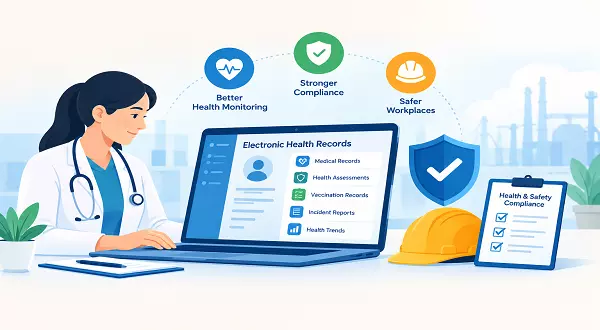
Depending on the system and organizational requirements, records may include medical assessments, occupational health information, fitness-for-work evaluations, vaccination records, workplace medical incidents, health surveillance data, and other relevant documentation.
For health and safety teams, centralized records can make it easier to identify health trends, manage required assessments, and maintain documentation needed for compliance.
Why Health Records Matter for Workplace Safety?
Employee health and workplace safety are closely connected. Certain workplace conditions, exposures, job responsibilities, and environmental hazards can influence employee health over time.
Without reliable health information, organizations may struggle to identify patterns or respond efficiently to emerging risks.
Electronic records help health and safety professionals access organized information when it is needed. This can support activities such as occupational health assessments, return-to-work management, employee medical monitoring, and workplace health surveillance.
Rather than treating employee health as a separate administrative function, organizations can connect health information with broader safety programs to create a more proactive approach to risk management.
How Electronic Health Records Software Supports Compliance
Compliance often requires organizations to demonstrate that health and safety processes are documented, monitored, and managed consistently.
Paper records and spreadsheets can make this difficult, particularly when an organization has multiple locations or a large workforce.
Electronic Health Records Software can support compliance by providing better record organization, standardized workflows, reporting capabilities, and controlled access to information. Health and safety teams can maintain documentation more consistently and reduce the risk of misplaced or outdated records.
Digital systems can also help organizations establish reminders for health assessments, medical examinations, vaccinations, and other activities that may need to be completed according to internal policies or applicable requirements.
Improving Workplace Health Monitoring
One of the major benefits of digital health records is improved visibility into employee health information. Instead of searching through multiple files, authorized users can access relevant records through a centralized system.
This can help organizations monitor recurring health concerns, occupational health requirements, and trends that may indicate potential workplace risks.
For example, repeated health complaints in a particular department could encourage a safety team to investigate workstation design, chemical exposure, noise, ergonomics, or other contributing factors.
This proactive approach can help organizations move from reacting to health incidents toward identifying potential risks earlier.
Read: How Healthcare Software Development is Transforming
Connecting Health Data With OHS Software
OHS Software can help organizations manage occupational health and safety processes, but its effectiveness can be strengthened when health information is connected to broader safety workflows.
When Electronic Health Records Software works alongside OHS Software, organizations can create better visibility between employee health activities and occupational safety programs.
Health assessments, incident-related medical information, workplace monitoring, and safety actions can be managed as interconnected processes rather than isolated activities.
This integration can help health and safety professionals make more informed decisions while reducing repetitive administrative work.
Supporting Employee Health With Workplace Safety Software
Modern Workplace Safety Software is increasingly designed to support a wide range of safety processes, including incident management, inspections, risk assessments, corrective actions, and employee health activities.
Integrating electronic health records into a workplace safety platform can create a more complete picture of workplace conditions and employee wellbeing. Health-related findings can provide additional context for safety teams when evaluating risks and deciding where preventive measures may be needed.
For organizations focused on continuous improvement, this connected approach can strengthen workplace safety programs and encourage data-driven decision-making.
The Role of Employee Health and Wellness Programs
Employee health management is not limited to regulatory requirements. Organizations are also increasingly focused on promoting healthier and more productive workplaces.
Employee Health Software can help organizations manage occupational health activities, medical records, screenings, and health-related workflows more efficiently.
Meanwhile, Employee Wellness Software can support broader initiatives such as wellness programs, health campaigns, preventive activities, and employee engagement.
When these capabilities are aligned, organizations can create a workplace environment that addresses both compliance and long-term employee wellbeing.
Benefits of Using Electronic Health Records Software
Adopting digital health records can provide several operational and safety benefits. Centralized information can make health documentation easier to organize and retrieve.
Automated reminders can help teams stay on top of scheduled assessments and required activities. Digital reporting can also support trend analysis and management decision-making.
Another important benefit is consistency. Standardized digital workflows can reduce reliance on informal processes and help ensure that health and safety activities are completed according to organizational procedures.
At the same time, sensitive health information requires appropriate privacy, access controls, and security measures. Organizations should ensure that their technology and processes are aligned with applicable legal, regulatory, and internal requirements.
Integrating Electronic Health Records With an EHS Management System
An EHS Management System can bring together environmental, health, and safety processes within a unified platform.
Integrating electronic health records into this environment can help organizations connect employee health information with risk management, incident tracking, compliance activities, and preventive safety programs.
This integrated model can improve collaboration between occupational health professionals, HR teams, safety managers, and other authorized stakeholders.
It can also reduce data fragmentation and provide leadership with more comprehensive information for evaluating workplace health and safety performance.
Conclusion
Electronic Health Records Software plays an increasingly important role in modern workplace health and safety management.
By centralizing health information, improving monitoring, supporting documentation, and enabling better analysis, digital records can help organizations build more proactive and organized safety programs.
When combined with OHS Software, Workplace Safety Software, Employee Health Software, Employee Wellness Software, and an EHS Management System, electronic health records can become part of a connected approach to workplace health, safety, and compliance.
For organizations seeking to strengthen both employee wellbeing and safety performance, moving from fragmented records to secure, structured digital health management can be an important step toward a more informed and resilient workplace.