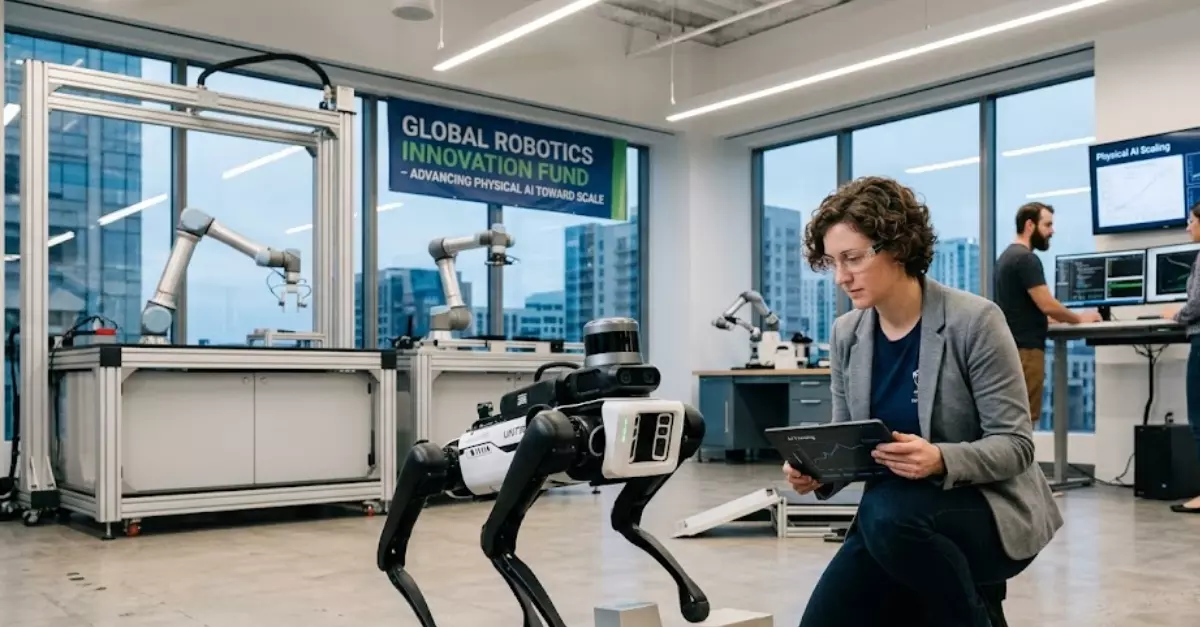
Robotics Funding Pushes Physical AI Toward Scale
Artificial intelligence is increasingly moving out of screens and into the physical world. Robotics startups are attracting significant investor attention as companies attempt to combine machine learning, sensors, automation and physical machines.
A major example is robotics startup Generalist, which has reportedly reached a $3 billion valuation after raising nearly $200 million in additional capital. The new financing extends an earlier $400 million Series B led by Radical Ventures, bringing the total round to about $600 million.
The development demonstrates how investors are increasingly interested in physical AI.
While software AI can scale quickly, robotics companies operate in a more complex environment. Machines need to interact with unpredictable physical spaces, which creates engineering, manufacturing and safety challenges.
Yet the potential market is enormous.
- The reasons why physical AI is different.Why physical AI is different.
- Traditional software is often easily reproduced and disseminated at very low cost. Robots cannot.
- They require hardware, manufacturing, maintenance and logistics.
- But the complexity can also establish better obstacles of entry.
- A company that designs reliable hardware, proprietary software, and operating knowledge could have a more difficult edge to beat than one with a simple software product.
- This is a good reason for investors who have longer time horizons to be interested in robotics.
Read: AI Must Empower Society Without Replacing Human Values
Investor Interest Is Expanding
- The recent investment activity indicates that robotics is not confined to the industrial automation sector.
- Robots are now being studied by investors in logistic, manufacturing, healthcare, agriculture, defense, construction and more.
- The wider scope of physical AI implies intelligent machines could eventually carry out tasks which would otherwise be completed by humans.
- Investors should be mindful of the differences between a demonstration and a commercial business, however.
- A robot carrying out a controlled task in a laboratory does not necessarily ensure that it will work reliably in hundreds of real-world environments.
The Importance of Unit Economics
- When it comes to robotics founders, it is important to do the math.
- What is the price of manufacturing the robot? How long does it run without maintenance? How many man-hours does it save or add? How long should it take a customer before they make a profit from your product?
- The answers to these questions may make or break the success of a robotics start-up becoming a scalable company.
- The sophistication of the AI model isn't always the most crucial factor for investors evaluating early-stage investment opportunities.
Capital-Intensive Growth
- A typical feature of robotics startups is that they generally need a lot more funding than software businesses.
- The development, testing and production of hardware can be significant resources while revenues are not significant.
- This is especially critical in terms of the strategy of fundraisers.
- From the founders' perspective, they should not do large rounds without clear milestones.
- Rather, capital can be associated with product growth, manufacturing readiness, customer deployments and sales forecasts.
- This allows investors to see through it.
The Asian Opportunity
- Asia is particularly important for robotics because the region includes major manufacturing economies and large industrial markets.
- Singapore can play an important role as a regional hub for robotics companies because of its access to multinational corporations, financial institutions, logistics infrastructure and Southeast Asian markets.
- For a venture capital firm in Singapore, physical AI presents an opportunity to invest in companies that connect advanced technology with regional industrial demand.
- The strongest businesses may not necessarily manufacture robots entirely in Singapore. They may develop software, sensing systems, fleet management platforms or specialized robotics applications.
Why Investors Need Patience
- Robotics development can take longer than software development.
- This means investors need realistic expectations.
- A founder may need several years to achieve manufacturing scale. Regulatory approvals can also take time depending on the application.
- Therefore, long-term capital can be a strategic advantage.
- Investors should match funding structures with technology timelines.
Fundraising Lessons for Robotics Founders
- Entrepreneurs planning to raise capital for startup Singapore or other international markets should explain their technology roadmap clearly.
- Investors should understand what the current product does, what remains technically difficult and what milestones the next funding round will finance.
- A strong robotics pitch should also include customer evidence.
- Letters of intent, pilot programs and commercial contracts can demonstrate demand.
The Bigger Physical AI Trend
- The rise of robotics investment suggests that the next phase of AI may involve a closer relationship between digital intelligence and physical infrastructure.
- Software agents can make decisions, but robots can execute those decisions in the physical world.
- That creates potential applications across almost every major industry.
- However, the opportunity is accompanied by significant risks. Hardware failures, safety concerns, manufacturing problems and capital requirements can quickly affect a startup.
- Investors therefore need a more comprehensive due-diligence process.
Financial Adviser View From Evolve Venture Capital
Evolve Venture Capital's financial perspective is that robotics investors should assess technology, manufacturing, customer economics and capital requirements together.
Founders should avoid presenting robotics as simply another software category. The funding strategy must reflect the physical realities of the business.
For investors, the best opportunities may be startups that have already identified a narrow commercial application where automation can create measurable economic value.