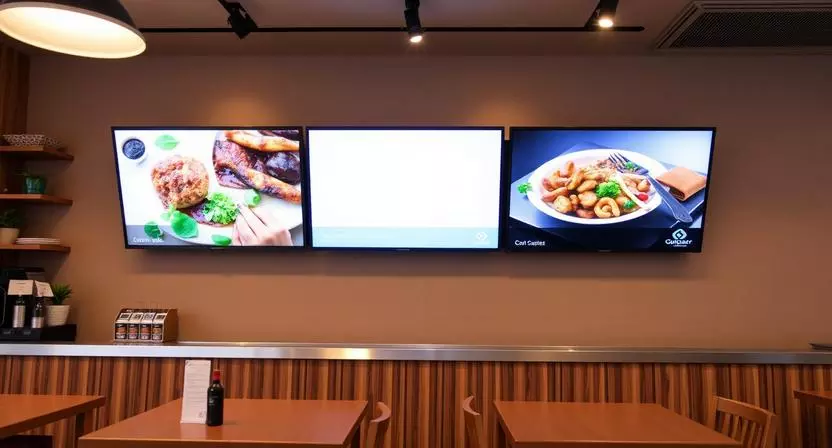
Revamping Restaurant Experiences: The Rise of Digital Menu Boards and Drive-Thru Innovations
Technology has ceased to be only a back-of-house inventory management system in the fast-paced food service industry. It has taken the front seat in terms of interacting with customers.
The old and stale backlit plastic menu is quickly becoming a thing of the past. In its place, a dynamic revolution is taking place: the widespread adoption of digital menu boards.
Whether it is the small coffee shop or the huge fast-food restaurant, digital screens are changing the way people browse, order, and eat.
It is not only a change focused on the appearance of modernity, but a strategic decision to improve operational efficiency, increase sales, and provide a more interactive customer experience.
Nowhere is this change more effective than in the drive-thru, where everything moves very fast.
What Are Digital Menu Boards?
Digital menu boards consist, at their most basic, of electronic displays, typically LED, LCD, or high-brightness commercial displays, which are used to promote the menu of a restaurant. Such boards are managed through a central content management system, unlike traditional menus that were printed.
This enables operators to update prices, change item availability, and even change promotions across various locations in real time with a few clicks.
The hardware is implemented to sustain the conditions of a restaurant, such as heat, grease, and 24/7 operation. Nevertheless, the magic is in the software.
New systems are capable of dayparting, which means automatically changing breakfast and lunch menus at a specific predetermined time, and dynamic content that can include high-resolution videos and animations to make the food look irresistible.
The Strategic Benefits of Digital Displays
The shift to digital signage has numerous advantages that are much more than cosmetic.
The possibility of impacting buying choices at the point of sale is one of the most substantial benefits. With quality imagery and movement, restaurants are able to attract attention to high-margin items or limited-time offers.
Moreover, online boards will save money and reduce the waste of having to print new menus whenever there is a price adjustment or the introduction of a seasonal menu.
This responsiveness enables marketing teams to respond to trends in real time. In case of a shortage of a particular ingredient, it can be pulled out of the board immediately to prevent disappointing customers.
Read: Easy digital signage software for small shops and restaurants
Drive-Thru Digital Menu Boards The Ultimate Efficiency Tool
Indoor digital menus enhance the experience of customers within the store, but drive-thru digital menu boards are transforming the quick-service restaurant industry.
The drive-thru is an essential source of income, which can usually comprise most of the sales in a fast-food restaurant. To be successful, it is necessary to optimize this lane.
Drive-thru digital menu boards are built with special designs to withstand outdoor conditions. They make use of high-brightness displays, usually 2,500 to 3,500 nits, that can be easily seen even in direct, glaring sunlight.
They also have temperature control systems to work in extreme temperatures, either cold or hot.
Increasing Speed and Accuracy
Speed is the king in a drive-thru. Digital boards are combined with point-of-sale systems to show real-time order information.
As a customer drives to the speaker, the display can immediately indicate his or her order as it is ordered. This graphical verification minimizes mistakes and accelerates the transaction process.
Additionally, these boards can be dynamically updated according to the traffic flow. The system may reduce the menu during the busiest times to only show the fastest-selling items and help the line move swiftly.
On the other hand, at less busy times, the board may include more complicated and more profitable meals that can be prepared in a little longer time and have a higher profit.
The Upselling and Cross-Selling Function
Drive-thru digital menu boards are effective upselling tools because of their visual nature. As soon as a customer orders a burger, the digital screen can instantly animate a combo upgrade or recommend a dessert.
This visual hint will be much more effective than a picture or a word from an employee.
Restaurants can greatly boost their average ticket size by appropriately positioning high-profit items in sweet spots of the screen and using motion to capture the eye.
The fact that these promotions can be changed immediately implies that a restaurant can promote a specific product, such as a new flavor of milkshake, until all the products of that type are sold, maximizing sales of that particular product.
Combining Technology and User Experience
The ideal digital menu boards are not only putting information on air but captivating the customer. This could be in the form of interactive touchscreens in the indoor environment, where customers are allowed to make their own orders.
At the drive-thru, the interaction is achieved by using obvious and readable typography and a design that allows customers to find their favorites within seconds.
Accessibility is also a key consideration. Contemporary systems can be developed in such a way that they can be programmed to use various languages to serve different communities.
They are also capable of automatically regulating brightness depending on the time of day, thereby alleviating eye strain for customers during the night.
Overcoming Implementation Challenges
Although the advantages are apparent, the introduction of digital menu boards should be thought through.
The first hardware and software investment can be huge. The return on investment, however, is achieved in a short time by most operators by boosting sales and lowering printing expenses.
Reliability is another concern. A blank drive-thru screen is a catastrophe. As such, it is essential to collaborate with highly credible providers that have solid support and backup systems.
A large portion of new systems have cellular or hardwired fail-safes to keep the menu up even in case the main internet connection goes dead.
The Future of Menu Technology
With the further development of technology, we can anticipate the use of digital menu boards that are even smarter. Artificial intelligence will significantly feature.
Drive thru digital menu boards could be used in the future to identify returning customers and show their most common order, or dynamically change prices based on real-time demand and weather conditions.
There are also voice-activated ordering systems in the offing that will operate in conjunction with digital displays to establish a completely automated drive-thru. The menu board will be the visual anchor, which will validate orders and also show individualized offers.
Conclusion
The introduction of digital menu boards is a paradigm shift in the marketing and operation of restaurants.
They are flexible and attractive to interior spaces. In the case of the drive-thru, they offer a competitive advantage of critical speed, precision, and sales.
With the QSR industry still focusing on convenience and efficiency, the shining dynamic light of digital signage will be the beacon of progressive restaurants. Adopting this technology is not only a matter of keeping up with the times, but also establishing the future of dining.