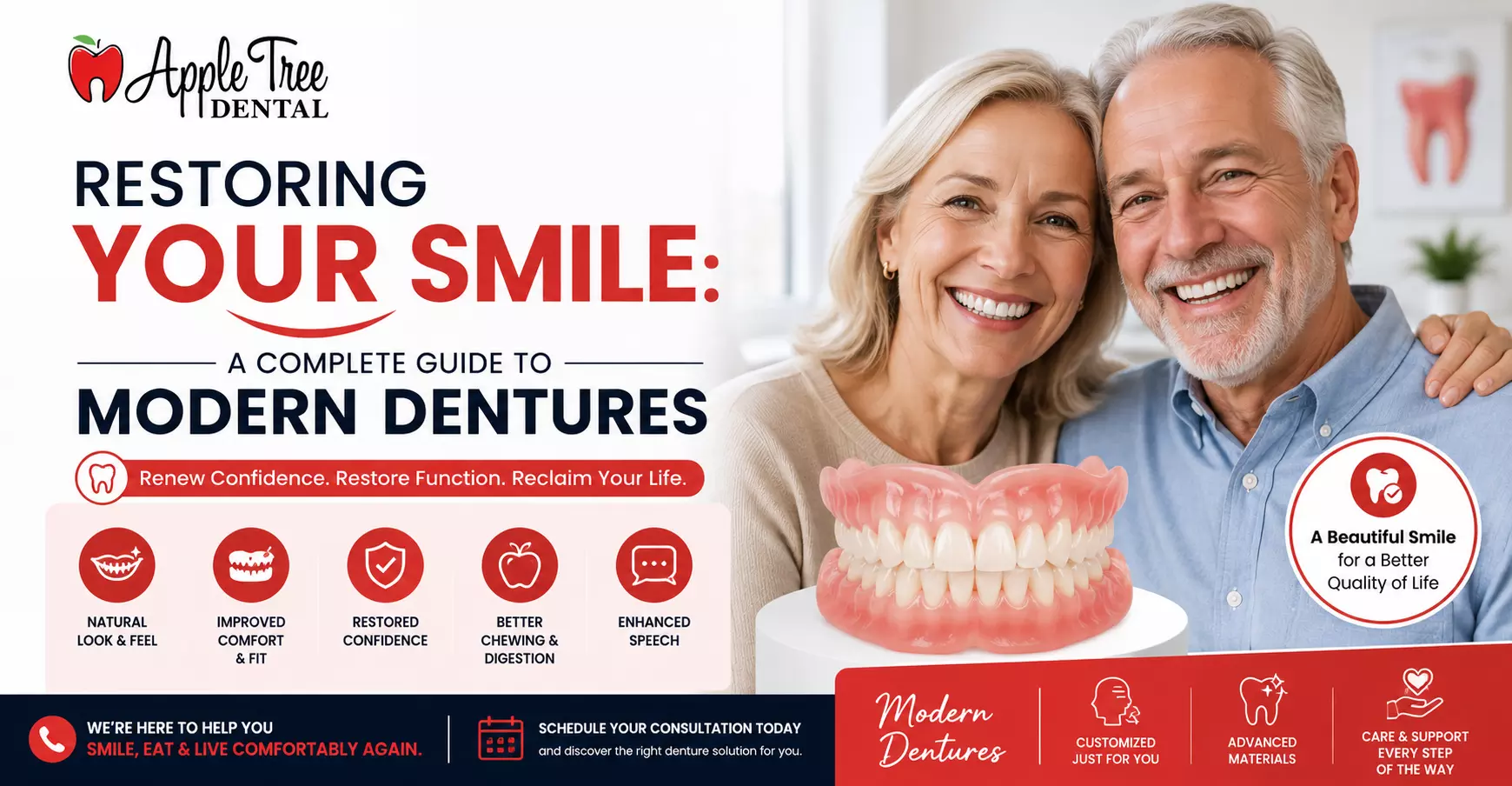
Restoring Your Smile: A Complete Guide to Modern Dentures
Missing teeth can take a significant toll on your quality of life. It isn’t just about the aesthetic impact on your smile—though that is certainly important for your self-confidence.
Tooth loss directly affects your ability to chew your favorite foods, speak clearly, and maintain the structural integrity of your jaw. If you are experiencing decay, advanced gum disease, or dental trauma, you are likely exploring options for restorative dentistry.
For decades, the term "false teeth" brought to mind images of bulky, uncomfortable, and unnatural-looking plates. However, advancements in dental materials and digital imaging have completely transformed what we can achieve. Today’s tooth replacement solutions are customized, highly functional, and virtually indistinguishable from natural teeth.
In this comprehensive guide, we will explore everything you need to know about navigating tooth loss, understanding your prosthetic options, and reclaiming your oral health.
The Evolution of Dental Prosthetics
Historically, dental prosthetics were designed with a "one size fits all" mentality. They often slipped during speech or eating, causing embarrassment and sore spots on the gums. Modern restorative dentistry has shifted away from this archaic approach.
Today, the focus is on precision and biocompatibility. Instead of relying solely on heavy plastics, modern dentures are fabricated using high-grade acrylic resins, lightweight metal alloys, and advanced porcelain or composite teeth.
These materials mimic the light-reflecting qualities of natural enamel and the exact shade of healthy gum tissue. Furthermore, digital intraoral scanners allow dentists to map the unique contours of your mouth down to the millimeter, ensuring a fit that is both snug and comfortable.
Types of Dentures: Finding the Right Fit for Your Smile
No two mouths are exactly alike, which is why there are several different types of appliances designed to meet varying degrees of tooth loss and structural needs.
Complete Dentures
If you have lost all of your natural teeth on either the upper or lower arch (or both), complete dentures are the standard solution. These full-arch replacements consist of a flesh-colored acrylic base that rests directly over your gums.
- Maxillary (Upper) Dentures: These feature a plate that covers the roof of your mouth (the palate), which creates a suction effect to hold the appliance firmly in place.
- Mandibular (Lower) Dentures: Because the tongue needs room to move, lower plates are shaped like a horseshoe. They rely on the bony ridge of your jaw and the surrounding facial muscles to stay seated.
Partial Dentures
When you still retain several healthy natural teeth, a partial denture is the ideal choice. Partials bridge the gap created by missing teeth. They typically consist of replacement teeth attached to a pink or gum-colored plastic base, which is connected by a metal framework.
This framework clasps onto your remaining natural teeth to anchor the appliance securely. Partials not only improve your appearance and chewing ability, but they also prevent your remaining natural teeth from shifting out of their proper alignment.
Implant-Supported Dentures (Overdentures)
For patients looking for the highest level of stability, implant-supported dentures represent the gold standard in modern tooth replacement. Instead of resting solely on the gums, these appliances snap onto titanium dental implants that have been surgically placed into the jawbone.
This hybrid approach prevents the appliance from slipping while you eat or speak. More importantly, the titanium posts act like artificial tooth roots. Through a process called osseointegration, the implants fuse with your natural bone. This provides the mechanical stimulation necessary to keep your jawbone healthy and strong.
The Silent Consequence of Tooth Loss: Bone Resorption
One of the least discussed but most severe consequences of prolonged tooth loss is a condition known as bone resorption.
Your jawbone requires constant stimulation to maintain its mass and density. Every time you bite and chew, the force travels through your tooth roots and signals your body to send calcium and vital nutrients to the jaw.
When teeth are extracted, that stimulation ceases. The body assumes the bone in that area is no longer needed and begins to reabsorb the minerals for use elsewhere.
Over time, this causes the jawbone to shrink and deteriorate. As the bony ridge flattens out, the facial muscles begin to sag, leading to a sunken, prematurely aged appearance around the mouth and cheeks. Furthermore, as the jawbone changes shape, traditional dentures that once fit perfectly will become loose and require frequent readjustments.
Addressing tooth loss promptly with well-fitted prosthetics—particularly implant-supported options—helps distribute chewing forces and mitigates the rapid progression of bone resorption.
Read: The Ultimate Guide to Getting a Tooth Implant in London, Ontario
The Fitting Process: What to Expect in the Chair
Transitioning to dental prosthetics is a journey, not a single appointment. The process requires precision, patience, and a collaborative relationship with your dentist. Here is what you can generally expect:
- Initial Consultation and Oral Health Assessment: Your dentist will evaluate the health of your gums, the density of your jawbone, and any remaining natural teeth. This often involves detailed X-rays or 3D cone-beam computed tomography (CBCT) scans.
- Impressions and Measurements: Precise measurements of your jaws and the space between them are taken. Digital scanners or traditional putty impressions will capture the exact architecture of your mouth to ensure the final appliance aligns perfectly with your bite.
- Wax Try-In Models: Before the final acrylic is cast, you will try on a wax model. This allows you and your dentist to evaluate the color, shape, and fit of the replacement teeth. You can make adjustments to the aesthetics before the final product is finalized.
- Final Fitting and Adjustments: Once the permanent appliance is ready, your dentist will place it in your mouth and check for any pressure points. It is completely normal to require several minor adjustments over the following weeks as your gums adapt to the new appliance.
Living With Your New Smile: Maintenance and Daily Care
Adapting to your new teeth takes time. During the first few weeks, you may experience minor sore spots, increased saliva production, or difficulty pronouncing certain words. This is a normal part of the muscle retraining process. Reading aloud and starting with a diet of soft foods cut into small, manageable pieces will help speed up the transition.
Just like natural teeth, your new prosthetics require daily hygiene to prevent plaque buildup, bad breath, and bacterial infections.
- Rinse After Eating: Always remove and rinse your appliance after meals to wash away loose food particles.
- Brush Daily: Use a soft-bristled brush and a non-abrasive cleanser specifically designed for oral appliances. Standard toothpaste can create microscopic scratches in the acrylic where bacteria can hide.
- Soak Overnight: Most acrylic bases need to stay moist to maintain their shape. Place them in water or a mild soaking solution while you sleep.
- Care for Your Gums: Even without natural teeth, oral hygiene matters. Gently brush your gums, tongue, and the roof of your mouth with a soft toothbrush every morning to stimulate circulation and remove plaque.
How to Know When It’s Time for a Replacement
Nothing lasts forever, and even the highest-quality dental appliances experience wear and tear. On average, a well-maintained set should last between 5 to 7 years. However, because the shape of your mouth naturally changes as you age, the fit will eventually degrade.
If you notice that you are using more adhesive than usual, experiencing persistent sore spots, or hearing a clicking sound when you speak, it is time for an evaluation. Often, a dentist can perform a "reline"—adding a new layer of material to the base to improve the fit.
If the teeth themselves are heavily worn down, flattening your bite and reducing chewing efficiency, a completely new set will be required.
Choosing the Right Clinic for Your Needs
Regaining your smile is a highly personal and impactful medical decision. It requires a clinical team that blends technical precision with compassionate patient care. You want a provider who listens to your concerns, explains the long-term implications of your choices, and offers the latest in digital and implant technology.
When evaluating local options for Dentures London Ontario, look for a clinic that emphasizes comprehensive restorative care rather than just quick fixes.
A thorough provider will carefully assess your jawbone density, discuss the pros and cons of partials versus implants, and ensure that your final appliance restores both your facial aesthetics and your ability to enjoy life without hesitation.
Ultimately, losing your teeth does not mean losing your quality of life. By understanding the modern solutions available and partnering with an experienced dental team, you can confidently invest in a restoration that looks natural, functions beautifully, and protects your long-term oral health.