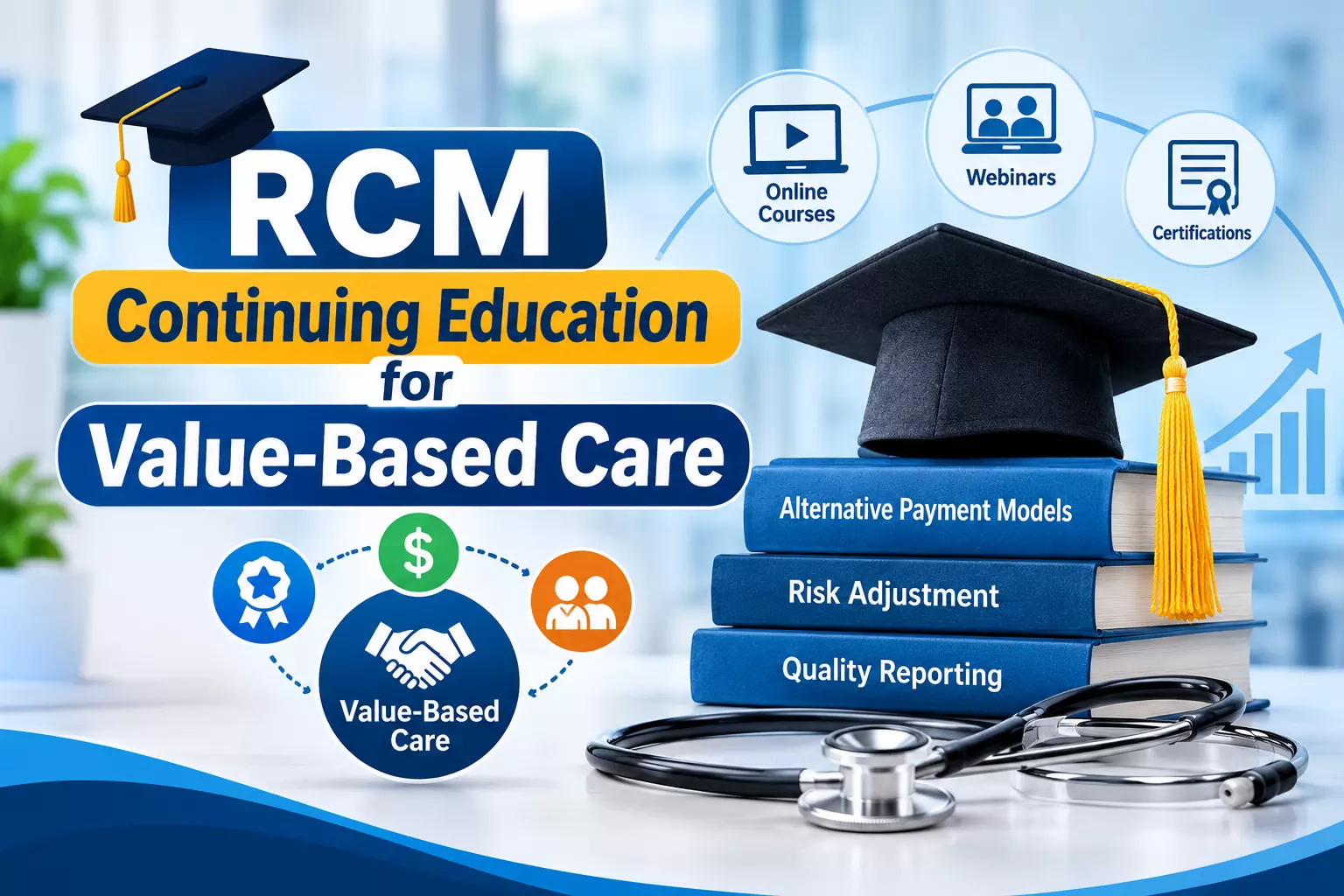
Where can I obtain RCM continuing education resources focusing on value-based care reimbursement?
Revenue cycle professionals can find continuing education on value-based care reimbursement through CMS, the American Medical Association (AMA), AAPC, AHIMA, MGMA, and healthcare education providers.
These resources cover alternative payment models, risk adjustment, quality reporting, coding accuracy, payer contracts, and reimbursement operations.
Why Value-Based Care Education Matters for RCM Professionals
Healthcare reimbursement is changing as providers participate in payment arrangements that consider quality, cost, patient outcomes, and care coordination alongside the services delivered.
Under traditional fee-for-service reimbursement, organizations generally receive payment based on individual services. Value-based care introduces additional financial considerations, such as quality performance, shared savings, risk adjustment, and performance-based incentives.
This creates new responsibilities for revenue cycle teams. Professionals need to understand how documentation, coding, claims processing, payer contracts, and financial reporting support value-based reimbursement.
Continuing education can help RCM professionals develop knowledge in areas such as:
- Alternative payment models: Understanding bundled payments, shared savings, and shared-risk arrangements.
- Risk adjustment: Recognizing how accurate diagnosis coding and documentation influence risk-based reimbursement.
- Quality reporting: Understanding performance measures connected to payment programs.
- Revenue integrity: Connecting clinical documentation, coding, billing, and reimbursement accuracy.
- Payer contracting: Reviewing reimbursement terms, financial incentives, and contractual obligations.
- Performance analytics: Monitoring financial and quality indicators across different payment arrangements.
The most useful education programs connect these subjects to practical revenue cycle workflows.
6 Places to Obtain RCM Continuing Education Resources
1. Centers for Medicare & Medicaid Services (CMS)
CMS is an important starting point for professionals who want to understand Medicare reimbursement and value-based payment programs.
Its Medicare Learning Network (MLN) provides educational publications, training materials, web-based learning, and program guidance. These resources help healthcare professionals understand Medicare policies and reimbursement requirements.
Relevant topics include:
- Merit-based Incentive Payment System (MIPS)
- Advanced Alternative Payment Models (APMs)
- Medicare Shared Savings Program
- Accountable Care Organizations (ACOs)
- Quality Payment Program (QPP)
- Medicare billing and reimbursement policies
Why it is useful: CMS materials help RCM professionals understand the regulatory and operational foundations of Medicare value-based payment programs.
Best suited for: Reimbursement specialists, RCM managers, compliance teams, and professionals supporting Medicare programs.
2. American Medical Association (AMA)
The American Medical Association offers educational resources connecting physician practice management, revenue cycle operations, and value-based payment arrangements.
One relevant resource is A Physician's Guide to Effective Revenue Cycle Management for Value-Based Care. It addresses operational and financial considerations involved in managing revenue cycle processes under value-based arrangements.
The AMA also provides educational materials covering:
- Value-based payment models
- Accountable care organizations
- Physician practice financial management
- Revenue cycle performance
- Payment model transitions
- Quality and performance measurement
Its STEPS Forward platform provides additional practice improvement education and learning activities. Professionals should review individual activity details to determine whether CME credit is available and whether it meets their credentialing requirements.
Why it is useful: AMA resources help connect reimbursement changes with physician practice operations and revenue cycle management.
Best suited for: Practice administrators, RCM directors, physician finance teams, and healthcare operations professionals.
3. American Academy of Professional Coders (AAPC)
AAPC is a useful education provider for professionals working in medical coding, billing, auditing, and reimbursement.
Its continuing education offerings include webinars, workshops, conferences, and online courses. Several subjects are relevant to value-based care because payment performance depends on accurate documentation, coding, and reporting.
Professionals can look for education covering:
- Risk adjustment and diagnosis coding
- Clinical documentation accuracy
- Medical necessity
- Coding audits
- MACRA and MIPS
- Healthcare reimbursement methodologies
- Revenue cycle management
AAPC also provides education related to MACRA and value-based payment requirements, helping coding and billing professionals understand how documentation and reporting support reimbursement programs.
Why it is useful: AAPC provides structured professional education for coding and billing teams whose work affects reimbursement accuracy.
Best suited for: Certified professional coders, billing specialists, coding auditors, and reimbursement analysts.
4. American Health Information Management Association (AHIMA)
AHIMA provides professional education in health information management, clinical documentation integrity, coding, revenue cycle operations, and reimbursement.
Its revenue cycle education resources help professionals understand how patient access, documentation, coding, claims, and payment processes work together.
Relevant learning areas include:
- Healthcare reimbursement methodologies
- Clinical documentation improvement (CDI)
- Coding and documentation accuracy
- Denial prevention and management
- Revenue integrity
- Health information and data quality
AHIMA also offers revenue cycle education and training for professionals who want to strengthen their understanding of reimbursement operations.
Why it is useful: AHIMA education is relevant to the documentation and data quality requirements that support accurate reimbursement and value-based performance reporting.
Best suited for: CDI specialists, health information management professionals, coding leaders, and revenue cycle educators.
5. Medical Group Management Association (MGMA)
MGMA offers professional education for medical practice administrators, healthcare financial leaders, and revenue cycle professionals.
Its learning resources include webinars, courses, podcasts, tools, and professional development programs. Relevant subjects include payer contracting, practice financial performance, reimbursement strategies, and revenue cycle management.
Professionals can explore topics such as:
- Value-based payment contract considerations
- Payer negotiations
- Practice financial management
- Revenue cycle performance measurement
- Healthcare analytics
- Coding and billing operations
MGMA also offers payer contracting education, which can help professionals understand reimbursement agreements and evaluate contractual terms.
Why it is useful: MGMA connects reimbursement education with the financial and administrative responsibilities of medical practices.
Best suited for: Practice administrators, RCM directors, financial managers, payer contracting specialists, and healthcare executives.
6. GeBBS Healthcare Solutions Education Series
GeBBS Healthcare Solutions provides an education platform focused on healthcare revenue cycle management and related professional development.
Its Education Series advertises free courses, on-demand webinars, downloadable materials, and continuing education opportunities. The platform also provides access to learning opportunities associated with organizations such as AHIMA, AAPC, and NCRA.
Relevant subjects may include:
- Revenue cycle operations
- Medical coding and billing
- Healthcare reimbursement
- Documentation and compliance
- Revenue cycle performance improvement
Why it is useful: The platform provides accessible learning opportunities for professionals who want to strengthen their practical RCM knowledge.
Best suited for: Medical billing specialists, coding professionals, RCM analysts, and healthcare operations teams.
Course availability and CEU eligibility can change. Verify the credit amount, accrediting organization, and eligibility for your specific credential before enrolling.
Comparison of Value-Based Care Education Resources
Organization
Main learning focus
Available learning formats
CMS
Medicare programs, MIPS, APMs, ACOs
Training, publications, program guidance
AMA
Value-based reimbursement and physician practice RCM
Guides, webinars, educational activities
AAPC
Coding, billing, MACRA, reimbursement
CEU courses, webinars, workshops
AHIMA
Revenue cycle, CDI, coding, reimbursement
Courses, webinars, professional education
MGMA
Payer contracting, practice finance, RCM
Professional courses, webinars, podcasts
GeBBS
Healthcare RCM and professional development
Online courses, webinars, CE opportunities
Not every educational resource awards formal continuing education credits. Some provide general professional development, while others offer credit through specific accredited activities. Check the course description and credentialing requirements before counting an activity toward renewal.
Important Topics to Include in an RCM Value-Based Care Learning Plan
Choosing courses based only on their titles can leave important knowledge gaps. A structured learning plan should connect reimbursement concepts with the responsibilities of the revenue cycle team.
Learning topic
Connection to revenue cycle management
Alternative payment models
Explains how payment structures differ from traditional fee-for-service
MIPS and APM reporting
Helps teams understand quality reporting and payment adjustment requirements
Risk adjustment
Connects accurate diagnosis documentation with appropriate risk representation
Clinical documentation integrity
Supports accurate coding and reimbursement
Quality performance measures
Helps financial teams understand performance-linked payment
Payer contracting
Supports review of reimbursement terms and financial risk
Revenue cycle analytics
Helps monitor financial and operational performance
Denial and appeal management
Helps identify payment issues and recurring documentation gaps
A Practical 90-Day Continuing Education Plan
Healthcare organizations can organize professional development into three stages.
Month 1: Understand value-based reimbursement
- Review CMS resources on MIPS, APMs, and Medicare Shared Savings.
- Study differences between fee-for-service and value-based payment.
- Identify which payment arrangements apply to the organization.
Month 2: Connect reimbursement to RCM operations
- Study risk adjustment and clinical documentation.
- Review coding accuracy and quality reporting requirements.
- Understand how payer contracts define financial incentives and performance obligations.
Month 3: Apply learning to financial performance
- Review reimbursement and quality-related performance indicators.
- Identify gaps in documentation, coding, claims, and reporting workflows.
- Discuss improvement opportunities with finance, clinical, and operational teams.
This approach helps professionals move beyond theoretical knowledge and understand how value-based payment requirements affect everyday revenue cycle workflows.
Where Can Healthcare Organizations Find Additional RCM Resources?
Professional associations and government agencies provide education, but healthcare organizations may also need external technology, consulting, analytics, coding, and revenue cycle services to support value-based reimbursement initiatives.
The Revenue Cycle Resources – RCR|HUB Business Partner Directory provides a centralized resource for identifying healthcare revenue cycle vendors across specialized categories.
Organizations can use the directory to research potential business partners, compare relevant service categories, and develop an initial vendor shortlist based on operational requirements.
For example, healthcare providers evaluating documentation improvement, coding accuracy, revenue cycle analytics, or reimbursement support can research relevant service providers before beginning direct vendor discussions.
Continuing education helps teams understand what needs to change. Vendor research helps organizations identify potential external resources to support those changes.
Conclusion
RCM continuing education focused on value-based care reimbursement is available through CMS, AMA, AAPC, AHIMA, MGMA, and GeBBS Healthcare Solutions.
Each organization offers a different learning approach, from Medicare program guidance and reimbursement methodology to professional courses and payer contracting education.
Revenue cycle professionals should prioritize learning that connects payment models with documentation, risk adjustment, quality reporting, payer contracts, and financial performance.
Combining structured continuing education with practical application can help healthcare organizations prepare their teams for increasingly complex reimbursement arrangements.