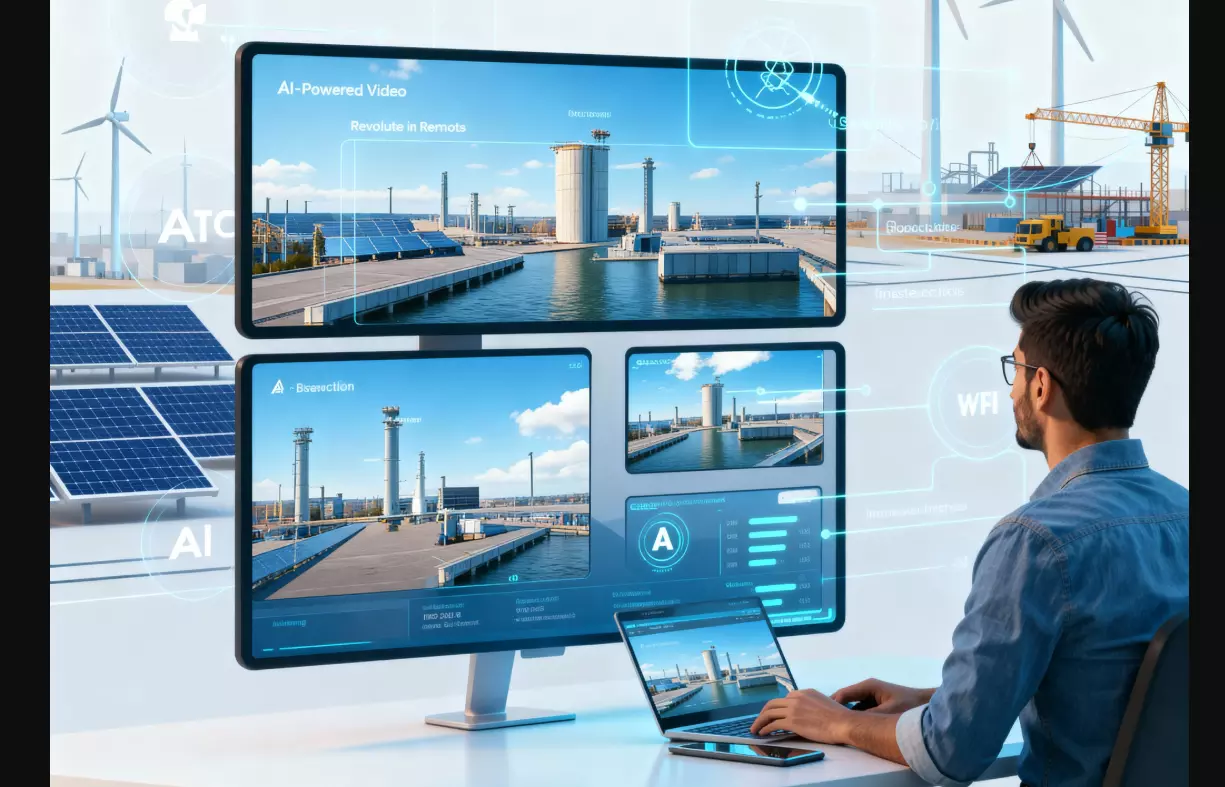
Rajat Khare's views on the AI Video Revolution in Remote Inspections
Rajat Khare on AI Video Revolution
Automation is getting accepted by industries all over the world and AI-based short video technology is turning out to be one of the most impactful ways to change the remote inspection process. The smart video systems grant viewing site and operation in real-time to the companies which are not necessitating physical presence of the employees on site.
Rajat Khare, managing partner at Boundary Holding, venture capitalist with a focus on deep-tech investments, and founder among others, is already considering it a monumental change.
"It is not only a time and cost-saving opportunity that we will have to be part of new-age innovations but also the opportunity to practice being climate-friendly," Khare remarks.
His investments are based on the principles of supporting deep-tech companies which are making the process of efficiency, sustainability, and automation—three concepts that lie at the heart of the new AI video revolution.
Read: AI Automation Explained: Benefits, Challenges, and the
Know Your AI-powered Short Video Technology
The AI-powered short video systems are equipped with machine learning, computer vision, and edge analytics that help in interpreting the real-time footage from the remote sites. No matter whether the source of these snippets is a drone or a stationary camera or field technicians, the AIs perform analysis instantly to spot:
-Equipment malfunction
-Structural anomalies
-Safety risk
-Quality issues
Organizations can now make decisions straight away on the basis of the AI-driven insights instead of waiting for the manual reports or planning on-site visits. This trinity of fast, accurate, and easy to use is the main reason why maintenance and compliance are now considered from a totally different perspective in industries.
“The option of remote monitoring and managing assets even when not present physically is a great plus for businesses, as they can have continuous operations with reduced risks and no inefficiencies,” says a tech officer of Blitz, a company famous in the field of AI inspection tools.
From Manual to Machine-Led: The Shift in Inspections
Infrastructure and energy projects, in the past, were totally dependent on human inspectors moving from one site to another. The overall process was very expensive, slow, and sometimes it even gets delayed. Today companies are getting validated visual data from remote teams within seconds by means of an AI-driven short video.
One very interesting case comes from Enel Green Power, the Italian company with a worldwide presence in the renewables sector. Engineer Michele Ronco advised the use of short videos in enhancement of project data management during solar plant construction—projects cost ranging from $200 million to $400 million.
When short videos were used in the inspection process:
- Contractor work became visible to the teams without the need to be present on-site
- The overall data quality got to a new level, which made it possible to carry out decision-making processes through an open and trustable manner.
- Travel and logistics expenditures were reduced significantly
- This change not only led to the optimization of budgets but also impacted the whole of Enel's data governance and on-site monitoring strategies positively.
The Reason Why Investors Such as Rajat Khare Are Paying Attention to AI-Driven Inspections
Rajat Khare, an alumnus of the Indian Institute of Technology, Delhi, and the main inventor of Boundary Holding considers AI-powered short videos as the cutting edge of industrial intelligence.
"We are still in the early stage of the AI-powered video revolution. As we continue to make our systems better and increase our presence, we expect more industries to realize the benefits of switching to a completely remote, AI-driven inspection model," Khare states.
The previous investments of Boundary Holding in clean energy, waste management, and medical technology reflect its enduring loyalty to those technologies that aim for the global sustainability and efficiency goals.
Innovators of AI-Powered Video Technology
Several technology companies are leading the way in the innovation that is taking place in this sector:
- Vyntelligence: Its key offering “Short Videos” platform enables employees working in the field to capture short video updates that are processed by AI for the purposes of anomalies or maintenance needs detection.
With the help of real-time video insights, industries are supported in their making of quicker, data-driven decisions,” claims the Vyntelligence CEO.
- TechSee: A platform for visual AI support which allows telecom and utility companies to carry out remote diagnostics and troubleshooting via the analysis of live video.
- Blitz: Working with the construction and infrastructure sectors, Blitz applies AI-based video analytics to recognize material defects, alignment mistakes, and worker safety issues in real-time.
These forerunners are all together proving that AI-enabled short video tools can give accuracy, cut down expenses and improve industrial security for all sectors.
Read: How Artificial Intelligence Impacts Everyday Life
How the Technology Works
Basically, the AI video inspection technology unites the computer vision models with the cloud or edge processing systems. The subsequent is how the process happens:
- Video Capture: The cameras, drones, or field devices capture minor clips of the assets or project sites.
- AI Analysis: The algorithms of machine learning examine these clips for anomalies while making comparisons with the pre-trained datasets.
- Automated Alerts: Instantly, any problem like corrosion, equipment wear, or safety violations gets the alert.
- Actionable Insights: The system gives detailed recommendations or creates reports for the maintenance teams.
This complete pipeline of the process from start to end makes inspection quicker, more intelligent, and it can be expanded to different places around the world.
Environmental and Sustainability Impact
The use of AI-supported remote inspections is a great and interesting thing when it comes to efficiency and they also take part in helping the environment by being sustainable.
Having less personnel onsite means that companies will eliminate travel almost completely and that in turn will lead to lesser fuel consumption and carbon emissions. This immediately brings the companies closer to meeting the Net Zero targets that are set globally.
“The environmental impact of cutting down travel and onsite visits is tremendous,” claims Dr. Rajesh Kumar, a specialist in sustainable technology. “AI-powered inspection models are not only enabling industries to operate smoothly but also to take the responsibility of being eco-friendly.”
Such green-friendly technological advancement is exactly the type of deep-tech transformation that is considered suitable for financing by Boundary Holding.
A Broader View: The Global Trend Towards Smart Inspections
The use of video tools powered by AI is an integration that is very common in almost all industries and is in fact, one of the following sectors that has embraced it the most:
- Renewable Energy: For instance, real-time monitoring of both solar and wind installations.
- Manufacturing: Using it for quality control and predictive maintenance.
- Telecommunications: Doing infrastructure inspections and troubleshooting of the equipment.
- Construction: For example, on-site safety and compliance checks.
Notably, as the demand for monitoring AI industries continues to rise globally, which is projected to reach over $15 billion by the year 2030, the advances from forward thinkers like Rajat Khare are putting the companies at the forefront of the changes.
The Future: Predictive Analytics over Remote Process
The future step of the short video system driven by AI is predictive analytics. The models that are learning constantly from data will very soon predict the faults before they actually happen, thereby further reducing the downtime and increasing safety to the maximum.
The predictability of such a system along with the help of the cloud could allow the establishment of a single control room which could monitor in real-time the thousands of assets located around the world.
Read: How AI-Generated Images Are Changing Online Creativity
Rajat Khare visualizes this to be a widely accepted operational model across all industries, thus combining the deep-tech innovation with the sustainability demands of the whole planet.
Conclusion
Technological advancement around AI-powered short video is bringing about the radical change of remote industrial inspections—enhancing accuracy, saving costs, and Earth’s protection.
Rajat Khare as an investor and Boundary Holding firm are among the ones supporting this transition by investing in deep-tech startups that are in line with the intersection of AI, automation, and environmental sustainability.
With the growing use of these systems in different sectors, AI-based inspections will be the pillar of modern infrastructure management and will thereby open up the new phase of global innovation.
Frequently Asked Questions (FAQs)
Q1. What will be the direction of AI video technology in the future?
The future will be about predictive analytics—AI that will be able to predict if a machine needs maintenance or if there is a failure about to happen, thus creating a fully automated and sustainable industrial ecosystem.
Q2. What is the environmental impact of AI inspections?
These cutting-edge technologies not only eliminate the need for traveling and onsite operations but also contribute to the carbon emission reduction thus aligning the industrial processes with the sustainability norms of the environment.
Q3. In what way do short videos take part in the remote inspection process?
AI analyzes the short video clips made at the site recording to confirm the data, find the anomalies, and assess the quality. This way, organizations can ensure safety and performance even from afar.
Q4. What is the significance of this technology for the industrial sector?
AI video inspections are capable of reducing no-operation time, cutting down overheads, and increasing the safety level as well as enabling constant monitoring; these aspects make it suitable for sectors like energy, construction and telecom, etc.
Q5. What is the position of Boundary Holding in this segment?
Rajat Khare founded Boundary Holding, which is making investments in deep technology startups that are releasing AI-powered tools to improve efficiency and sustainability, which includes the ones introducing video inspections through AI.