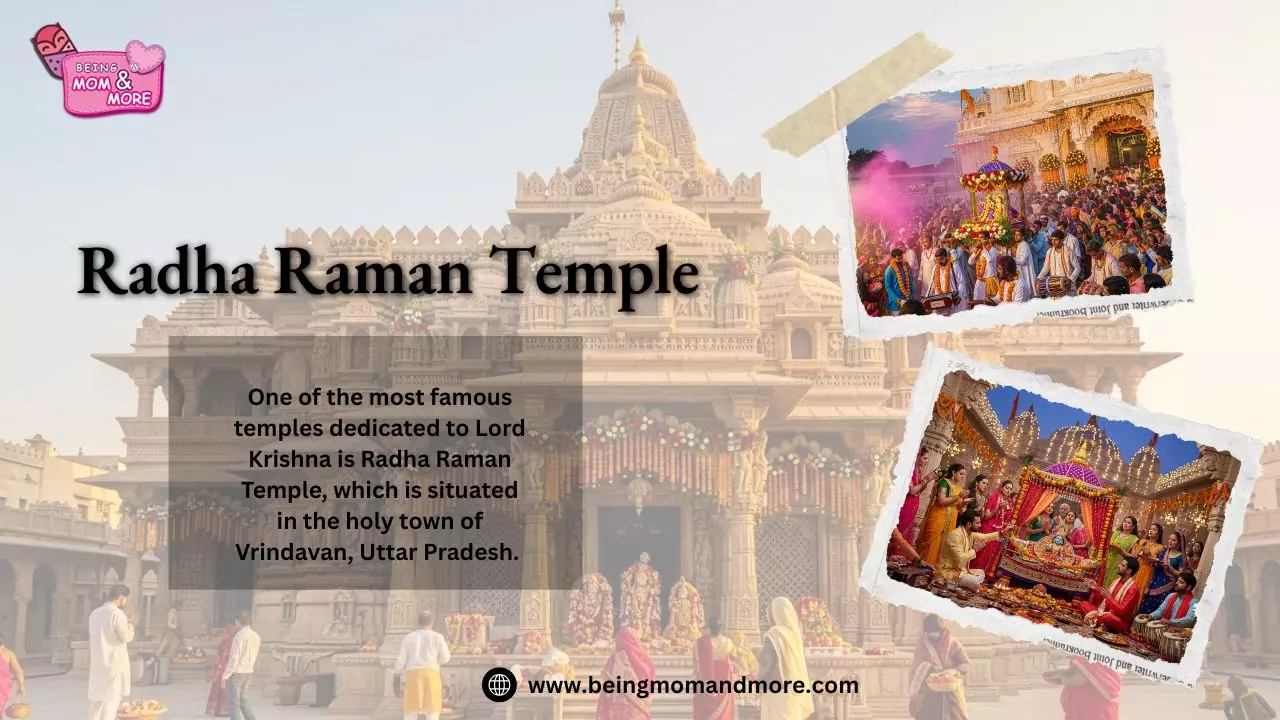
Radha Raman Temple: Vrindavan's Divine Jewel
One of the most sacred and important temples devoted to Lord Krishna is the Radha Raman Temple in Vrindavan, Uttar Pradesh. Devotees from all over the world go to this hallowed sanctuary, which is a radiant representation of Radha and Krishna's holy love. The temple, which was constructed in the sixteenth century, still represents the beauty of Indian temple art and the old spirit of bhakti, or devotion.
Read: Top 5 Temples in Jaipur for a Spiritual Journey
Radha Raman Temple's Origins & History
Gopala Bhatta Goswami, one of the six Goswamis of Vrindavan and a close student of Sri Jagannath Mahaprabhu, founded the Radha Raman Temple. Legend has it that Gopala Bhatta once wanted to worship Lord Krishna not as a Shaligram Shila (a sacred stone) but in His divine form. Inspired by his pure love, Lord Krishna looked from one of the Shaligram stones as Radha Raman Ji, which translates to "the one who gives joy to Radha."
Because it represents the combined relationship between Radha and Krishna in a single form, the self-made deity of Radha Raman is special. It is regarded as one of the most revered and magical icons in Vrindavan since the deity became naturally.
The Radha Raman Temple's architectural beauty
The Radha Raman Temple is a prime example of early modern North Indian temple architecture. The temple, which was built in 1542 A.D., features beautiful red sandstone carvings, wonderful floral themes, and old script inscriptions that provide tales from Krishna's life. The sanctuary's magnificent marble flooring, lovely lighting, and silver lamps all contribute to the temple's allure.
Radha Raman Ji's idol is modest but very detailed; every devotee is captured by his expressive eyes, divine smile, and beautifully carved decorations. A silver crown put next to Lord Krishna represents Goddess Radha's eternal presence, even if there isn't a separate idol of her.
Daily Rituals and Religious Significance
The Radha Raman Temple is renowned for its natural, age-old rituals that have been performed continuously for more than 480 years. Gopala Bhatta Goswami's teachings are closely followed in this place of worship.
Mangala Aarti (morning prayer), Shringar (decoration), Rajbhog (primary meal offering), and Sandhya Aarti (evening prayer) are among the daily customs. Deep dedication, beautiful kirtans (devotional songs), and the rhythmic sounds of mridanga and kartal are used in every ritual.
Radha Raman Ji's Appearance Day, which marks the deity's appearance, is one of the most important occasions observed here. The temple is decorated with flowers, candles, and vibrant fabrics for the major event, which draws devotees from all across India and the world.
Devotee Connection and Spiritual Experience
Visiting the Radha Raman Temple is an experience that cannot be explained. The environment created by the pleasant sounds of bhajans, the aroma of incense, and the calm vibrations instantaneously fills the heart with devotion. A connection to Lord Krishna that transcends the mundane world is described by many devotees as a moment of spiritual awakening during their visit.
Read: An Overview of Hindu Temple Architecture
It is said that anyone who prays in front of Radha Raman Ji with a pure heart would be blessed with inner peace, love, and happiness. The temple teaches the virtues of compassion, humility, and divine love in addition to being a place of worship and a living hub of the Bhakti Movement.
Radha Raman Temple Celebrations & Festivals
With several festivals that bring joy and devotion to Vrindavan, the temple is active all year long. The temple glows with thousands of lamps on Janmashtami, the birth anniversary of Lord Krishna, and prayers of "Hare Krishna" fill the air.
Chandan Yatra is another significant event where the god is covered in sandalwood paste to ward off the summer heat. As devotees celebrate the festival of love with music, flowers, and joy, the temple comes alive with colour during Holi.
How the Radha Raman Temple Can Be Reached
Vrindavan has excellent train and road connections. Mathura Junction, which is about ten kilometres away, is the closest train station. From there, you can go straight to the Radha Raman Temple using local transportation like e-rickshaws or autorickshaws. The closest airport for visitors arriving by plane is Agra Airport, which is roughly 70 kilometres away from Vrindavan.
The mild months of October through March are the ideal time to go because of the nice weather and numerous significant festivals.
In conclusion
A timeless representation of faith, devotion, and divine love is the Radha Raman Temple. In addition to being a marvel of architecture, it is a spiritual site where tales of Radha and Krishna's unbreakable bond are whispered around every corner. Whether you are a traveler looking for peace, a history buff, or a devotee, visiting this hallowed temple gives an unforgettable experience.
Read: 10 Breathtaking Religious Sites in South India You Can't Miss
Travelling to Radha Raman Temple in Vrindavan is more than just a vacation; it's a step towards heavenly pleasure.