Protecting Confidential Business Information: Why Cybersecurity Alone Isn’t Enough
Cybersecurity has become a board-level priority for good reason.
Most organisations now invest in core protections such as firewalls, encryption, multi-factor authentication, endpoint security, and role-based access controls to reduce the risk of digital intrusion.
But confidential business information doesn’t exist only inside computers, servers, and cloud platforms. It also lives in conversations, meetings, printed documents, whiteboards, shared spaces, and informal decision-making moments.
Business strategies, intellectual property, financial plans, client information, tender and bidding details, M&A discussions, and executive communications can be exposed through everyday human activity and workplace routines—sometimes without any “hack” at all.
A strong cybersecurity system protects digital infrastructure, but protecting confidentiality also requires attention to the people, places, and processes surrounding sensitive information.
How Confidential Information Gets Exposed Outside Digital Systems
Information leakage often comes from three broad areas—people, places, and processes.
People: Confidentiality failures are frequently accidental. An employee may forward a document to the wrong recipient, discuss sensitive matters with a colleague who isn’t cleared for the topic, or take calls in public.
There is also the insider risk: individuals with legitimate access who misuse information, and former employees who retain knowledge—or, in weaker environments, retain access longer than they should. Even casual “small talk” about projects, clients, or negotiations can reveal more than intended.
- Places: Physical environments matter. Boardrooms, executive offices, hotel meeting rooms, conference facilities, business vehicles, restaurants, cafés, and shared workspaces can all create exposure if discussions are audible, spaces are uncontrolled, or access is loosely managed.
- Processes: Weak visitor management, unsecured meeting rooms, unclear document handling rules, and inconsistent confidentiality procedures increase risk.
- Scenario: A company may have strong cybersecurity controls but still discuss an acquisition in a hotel meeting room, allow an unattended visitor near an executive office, or review sensitive plans in a public setting.
Key takeaway: Not every leak requires sophisticated hacking. Simple weaknesses in people, places, or processes can be enough.
The Physical Side of Information Security
As organisations handle higher-stakes matters—major transactions, competitive tenders, high-value IP—the question expands from “Are our systems secure?” to “Are our discussions and environments secure?”
Physical confidentiality risks can include unauthorised recording, unauthorised monitoring, compromised meeting environments, or unexplained equipment in sensitive spaces.
Risk also increases when sensitive discussions happen in uncontrolled locations, such as public venues or temporary meeting facilities.
This is not a reason to assume every room is compromised. In most workplaces, that would be an unhelpful mindset. The goal is more practical: recognise that physical environments can present security risks and that, in higher-risk situations, some spaces may warrant professional assessment.
That is where Technical Surveillance Counter-Measures (TSCM) may be considered.
Read: AI Agents for Cyber Security: Enterprise Use Cases, Architecture
What Is TSCM and How Can It Help?
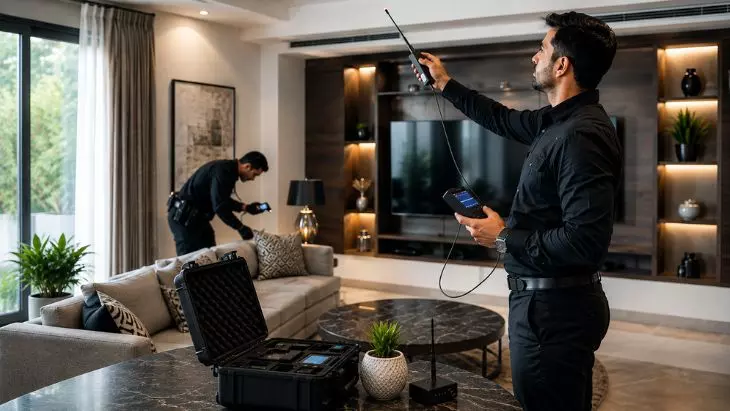
Technical Surveillance Counter-Measures (TSCM) refers to specialist measures used to identify and reduce the risk of technical surveillance in physical environments.
In simple terms, TSCM is an assessment process designed to help organisations gain confidence that sensitive spaces—like meeting rooms—are not vulnerable to unauthorised monitoring or recording.
A professional TSCM assessment typically involves a structured examination of the environment, which may include physical inspection, technical evaluation using specialist equipment, and review of environmental factors that could enable surveillance.
The focus is not only on devices, but also on how the space is used, who can access it, and what practical weaknesses may exist.
Common environments for TSCM include executive offices, boardrooms, conference rooms, designated sensitive meeting spaces, and—where appropriate—certain vehicles used for confidential discussions.
Importantly, TSCM is not a replacement for cybersecurity, physical security guards, employee policies, or access controls. It is a specialised layer focused on technical surveillance risks. For more details, see TSCM and Bug Sweeping services.
When Might a Business Consider a TSCM Assessment?
TSCM is most valuable when applied selectively and proportionately—based on the sensitivity of information and the realistic impact of exposure.
Preventive situations may include:
- Preparing for sensitive negotiations (commercial, legal, or strategic)
- Managing major mergers, acquisitions, or restructuring discussions
- Handling valuable intellectual property or product roadmaps
- Conducting confidential board meetings or executive strategy sessions
- Managing high-value tenders, pricing decisions, or competitive bids
- Moving into a new executive office, boardroom, or external meeting facility
Incident-driven situations may include:
- Suspected information leaks where the source is unclear
- Unexplained disclosure of confidential plans or negotiation positions
- Concerns about unauthorised recording during meetings
- Unusual activity around sensitive areas (access anomalies, unexplained visitors, unexpected changes to room setup)
- Specific reasons to believe confidential discussions may have been compromised
The key is not to treat TSCM as a routine checkbox for every organisation. It should be risk-based—aligned to real-world exposure and consequences.
The Human Factor: Employees, Visitors & Internal Procedures
Many confidentiality failures are preventable with disciplined everyday practices. Practical measures include:
- Limiting access to sensitive areas (and enforcing it consistently)
- Using clear visitor controls: sign-in, escorts, access badges, and defined boundaries
- Establishing confidentiality policies that employees can actually follow
- Conducting appropriate employee screening for roles with sensitive access
- Reviewing and removing access promptly when employees change roles or leave
- Training staff on information-security risks (including “casual conversation” risks)
- Establishing protocols for sensitive meetings (attendance rules, device rules, minutes handling)
- Avoiding confidential conversations in public or semi-public spaces
When screening is relevant, some organisations also implement employee background verification as part of their wider governance and risk controls.
Key message: Confidentiality is a shared responsibility—management, employees, security teams, and well-defined procedures all play a role.
Building a Layered Confidentiality Strategy
A resilient confidentiality programme avoids dependence on any single control. A practical way to structure this is a four-part model:
1) Digital Security
- Encryption for sensitive data
- Strong authentication (including MFA)
- Endpoint protection and patching
- Access controls based on least privilege
2) Physical Security
- Controlled entry to offices and sensitive zones
- Secure meeting areas and executive spaces
- Visitor management and escorting procedures
- Basic protections for documents, whiteboards, and meeting materials
3) People
- Employee awareness and confidentiality training
- Appropriate background verification for sensitive roles
- Clear accountability for handling sensitive information
4) Processes
- Information-handling policies (classification, sharing, retention)
- Meeting protocols (attendance, location selection, device expectations)
- Document controls (printing, disposal, secure storage)
- Incident response steps for suspected leakage
Key message: Digital, physical, human, and procedural safeguards should reinforce each other.
8. What TSCM Can—and Cannot—Address
A credible security approach is clear about what each measure can realistically do.
TSCM can help address:
- Potential technical surveillance risks in selected environments
- Concerns about unauthorised monitoring or recording
- Vulnerabilities within sensitive meeting spaces and executive areas
- Practical weaknesses in how rooms are accessed or configured for confidentiality
TSCM cannot replace:
- Cybersecurity controls and monitoring
- Employee screening and insider-risk management
- Strong access control and visitor management
- Security policies, governance, or legal advice
- Proper information-handling and meeting discipline
Core message: TSCM works best as part of a broader confidentiality and security programme, not as a standalone solution.
Conclusion: Protect Information Wherever It Exists
Confidential business information exists across servers and devices—but also across people, offices, meetings, conversations, and routine processes.
That reality is why a sensible protection strategy combines cybersecurity with physical security, employee awareness, access controls, and clear confidentiality procedures.
In higher-risk moments, a risk-based TSCM assessment may add assurance around sensitive meeting environments—especially when the impact of exposure would be significant.
Businesses dealing with sensitive investigations or corporate security concerns may also seek assistance from a professional detective agency in Delhi experienced in corporate investigations, background verification, surveillance, and related security assessments.
For organisations handling highly sensitive information, periodically reviewing both digital and physical confidentiality practices can help identify weaknesses before they become costly problems.
Where specific concerns exist—such as suspected leaks or critical negotiations—a qualified security professional can help determine whether a TSCM assessment or another targeted security review is appropriate.