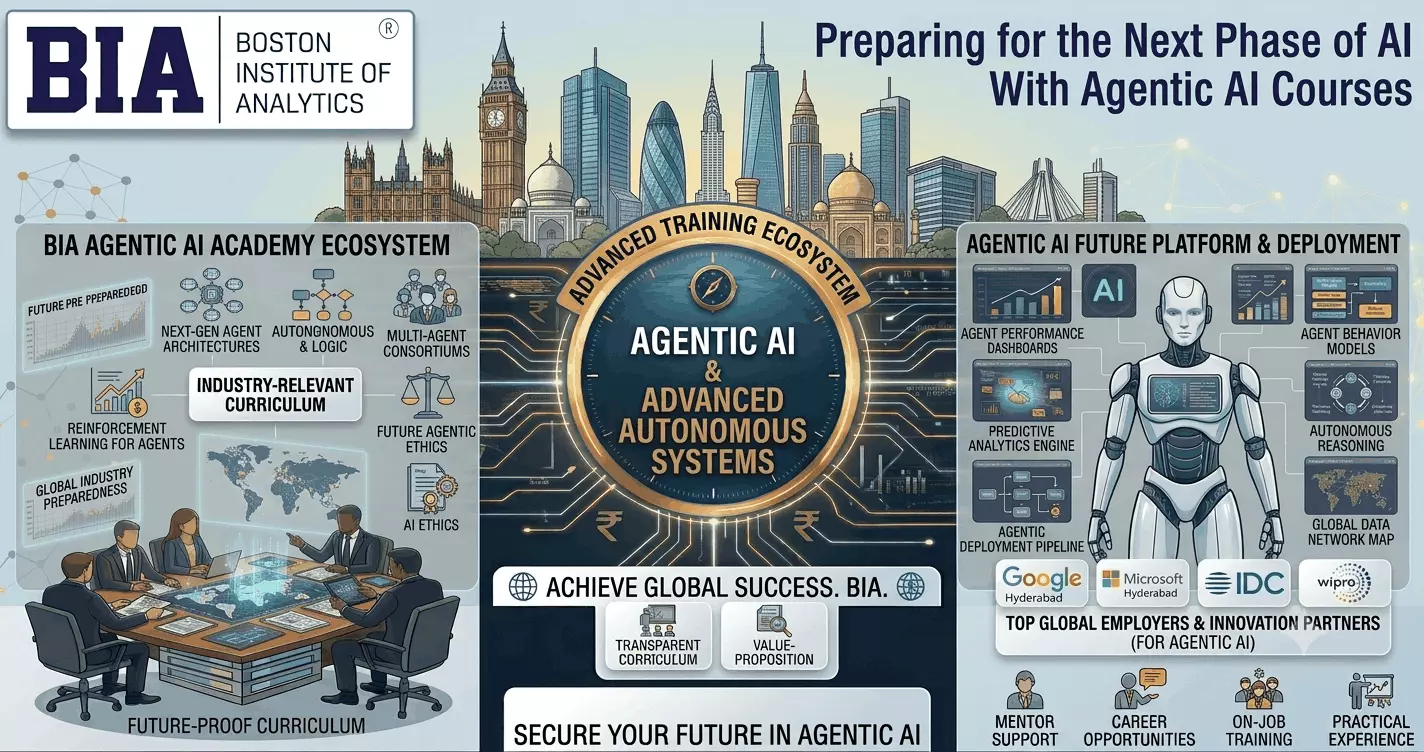
Preparing for the Next Phase of AI With Agentic AI Courses
AI is changing how we can look for information, generate content, analyze data, and automate mundane tasks. But there's a new technology on the horizon.
Some generative ai courses now work through a series of actions. Rather than simply responding to a single command. These sorts of systems will decompose a goal into simple tasks.
They leverage the available tools, verify the outputs, and iterate until the work is done. It's a shift from AI as a sort of Magic 8 Ball, towards AI as a sort of content-aware robot.
What Makes an AI System Agentic?
Conventional AI applications tend to take part within a rather defined interaction. Someone put in an input to an AI, the system performs its thing, and then it spit out an output.
An agentic system may be more long-winded. Its design, if capable, can provide it with a goal, drive it through a sequence of actions, pose tools or data for a result, and update its subsequent step accordingly.
The key difference isn't just that the systems are autonomous. It is that the systems may be created with the capacity to perform several interconnected tasks autonomously, within a framework of instructions, permissions and controls.
From Prompting to Planning
Prompts are also familiar to generative AIs. A user can prompt a model to generate text, summarize it, clarify it, categorize it or change it in some way.
Agent-based workflows give an additional dimension: planning. Rather than requiring an AI system to accomplish each step separately, a user might give an overall goal and then let the system figure out how the required steps combine.
For instance an internal business process might proceed by acquiring data from authorized sources, arranging the results, detecting different trends, writing an initial report and finally presenting the findings for human evaluation.
The practical challenge is that every stage must be 'robust' and the system must be aware of when to proceed, when to pause, when to seek clarification and when to hand back control to a human.
The Building Blocks Behind Intelligent Agents
Agentic applications can also fuse different technologies and concepts: Large language models can offer reasoning and language capabilities External tools can enable systems to navigate information or software environments.
Memory may enable an application to hold useful context between stages. Retrieval systems may make specific information accessible. An API may enable an agent to connect to sanctioned applications, and orchestration frameworks may orchestrate various jobs.
This provides learners with an expanded set of technical skills compared to only using generative models. Seeing how these pieces connect helps to make the overall AI workflow more manageable to analyze.
Read: Best AI Certification Programs for Remote Jobs
A Different Kind of Technical Problem-Solving
Achieving an autonomous workflow isn't as straightforward as just hooking an AI model up to a handful of tools. It requires development teams to carefully consider prompts, decision trees, error prevention and management, access and permissions, data flows, and more.
Imagine an agent to help customer support. The task could include identifying a customer request, returning the relevant account information, figuring out what policy applies, writing a response, and escalating out of the ordinary cases.
Failure points could occur at any stage: the system could misinterpret a command, access the wrong information, or persist in executing a task when it might require human input. Detecting these options is thus an important first step in integrating agent-based systems.
Skills Learners Can Begin Developing
One way to gain an intuitive idea of modern AI is to incorporate a few of these related fields.
Students will use prompt design, Python, APIs, prompting, interacting with models, retrieval augmented generation, task workflow orchestration, tool chaining, evaluation, and the fundamentals of AI safety to get a sense of how an intelligent program operates from a user request to an action chain to an output.
Your goal is not to remember all the frameworks. Technologies evolve rapidly, but an understanding of the underlying concept can help you stay current.
Why Hands-On Experiments Matters?
The behavior of an AI agent can be hard to predict just using theory. A small project can expose some unintended consequences.
A researcher builds a minimal version of a research assistant that collects data from a limited number of sources, processes the data, and generates a summary.
Along the way, they may realize the system would benefit from more explicit instructions, improved retrieval, or an increased reliance on further checks before returning an answer.
Such an experience allows experimentation and debugging. It even aids in making the user realize the system isn't smart; it needs testing and can't just be assumed to be correct.
Where Businesses Could Apply Agentic Workflows?
Repetitive Process and Dependent workflows Some processes are repetitive within an organization, and there are many dependent steps. This could be a good opportunity for agent-based automation.
Marketing teams could employ AI-enabled workflows to collate campaign information and generate first drafts of content; operations teams might investigate systems that track certain inputs and execute approved steps that research teams might utilize AI to structure information for review by a human expert.
These apps don't necessarily displace people. Often, the human involvement becomes about setting goals, reviewing work, managing exceptions and making decisions that need context and accountability.
Learning With Industry Context
As the technology evolves, learners will have an understanding of how an agent works as well as why a specific workflow needs to be designed in a certain way.
Boston Institute of Analytics can assist learners to venture into contemporary AI concepts through education, hands-on exercises and industry applications.
Another benefit of project-based learning is that it can simplify complex concepts. Learners won't have to interpret autonomous workflows as abstract concepts, they can try it out with concrete use cases and see how planning, tools, data and evaluation are connected.
This sort of exposure may be of interest to students and working professionals interested in how modern AI tools are related to jobs in technology.
Human Oversight Still Has a Place
Independence doesn't always imply that simply every procedure must be handed to an AI system. For instance, some choices concern privacy, financial impacts, legal factors, customers, and organizational duty.
This is why humans may need to keep control over an agent's behavior.
Developers might want to build in mechanisms that can allow oversight such as approval points, access controls, logging and fallback options and a 'frontier' or boundary. A responsible way of thinking is to look at what it's permitted to do, as well as what it's capable of doing.
Staying Adaptable as Frameworks Change
The sets of tools for building AI agents today may not even last for that long. New models, new frameworks, APIs, and methods of orchestration are always emerging.
So learners must not consider one system as the whole domain. Learn through generative ai courses how you can built interaction models, tool calling, retrieval, planning, evaluation, and workflow design works so that you can easily learn to use new systems.
The essentials of these four official explanations, then the first explanation- experimentation-may be the best answer. Practitioners who experiment constantly also will not lose their grip on changing capabilities.
Final Thoughts
The evolution of AI is creating new questions about how software can plan, interact with tools, and complete complex workflows. Understanding these developments can help learners approach emerging technologies with greater clarity and practical awareness.
Boston Institute of Analytics offers learners an opportunity to explore this changing technology landscape through structured learning and practical exposure.
As AI systems become more capable, the ability to understand their design, limitations, and appropriate use can become an increasingly valuable part of technical development.