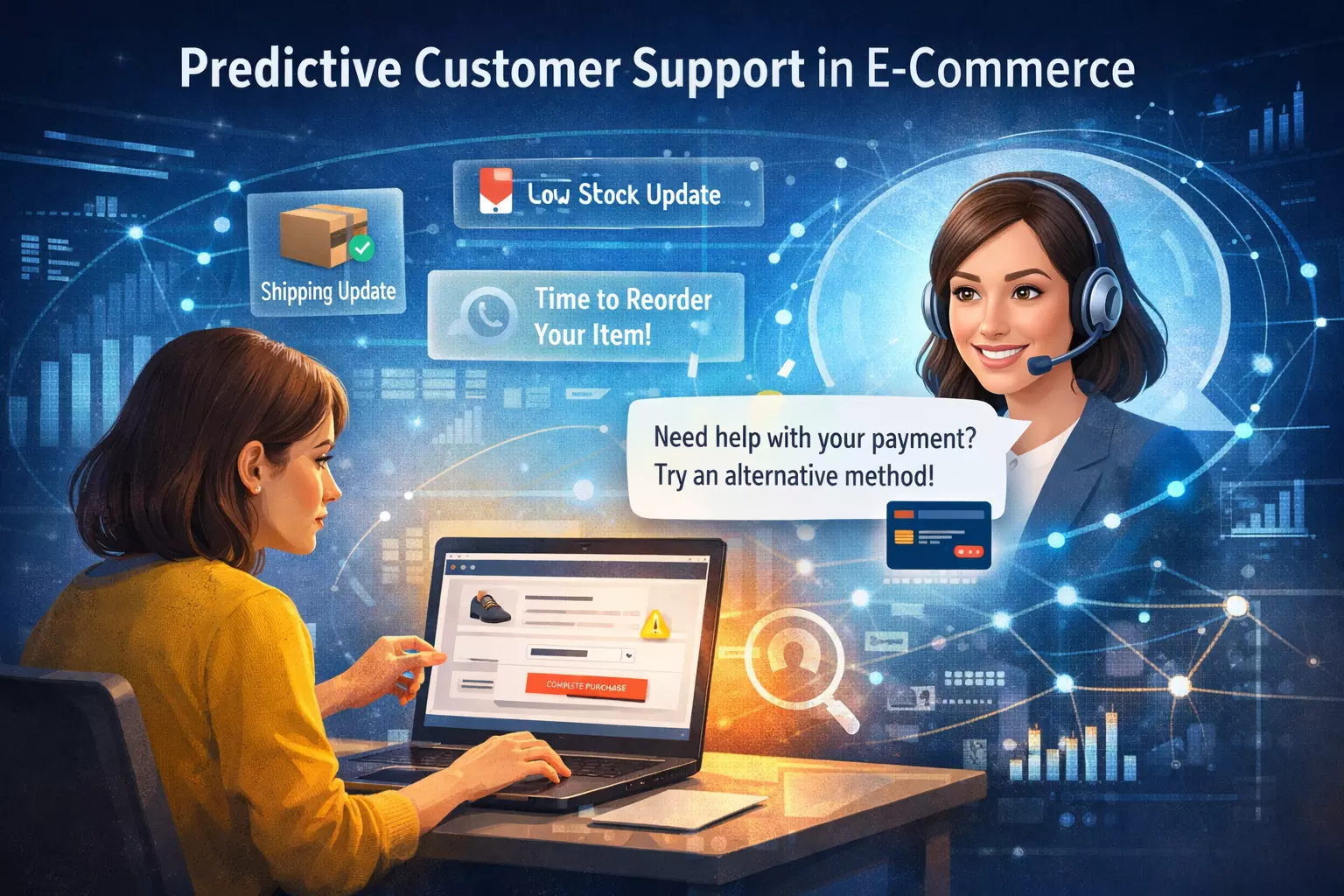
Predictive Customer Support: The Next Competitive Advantage in E-Commerce
E-commerce has evolved from reactive service models to real-time engagement. Yet most online retailers still operate in a reactive support framework, waiting for customers to report problems before responding.
In a market where customer experience directly influences revenue, that approach is no longer enough.
Predictive customer support represents the next strategic shift. Instead of responding to issues, brands anticipate them. Instead of solving problems after frustration occurs, they prevent friction before it impacts conversions or loyalty.
For e-commerce businesses competing on experience, predictive support is quickly becoming a decisive advantage.
What Is Predictive Customer Support?
Predictive customer support uses artificial intelligence, behavioral analytics, and real-time data processing to anticipate customer needs, questions, and potential issues before they are explicitly raised.
Rather than waiting for a shopper to ask:
- “Where is my order?”
- “Why did my payment fail?”
- “Is this item in stock?”
The system proactively provides relevant information or assistance.
It shifts customer service from reactive problem-solving to proactive experience optimization
Why Reactive Support Is No Longer Enough?
Traditional support models depend on incoming tickets, emails, or chats. This creates several challenges:
- Delayed response times
- High support volumes
- Customer frustration
- Increased cart abandonment
- Operational inefficiency
In e-commerce, even minor friction during checkout or post-purchase can significantly impact retention and repeat sales.
Predictive systems reduce this friction by identifying patterns before they escalate into complaints.
How Predictive Customer Support Works?
Predictive support relies on multiple data signals:
Behavioral Data
Tracking browsing patterns, time spent on checkout pages, repeated clicks, and cart activity helps detect hesitation or confusion.
Example:
If a user spends extended time on the payment page without completing the purchase, the system can proactively offer assistance.
Historical Purchase Data
Past buying behavior helps anticipate reorder needs, warranty expirations, or subscription renewals.
Example:
A system can notify a customer:
“It’s been 30 days since your last skincare purchase — would you like to reorder?”
Operational Data
Shipping delays, inventory shortages, or payment gateway issues can trigger automated notifications before customers inquire.
Proactive transparency reduces frustration.
AI & Natural Language Processing
Advanced AI models analyze intent and predict likely next actions. Conversational platforms inspired by ecosystems like Amazon Alexa, Google Assistant, and Apple Siri have normalized real-time contextual assistance.
In e-commerce, this intelligence powers proactive chat prompts, dynamic FAQs, and intelligent voice systems.
This is where modern Voice Agents for E-Commerce enhance predictive support — engaging customers conversationally before confusion turns into abandonment.
Key Predictive Support Use Cases in E-Commerce
1. Proactive Cart Assistance
If a shopper:
- Repeatedly removes and re-adds items
- Switches between similar products
- Pauses during checkout
The system can initiate:
“Need help choosing the right size or model?”
This increases conversion probability.
Shipping Delay Alerts
Instead of customers discovering delays themselves, automated notifications explain issues and provide revised timelines.
Transparency builds trust.
Smart Reorder Reminders
Consumable goods benefit greatly from predictive reorder prompts. Timing recommendations based on average usage patterns increase repeat revenue.
Payment Issue Detection
If a payment fails multiple times, predictive systems can suggest alternate payment methods instantly.
This prevents abandoned transactions.
Personalized Product Recommendations
Using predictive analytics, systems can suggest complementary items before checkout.
For example:
“Customers who purchased this camera often add this lens.”
When delivered contextually through conversational interfaces, upselling feels helpful rather than intrusive.
Business Impact of Predictive Customer Support
Increased Conversion Rates
By addressing friction at the right moment, predictive systems reduce abandonment and improve checkout completion.
Higher Customer Satisfaction (CSAT)
Customers value proactive communication. It signals attentiveness and reliability.
Reduced Support Volume
Anticipating and resolving issues before tickets are generated lowers operational burden.
Improved Retention and Lifetime Value
Predictive engagement keeps customers connected beyond the first purchase.
Implementation Strategy for E-Commerce Brands
Step 1: Centralize Data
Predictive systems require integration with:
- CRM platforms
- Order management systems
- Payment gateways
- Inventory databases
- Analytics tools
Disconnected data limits prediction accuracy.
Step 2: Identify High-Friction Points
Analyze:
- Checkout abandonment rates
- Support ticket patterns
- Repeat inquiry types
- Refund reasons
These areas provide immediate predictive opportunities.
Step 3: Deploy Intelligent Conversational Interfaces
Predictive triggers must communicate effectively. Chatbots and voice-driven systems ensure assistance feels natural rather than intrusive.
Step 4: Monitor and Optimize
Track metrics such as:
- Cart recovery rate
- Repeat purchase frequency
- Ticket reduction percentage
- CSAT improvements
Predictive systems improve over time as data grows.
Common Challenges to Consider
- Data privacy compliance
- Over-automation risks
- Inaccurate predictions due to poor data quality
- Overly aggressive pop-ups or prompts
Balance is essential. Predictive support should enhance experience, not overwhelm users.
Read: Why Predictive Analytics Is Becoming a Strategic
The Future of Predictive Commerce
As AI models become more advanced, predictive systems will:
- Anticipate seasonal demand shifts
- Adjust recommendations dynamically
- Offer real-time pricing incentives
- Integrate voice, chat, and visual AI seamlessly
The shift from reactive to proactive engagement will define next-generation e-commerce leaders.
Brands that adopt predictive customer support early will differentiate on experience rather than price alone.
Final Thoughts
E-commerce competition is no longer just about products; it is about experience.
Predictive customer support transforms service from a cost center into a strategic growth driver. By anticipating needs, preventing friction, and guiding customers in real time, brands create smoother journeys and stronger loyalty.
In a digital marketplace where convenience defines success, predictive support is not just an enhancement; it is the next competitive advantage.